Geomechanics, Streamlined.
© 2026 Geomechanics.io. All rights reserved.
Komatsu South Africa has become the first surface Trackless Mobile Machinery OEM to secure Technology Readiness Level 4 (TRL4) certification, following independent verification by the University of Pretoria at the Gerotek Test Facilities in West Pretoria and on a live mining customer site. The TRL4 process validates collision prevention and related control systems under controlled and operational conditions, as required by South Africa’s TMM safety regulations. For mine operators, this signals that Komatsu’s surface fleets now meet a formally tested baseline for Level 9 collision avoidance integration and compliance planning.
LGMG’s new MTH150M rigid truck targets China’s fast‑growing methanol haulage fleet, offering a lower‑cost alternative to diesel with longer range than current battery‑electric options. Built on a 150 t‑class platform derived from its diesel MHT150 series, the truck integrates a high‑pressure methanol fuel system and engine package certified to China VI‑equivalent off‑road standards. For mine operators, the key trade‑offs are reduced CO₂ and NOx emissions without relying on high‑capacity charging infrastructure, but with added complexity in methanol storage, handling and on‑site fuel logistics.
Legislative constraints are preventing a Cambridge housing development from commissioning a greywater reuse system installed five years ago, Cambridge Water has confirmed. The scheme, designed to recycle treated wastewater from homes for non-potable uses such as toilet flushing and irrigation, remains idle despite full physical installation. The impasse signals ongoing regulatory misalignment between building-level reuse technologies and current UK water quality and adoption rules, delaying potential reductions in potable demand and wastewater discharge for new high-density schemes.
Sizewell C has appointed recruitment provider Rullion to run its early careers programme as the Suffolk nuclear project ramps up workforce planning for construction and commissioning. The partnership targets a long pipeline of apprentices, graduates and trainees across civil, mechanical, electrical and nuclear disciplines to support delivery of the twin EPR units and associated marine and civils works. For contractors and consultants, the move signals upcoming demand for site-ready junior engineers, technicians and project controllers familiar with nuclear-licensed site requirements and large-scale concrete and earthworks operations.
England’s 2026 hot, dry summer has pushed water companies to revisit large-scale seawater desalination, with schemes such as Thames Water’s previously shelved 150Ml/d Beckton plant back on the table. Developers face high capex, energy demand above 3kWh/m³ for reverse osmosis, and planning resistance over coastal intake/outfall structures and brine disposal. For civil and process engineers, the key constraints are grid connection capacity, integration with existing trunk mains and service reservoirs, and siting plants to avoid flood risk while remaining close to tidal water sources.
£28M in UK Government grants is being offered through a new competition for long-duration energy storage able to deliver electricity for at least 100 hours, targeting technologies beyond conventional lithium-ion. Funding is aimed at grid-scale systems that can support multi-day balancing of intermittent wind and solar, with an emphasis on demonstrators that can integrate into existing transmission and distribution infrastructure. Civil and geotechnical engineers should expect increased demand for sites, foundations, fire engineering and environmental permitting for large-footprint battery and alternative storage installations.
TechFest 2026 has named 185 finalists across 21 categories, recognising digital and technology-led advances in construction and civil engineering. Shortlisted entries span applications such as BIM-driven design workflows, sensor-based asset monitoring and AI-supported project controls on major infrastructure schemes. For practitioners, the awards signal where clients and contractors are currently investing in tools to manage programme risk, optimise whole-life performance and integrate data across design, construction and operations.
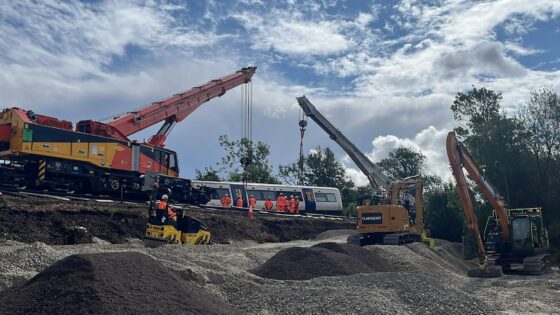
Rail services between Haywards Heath and Lewes will restart on Tuesday 1 September after Network Rail completed emergency repairs following last week’s passenger train derailment. The works are understood to have included track replacement and realignment on the affected section, plus inspections of ballast condition and signalling equipment to restore line speed and operational safety. Engineers will be alert to any residual geometry or subgrade issues, with early monitoring runs likely to check track behaviour under normal passenger loading.
Network Rail has launched an Expression of Interest for a £77.6M multi-year framework to deliver geotechnical and civil engineering works across its Wales and Western regions, covering earthworks, structures and associated lineside assets. The framework is expected to package embankment and cutting stabilisation, retaining walls, culverts and bridge repairs into regional workbanks, with contractors providing design-and-build capability under railway possession and access constraints. Bidders will need proven experience in rail-adjacent geotechnics, temporary works and working under live traffic with tight blockade windows.
Great British Energy – Nuclear (GBE-N) has set out an early works package for its new nuclear programme with an estimated contract value of £730M to £1.1bn, signalling a major pre-construction phase before main civil works. The scope is expected to cover site preparation, bulk earthworks, temporary works, utilities diversions and enabling infrastructure to de-risk later nuclear island construction. Contractors should anticipate complex ground engineering, stringent nuclear-grade quality control and long-lead procurement, with frameworks likely favouring teams experienced in large-scale UK nuclear and heavy industrial sites.
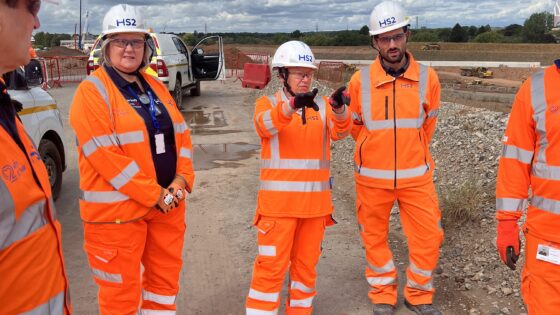
HS2 has agreed to introduce additional mitigation at a North Warwickshire construction site after residents complained of a foul odour from excavated material, worsened by recent high temperatures. Measures are expected to focus on improved stockpile management, faster removal of spoil and enhanced odour control around earthworks and temporary storage areas. Contractors on linear infrastructure schemes with large cut-and-fill operations may need to review spoil handling, covering strategies and monitoring during heatwaves to avoid similar community impacts.
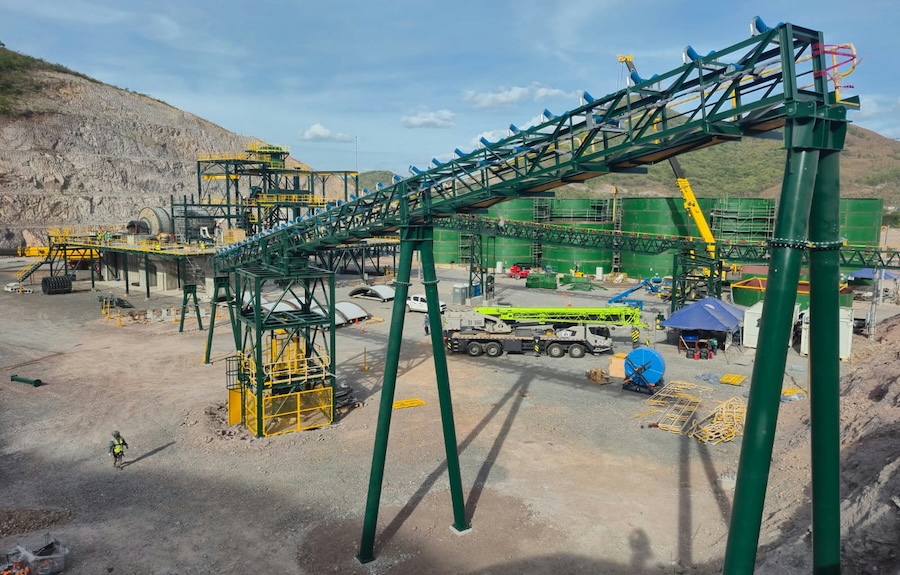
Metals Exploration has secured $27 million in five-year equipment financing from Banco de America Central as its La India gold project in Nicaragua targets first production in December 2026, with $20.2 million already drawn to replenish cash spent on a Caterpillar mining fleet. Structural, mechanical, piping and electrical works are about 50% complete, including 93% of bulk earthworks, 92% of civil foundations, 60% of the tailings storage facility and 244,000 tonnes of ore stockpiled on the ROM pad. A 2‑MW grid connection to ENATREL is energised, but Iran-related shipping disruption is delaying some equipment, making logistics and remaining infrastructure the critical schedule risks.
Gold’s jump to about US$4,600 per oz., after the US Treasury doubled buybacks of longer-dated Treasuries on 19 August and pushed spot prices up more than 3% in a day, is being linked by the World Gold Council to growing pressure on a US debt pile that has just hit US$40 trillion. Senior quantitative analyst Johan Palmberg argues that persistent deficits, reduced buying by foreign central banks and capital rules constraining banks are forcing more duration risk onto hedge funds and other price‑sensitive investors. If this dynamic nudges policymakers towards yield‑curve control rather than pure quantitative easing, weaker real yields, a softer US dollar and perceived financial repression could all support structurally higher bullion allocations.
Bunker Hill Mining is acquiring Silver47 Exploration in an all‑stock deal valued at about $163 million, offering 0.1724 Bunker Hill shares per Silver47 share, a 38% premium to Silver47’s last close, to form a larger US‑focused silver and critical minerals producer. The combined Bunker Hill Silver will pair the restarted Bunker Hill mine in Idaho’s Silver Valley with Silver47’s exploration portfolio in Alaska, Nevada and New Mexico, with ownership split 57% Bunker Hill and 43% Silver47. Bunker Hill has also secured roughly $11 million in near‑term funding, including a $10‑million concentrate prepayment facility with Ocean Partners UK and a $1‑million draw from Teck Resources.
Silver surged about 20% in August to touch $70/oz on 21 August, driven by the US Treasury’s move to double long-bond buybacks, pushing prices above several banks’ 2026 baseline forecasts but still below the most bullish $110–$160/oz year-end and Q4 targets. Equity leverage has been stark: Hecla Mining gained 47%, Wheaton Precious Metals 44%, and Coeur, First Majestic and Fortuna each 42%, while the Global X Silver Miners ETF rose 35% and junior-focused SILJ 32%. Forecasts now span roughly $67–$118/oz for peaks, with tail-risk scenarios from Bank of America and BMO stretching above $135/oz if the gold–silver ratio compresses.
Mining executives now rank labour, not capital, as the main constraint, with a 2024 MiHR survey showing 70% of 15–30-year-olds would not consider mining careers and Canadian mining-related enrolments falling from 1,400 in 2014 to 800 in 2020, declining 10% annually from 2016–2020. Rob McEwen, chairman of McEwen Inc., warns of an “acute shortage” as over half of the US mining workforce is expected to retire within three years and 46% of Gen-Z mining and energy workers plan to quit, even as demand for critical minerals and battery metals accelerates project pipelines.
European utilities increased Russian nuclear fuel use in 2025, with uranium deliveries up 7%, conversion up 9% and enrichment sales up 12%, leaving Russia holding 16% of EU uranium supply, 24% of conversion and 23% of enrichment capacity. Kazakhstan supplied 20% of EU and 28% of US utility uranium, but much of its output is locked into long-term contracts with China, Russia and India, tightening Western access. Sprott’s Jacob White notes only 37 million lb U₃O₈ has been contracted globally for 2026, while long-term prices have already climbed to US$94/lb, the highest in 18 years.
Central Nevada Gold has completed a US$20 million acquisition of Newmont’s past‑producing Mule Canyon mine in Nevada, targeting a prefeasibility study and key permits in H2 2027 ahead of a potential 2028 construction decision. Mule Canyon previously produced about 500,000 oz gold at an average head grade of 3.8 g/t with ~94% metallurgical recovery, and comes with a database of 2,149 drill holes totalling over 335,000 metres across six mineralised zones over 2.5 km. The company plans an IPO as early as 2027 after a 20‑hole metallurgical and infill drilling programme to upgrade inferred resources and de‑risk the project.
Greenland Mines has secured government approval under the Greenland Mineral Activities Act for the indirect transfer of the Sarfartoq carbonatite complex exploration licence, clearing a key condition in its US$35 million acquisition from Neo Performance Materials, which retains offtake rights to up to 60% of future ore or concentrate. The Nd-Pr-enriched project, about 60 km from Kangerlussuaq, carries a historic NI 43-101 resource with 5.88 Mt indicated at 1.77% TREO and 2.46 Mt inferred at 1.59% TREO, based on 23,000 m of drilling. The news sent Greenland Mines’ NASDAQ-listed shares up more than 22%, giving the company a market capitalisation of US$31.4 million.
New American Industrial Alliance and supply chain AI firm Exiger have launched the “Ground Truth” Critical Minerals Readiness Survey to map gaps between US industrial demand and available domestic or allied supply, following White House Executive Order 14415 on defence supply chains. The survey drills down to unmet needs by spec, grade, alloy and purity, and contrasts reshoring goals with actual sourcing capabilities across NAIA’s member base and wider manufacturers. Results, processed via Exiger’s 1EXIGER.AI platform, will feed a policy and investment “blueprint” to be unveiled on 16 September 2026 in Washington, DC.
Perenti Ltd has agreed to sell its BTP mining equipment rental and parts business to Beetle Industries Pty Ltd, an investment vehicle for a private consortium led by Cratus Group, which operates across Australia, Indonesia, China, Hong Kong and Singapore. The transaction removes a non-core fleet and component supply arm from Perenti’s balance sheet, while giving Cratus a platform to expand its resources, logistics and structural capital offering into heavy mobile equipment support. For mine operators, the deal signals potential changes in availability and pricing of rental fleets and component rebuild services across these regional markets.
Major works at the Henderson Road–Ferntree Gully Road intersection in Knoxfield are now complete, targeting congestion for the 40,000 vehicles using Ferntree Gully Road each day. Crews have delivered a new left‑turn slip lane from Henderson Road and associated signal and lane configuration changes to separate turning and through movements. The upgrade is expected to reduce queue lengths and conflict points at this high‑volume junction, with direct implications for pavement performance, signal timing plans and future traffic modelling on the surrounding arterial network.
Major Australian gold producers have reported strong FY26 results, with Ramelius Resources posting underlying EBITDA of $765.4 million and a record earnings margin despite slower-than-expected production. The company’s performance was driven by higher realised gold prices and disciplined cost control across its Western Australian operations, including Mt Magnet and Edna May. For mine planners and financiers, the numbers signal robust cash generation capacity even under production headwinds, supporting continued investment in brownfield expansions and targeted exploration.
Newmont has appointed former BHP Group chief financial officer Peter Beaven to its board of directors, with Beaven to join on 1 September 2026 and expected to serve on the audit committee. Beaven previously held the BHP CFO role from 2014 to 2020, overseeing capital allocation and balance sheet strategy during major portfolio simplification and divestment phases. His appointment signals continued emphasis on disciplined capital management and governance as Newmont integrates recent acquisitions and manages a multi-continent gold and copper asset base.