World’s 10 biggest copper mines: supply risk and price drivers for planners
Reviewed by Joe Ashwell
First reported on MINING.com
30 Second Briefing
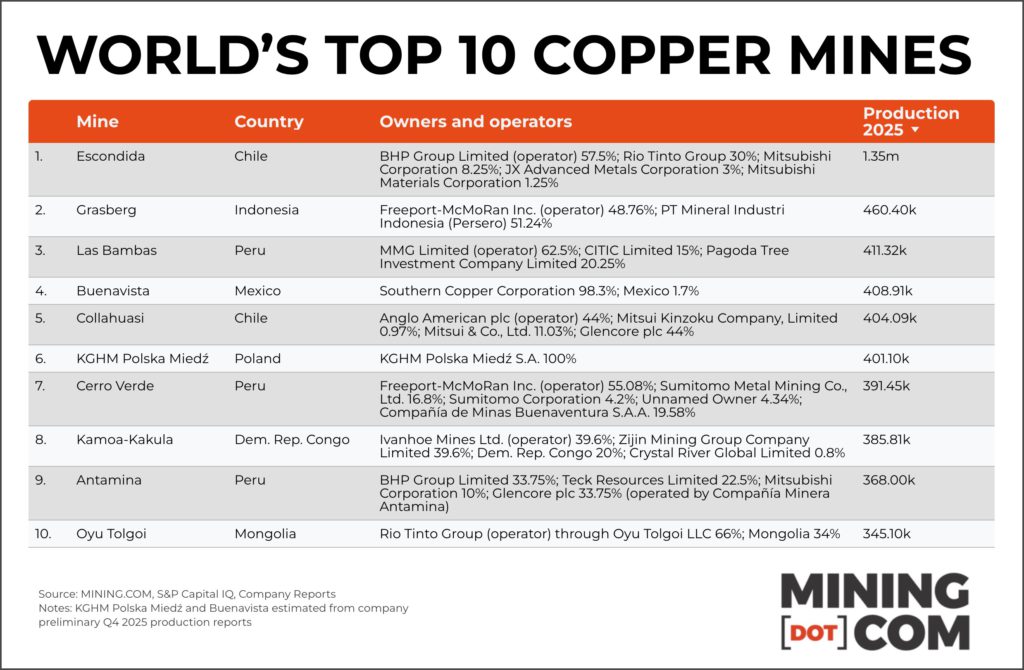
Copper prices, already up 40% in 2025 and hitting a record $14,500/t in January 2026, are being driven by AI-related demand, supply disruptions and looming cost pressures from energy and sulfuric acid shortages, with the ICSG now forecasting a 150,000 t deficit for 2026. The 10 largest copper mines produced 4.9 Mt in 2025, led by Escondida at 1,347.6 kt, while major assets such as Grasberg and Kamoa-Kakula face landslide, flooding and seismic-related constraints that could remove hundreds of thousands of tonnes from the market. For planners and project developers, the rankings emphasise concentration risk in a handful of long-lived operations and the growing influence of infrastructure bottlenecks, community blockades and state renegotiations on effective supply.
Technical Brief
- Escondida in Chile delivered 1,347.6 kt copper metal in 2025, with record material mined and concentrator throughput.
- Grasberg’s 460.4 kt output followed a deadly landslide releasing 800,000 t of mud, with full capacity only expected by early 2028.
- Las Bambas produced 411.3 kt after 2024 community protests and a road blockade on its key Peruvian haul route were lifted in April 2025.
- Collahuasi’s 404.1 kt output is supported by a new $1 billion water pipeline from Punta Patache to the Ujina deposit at >4,400 m elevation.
- Kamoa-Kakula dropped to 385.8 kt after seismic-induced flooding halted underground operations for three weeks in 2025.
- Ivanhoe now prioritises underground development, rehabilitation and access at Kamoa-Kakula, constraining ore delivery for 18–24 months.
- Oyu Tolgoi’s 345.1 kt production sits under renegotiation, with Mongolia seeking earlier profit payments and a larger revenue share on the $18 billion project.
Our Take
With copper prices up about 40% in 2025 and the top 10 mines supplying more than a fifth of global mined output, any disruption at assets like Grasberg, Collahuasi or Buenavista materially tightens a market that our broader Mining category coverage already shows as driving $250 billion in added value for majors in early 2026.
Prepared by collating external sources, AI-assisted tools, and Geomechanics.io’s proprietary mining database, then reviewed for technical accuracy & edited by our geotechnical team.
Related Articles

Related Industries & Products
Mining
Geotechnical software solutions for mining operations including CMRR analysis, hydrogeological testing, and data management.
Construction
Quality control software for construction companies with material testing, batch tracking, and compliance management.
CMRR-io
Streamline coal mine roof stability assessments with our cloud-based CMRR software featuring automated calculations, multi-scenario analysis, and collaborative workflows.
HYDROGEO-io
Comprehensive hydrogeological testing platform for managing, analysing, and reporting on packer tests, lugeon values, and hydraulic conductivity assessments.
GEODB-io
Centralised geotechnical data management solution for storing, accessing, and analysing all your site investigation and material testing data.