Geomechanics.io

  • Free Tools
Sign UpLog In

Geomechanics.io

Geomechanics, Streamlined.

© 2026 Geomechanics.io. All rights reserved.

Geomechanics.io

CMRR-ioGEODB-ioHYDROGEO-ioQCDB-ioFree Tools & CalculatorsBlogLatest Industry News

Industries

MiningConstructionTunnelling

Company

Terms of UsePrivacy PolicyLinkedIn
    Projects
    Research

    Mexico City’s sinking crisis mapped by NISAR: geotechnical design notes for engineers

    May 8, 2026|

    Reviewed by Joe Ashwell

    Mexico City’s sinking crisis mapped by NISAR: geotechnical design notes for engineers

    First reported on Geoengineer.org – News

    30 Second Briefing

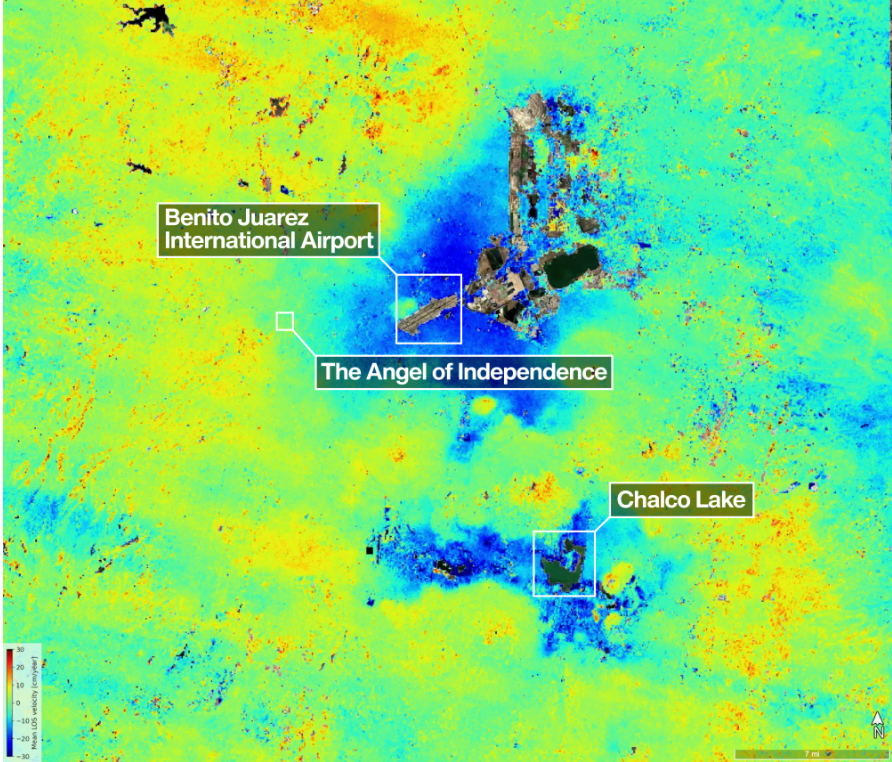
    Mexico City’s subsidence has been mapped in new detail by the NASA–ISRO NISAR L-band radar mission, revealing metropolitan zones sinking by more than 50cm per year over clay-rich former lakebed deposits. Interferometric SAR time-series show differential settlement across key infrastructure corridors, with some districts exhibiting cumulative subsidence of several metres over recent decades, far exceeding typical building serviceability limits. The data set offers geotechnical engineers block-scale deformation rates to refine foundation design, tunnel and metro monitoring, and groundwater extraction management.

    Technical Brief

    • For design and asset management, datasets allow corridor-scale prioritisation of retrofits, re-levelling and groundwater pumping controls.
    • Coverage is limited to NISAR’s acquisition swath and revisit schedule, so small-scale or very rapid failures may be under-resolved.

    Our Take

    For Mexico City, a subsidence ‘Failure’ context means NISAR data can be directly integrated into foundation design checks and sewer/water network renewal planning, allowing engineers to prioritise corridors where differential settlement rates threaten buried infrastructure and elevated transport structures.

    Because NISAR is designed for routine, global coverage rather than project-by-project tasking, municipalities and utilities in Mexico and other high-risk basins can treat it as a baseline deformation layer, reducing reliance on sparse levelling surveys and giving insurers and regulators a common reference for ground-movement risk.

    Geotechnical Software for Modern Teams

    Centralise site data, logs, and lab results with GEODB-io, CMRR-io, and HYDROGEO-io.

    No credit card required.

    • Save and export unlimited calculations
    • Advanced data visualisation
    • Generate professional PDF reports
    • Cloud storage for all your projects

    Prepared by collating external sources, AI-assisted tools, and Geomechanics.io’s proprietary mining database, then reviewed for technical accuracy & edited by our geotechnical team.

    Related Articles
    Brownfield success: integrated ground data workflows for project teams
    Geotechnical
    7 days ago

    Brownfield success: integrated ground data workflows for project teams

    Brownfield infrastructure projects are seeing geotechnical and environmental teams urged to integrate ground investigation, contamination data and 3D ground models from the outset, rather than running parallel site characterisation workflows. The piece stresses unified digital datasets combining borehole logs, in situ test results and contaminant plumes to refine ground risk registers, optimise foundation and earthworks design, and avoid late-stage remediation surprises. Case experience shows that early joint modelling of variable made ground, buried obstructions and legacy industrial pollution can materially cut unforeseen ground conditions claims and programme delays.

    Rock & Alluvium’s 40 m CFA piles at Bow Green: design notes for London ground engineers
    Geotechnical
    12 days ago

    Rock & Alluvium’s 40 m CFA piles at Bow Green: design notes for London ground engineers

    Rock & Alluvium, part of Van Elle, has installed its deepest continuous flight auger piles to date, reaching 40m, for the Bow Green development in East London. The record-depth CFA piles indicate challenging ground conditions and high load or settlement performance requirements typical of dense urban sites near the Thames. Contractors and designers may need to consider comparable pile lengths, rig capabilities and spoil management strategies for future high-rise or mixed-use schemes in similar London alluvial and made-ground profiles.

    Helical piles FAQ: design, torque capacity and corrosion notes for engineers
    Geotechnical
    14 days ago

    Helical piles FAQ: design, torque capacity and corrosion notes for engineers

    Helical piles are presented as displacement deep foundations that can be installed with small hydraulic drive heads on mini-excavators or skid steers, generating minimal spoil and vibration compared with driven piles. The FAQ addresses load capacity verification via torque correlation (e.g. kN-m per kN of capacity), corrosion protection options such as hot-dip galvanising and increased sacrificial thickness, and suitability in soft clays, fills, and below groundwater. Design is framed around ICC-ES AC358, with emphasis on tension, compression, and lateral performance for underpinning, boardwalks, and utility structures.

    Related Industries & Products

    Construction

    Quality control software for construction companies with material testing, batch tracking, and compliance management.

    Mining

    Geotechnical software solutions for mining operations including CMRR analysis, hydrogeological testing, and data management.

    CMRR-io

    Streamline coal mine roof stability assessments with our cloud-based CMRR software featuring automated calculations, multi-scenario analysis, and collaborative workflows.

    HYDROGEO-io

    Comprehensive hydrogeological testing platform for managing, analysing, and reporting on packer tests, lugeon values, and hydraulic conductivity assessments.

    GEODB-io

    Centralised geotechnical data management solution for storing, accessing, and analysing all your site investigation and material testing data.

    AllGeotechnicalInfrastructureHazardsEnvironmental