Geomechanics, Streamlined.
© 2026 Geomechanics.io. All rights reserved.
China’s Belt and Road strategy is consolidating control over critical minerals not at the pit but along export corridors, exemplified by the US$20 billion Simandou joint venture that couples a multi‑hundred‑kilometre heavy‑haul railway with the new deep‑water port of Morabaya to channel Guinean iron ore directly to Chinese industry. In Africa’s Copperbelt, where 15% of global copper reserves and most known cobalt resources sit thousands of kilometres from deep‑water ports, foreign‑financed rail and terminals effectively dictate whether concentrates move as raw exports or into local refining. Djibouti’s Doraleh Multipurpose Port, 85% funded by China and offering deep‑water berths suitable for naval deployment, illustrates how dual‑use port ownership can weaponise logistics and blunt resource‑nationalist policies such as export bans on unprocessed lithium, graphite, copper and cobalt.
B2Gold has secured the Menankoto exploitation permit for its Fekola Regional project in Mali, enabling pre-stripping and integration of regional ore with the existing Fekola complex, which is now expected to produce more than 150,000 oz. per year from 2028 into the mid‑2030s under a 65:35 ownership split with the state. The permit delay forced a cut to 2026 group guidance to 820,000–920,000 oz., while a fire‑damaged crushing circuit at the Goose mine has pushed all‑in sustaining costs there to $6,390/oz as B2Gold relies on mobile crushers ahead of restoring 4,000 t/d capacity. Despite lower guidance, group Q2 output of 203,648 oz. and AISC of $2,356/oz beat several bank forecasts, and the end of 264,768 oz. of gold prepayment deliveries should materially lift free cash flow from H2 2026.
Glomar Minerals has sent its UK Seabed Resources vessel RV Tangaroa on a 67‑day campaign to the Clarion‑Clipperton Zone, surveying two UK‑sponsored licence areas totalling about 133,000 sq. km for polymetallic nodules rich in manganese, cobalt, nickel, copper and rare earths. CEO Chris Williams is targeting first processing of nodules before the end of Donald Trump’s current term via Project Infinity, a modular US refinery with Cobalt Blue designed for 200,000 tonnes of nodules and 7,500 tonnes of terrestrial cobalt hydroxide per year. The company is actively exploring regulatory pathways outside the ISA and positioning for staged scale‑up from a sub‑full‑vessel operation.
Niron Magnetics has secured a conditional $150 million, 20‑year direct loan commitment from the US Department of War’s Office of Strategic Capital to build an advanced Iron Nitride magnet plant in Sartell, Minnesota. The 287,000‑square‑foot facility, due online in 2027, is designed for integrated material‑to‑magnet production of up to 1,500 tonnes per year of rare‑earth‑free permanent magnets, with a follow‑on US plant targeted at 10,000 tonnes annually from 2028. Iron Nitride technology, developed at the University of Minnesota over 13 years, offers a domestic alternative to rare earth magnet supply dominated by Asian producers.
Cummins has announced upgrades to its QSK60 high-horsepower mining engine alongside new capabilities for its PrevenTech remote monitoring platform, targeting better fuel efficiency, uptime and total lifecycle cost in large haul trucks and shovels. The QSK60 updates focus on combustion optimisation, extended overhaul intervals and improved parts commonality, while PrevenTech adds enhanced fault diagnostics, predictive maintenance analytics and fleet-wide performance benchmarking. For mine operators, the package aims to cut unplanned downtime, stabilise engine performance in high-altitude and high-dust environments, and support longer rebuild cycles.
Kaishan is expanding its intelligent mining drill rig line-up in China, adding automation and digital control to both surface and underground blasthole drilling systems. New rigs integrate features such as remote operation, data logging and optimised drilling parameter control, positioning them alongside Chinese advances in autonomous haul trucks and battery-electric or hybrid powertrains. For mine operators, the move signals growing domestic options for integrated autonomous fleets, with drill–blast data increasingly available for real-time optimisation of fragmentation, cycle times and energy use.
Glencore Technology will install its Albion Process oxidative leaching circuit at Rox Resources’ Youanmi gold project in Western Australia to treat refractory and semi-refractory ores that are not amenable to conventional cyanidation. The fine-grinding plus oxygenated leach system is designed to oxidise sulphide-hosted gold at atmospheric pressure, offering a lower-capex alternative to pressure oxidation or roasting for “next generation” deposits. For process and geomet teams, this signals growing commercial acceptance of Albion flowsheets for challenging gold mineralogies in Australian hard-rock operations.
Newmont has commissioned a Cat 6040 next generation hydraulic mining shovel at its Ahafo South gold mine in Ghana, its first deployment of the 400 t-class unit and one of only three mine sites globally using this model. The 6040, designed for large-scale hard rock operations, pairs with ultra-class haul trucks and incorporates Caterpillar’s latest cab ergonomics, hydraulics and machine health monitoring. For Ahafo South, the shovel is expected to lift loading productivity and reduce exposure around highwall and pit-floor digging zones.
Homes England has committed £27.7m to regenerate Sunderland’s former industrial Sheepfolds site, unlocking more than 350 homes as part of the Riverside Sunderland scheme, alongside £10m already invested by the North East Mayor. The funding will deliver enabling infrastructure – new roads, utilities and active travel routes – to connect the neighbourhood to the city centre and surrounding communities. A joint Major Projects Delivery Unit between Homes England, the North East Mayoral Strategic Authority and local councils will focus on de-risking complex sites, building on the Keel Crossing footbridge opened last year.
London Stansted has appointed Farrans to build new skylink walkways linking the main terminal to the existing satellite gate building, enabling the ageing people mover tracked transit system to be decommissioned and freeing space for a terminal extension adding three bays and 16,500 m² of floor area. The expansion is intended to make Stansted the largest single-terminal airport in Europe, with additional retail and F&B capacity. Skylink sections will be pre-assembled in a vacant northside hangar and moved overnight into position on SPMTs, with travelators and buggy access designed for full PRM coverage.
Capital&Centric has been appointed development partner for Ipswich Borough Council’s regeneration of the Pauls Silo grain complex and adjacent waterfront, working with consultant Drees & Sommer on detailed plans. The scheme will retain and restore the existing silo structure and neighbouring industrial buildings, with proposals to repurpose them for independent cafés, bars and restaurants while preserving the brick and concrete industrial fabric. New residential units are planned around the silo to activate the quayside throughout the day and evening, intensifying mixed-use loading on existing waterfront infrastructure.
Enva has launched White HIPS-8513, a high-impact polystyrene compound made from end-of-life refrigerators, containing 93% post-consumer recycled content and positioned as its whitest recycled HIPS grade for construction products such as piping, ducting, ventilation components, access panels and loft hatches. Life cycle assessment shows more than 90% lower carbon emissions than equivalent virgin HIPS while maintaining prime-equivalent mechanical performance and colour consistency. With integrated control from appliance recycling to compounding, Enva has installed capacity to supply 12,000 tonnes per year, targeting long-term, traceable raw material streams for manufacturers.
US-based CES Power has signed a four-year agreement with Caterpillar to supply Stage V-compliant generators for the UK and Ireland, focused on the 20–300 kVA rental segment. The deal, Caterpillar’s first of its kind in these markets, will “significantly expand” CES’s temporary power fleet for critical applications where emissions-regulated, mobile generation is required. Backed by investor Allied Industrial Partners, CES is using the agreement to accelerate its European expansion and strengthen availability of low-emission standby and construction-site power.
The Minerals Council of Australia is urging the Federal Government to suspend 25 July changes to skilled migration rules that prioritise onshore visa applicants over offshore candidates. MCA warns the shift will delay recruitment of critical roles such as mining engineers, geologists and diesel fitters, particularly for remote operations where local labour is already tight. Companies may face longer lead times to staff projects, constraining productivity gains and potentially slowing brownfield expansions and maintenance-intensive fleets.
Barton Gold has completed a 39,000m phase 2 drilling campaign at the Tunkillia gold project in South Australia, comprising 38,760m of reverse circulation and diamond drilling across 311 holes over five months. The work targets upgrades to JORC resource classifications ahead of a pre-feasibility study, focusing on better definition of existing mineralisation rather than pure step-out exploration. For mine planners and geotechnical teams, the expanded diamond core dataset should materially improve structural, geometallurgical and rock mass characterisation for pit design and scheduling.
AIC Mines has reported one of its highest-grade gold intersections at the Eloise South prospect in north Queensland, with diamond drilling returning 3.2m at 92.5g/t gold, including a 1.2m interval at 249g/t, just two kilometres south of the operating Eloise copper mine. The intercept lies within the broader Eloise tenement package, where existing underground infrastructure and services for copper provide potential synergies for future gold development. For resource geologists and mine planners, the narrow but ultra-high-grade zone raises questions on continuity, stope geometry, and ground support design in a mixed copper–gold setting.
Austral Resources has secured a $15 million non-dilutive royalty investment from Queensland Investment Corporation’s Queensland Critical Minerals Fund to expand its Rocklands copper processing facility in north-west Queensland from 3Mtpa to between 4.5Mtpa and 6Mtpa. The funding supports plant upgrades aimed at restarting the Rocklands operation and lifting copper output beyond the current heap leach–SX-EW production at Lady Annie. For engineers, the step-change in throughput will drive higher ore handling, tailings, and power demand, requiring corresponding expansions in materials handling, water management, and geotechnical infrastructure.
Tivan Limited has appointed ICA Natural Resources as debt finance adviser for its Speewah fluorite project in Western Australia, progressing funding for what is planned as a major fluorite supply source for Japanese offtake. ICA has been engaged by Japan Australia Fluorite Associates (JAFA) to lead transaction planning, structuring and execution of project debt, signalling a move towards bankable terms. For engineers, the mandate suggests upcoming definition of capital cost envelopes, project finance covenants and schedule constraints that will shape final mine, plant and infrastructure design.
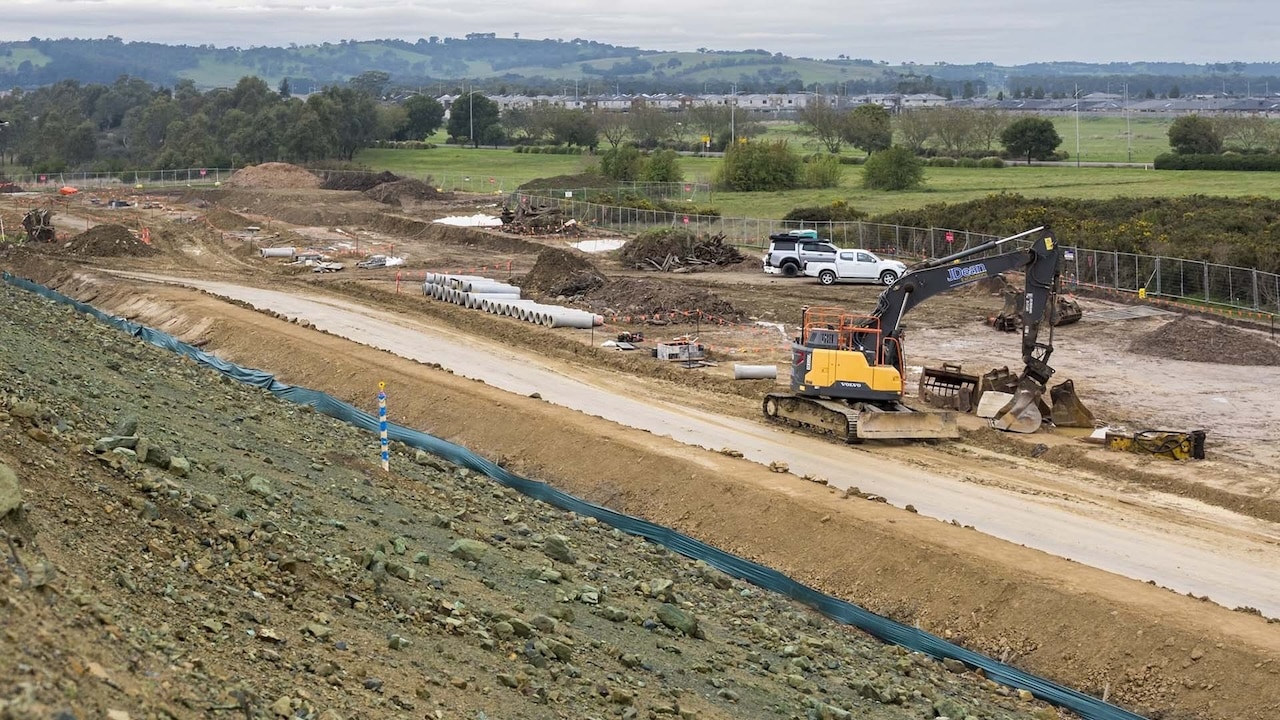
Construction has moved into the next stage on the Watson Street Interchange upgrade in Wallan, Victoria, accelerating works that began in early 2026 to reconfigure access to the Hume Freeway and key local roads. The project is focused on separating local and freeway traffic movements at the Watson Street–Hume Freeway interface to cut congestion and improve safety for the rapidly growing Wallan community. For designers and contractors, staging around live freeway traffic and maintaining access to the Hume will remain the critical delivery constraint.
Key intersection upgrades on the Brisbane Valley Highway in Queensland will start in August, after a contract award for works at Forest Hill–Fernvale Road and Quarry Access (Batten) Road. The package includes new or upgraded turning lanes, revised channelisation and intersection geometry, and associated pavement widening to improve traffic flow and heavy-vehicle movements to nearby quarries. For civil and geotechnical teams, the works mean short-term traffic staging, pavement reconstruction on an existing highway formation, and tie-ins to local access roads with high commercial vehicle loads.
Major works have started on Artemis Gold’s Blackwater EP2 growth project in British Columbia, with the first concrete pour for the new ball mill foundations completed ahead of schedule. Early works, initiated in January 2026, are close to completion, and engineering and procurement for EP2 are now well advanced. Lycopodium has been appointed EPCM contractor, signalling a move into full-scale construction that will affect mill layout, civils sequencing and tie-ins to the existing Blackwater processing infrastructure.
Metso has produced its 200th HRC™8 high pressure roll crusher at its Alwar, Rajasthan factory, signalling strong global uptake of the compact unit for manufactured sand and aggregates. The HRC™8 is engineered to process challenging feed materials and waste streams into saleable fine aggregates, using high-pressure interparticle crushing rather than conventional cone or impact crushing. For mine and quarry operators, the technology offers a route to increase fines production from marginal or waste rock, potentially reducing reliance on natural sand sources.
Aramine has launched ARAMAC, a standalone company focused on designing, manufacturing and distributing underground mining equipment and complementary solutions, formalising a new structure after more than 50 years in the sector. The move separates OEM activities from Aramine’s existing parts, service and rebuild business, giving a distinct brand to its battery-electric loaders, narrow-vein mining machines and other underground fleets. For mine operators, the change signals a clearer product roadmap and potentially faster support for equipment customisation, electrification upgrades and fleet standardisation in constrained underground environments.
Predictive and generative AI are being deployed in mineral processing circuits to forecast maintenance issues from historical sensor data and to optimise plant set-points in real time as ore feed characteristics change, tightening short-interval control. Autonomous haulage and drilling fleets are increasingly coupled with AI agents that coordinate dispatch, reroute trucks around blocked ramps, and adjust drill patterns on the fly based on blast-hole geophysics. For engineers, the shift is from static control logic to continuously learning agents that sit on top of existing fleet management and DCS/SCADA systems.