HS2’s Northolt Tunnel cross passages: design, safety and sequencing notes for engineers
Reviewed by Joe Ashwell
First reported on New Civil Engineer
30 Second Briefing
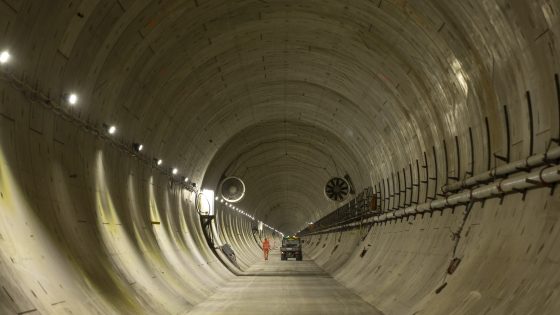
Completion of all 34 cross passages on HS2’s Northolt Tunnel marks a key advance in the 13.5km twin-bore drive beneath west London. The passages, mined at depth between the running tunnels, provide emergency egress and ventilation links at regular intervals, demanding precise control of ground movements in London Clay and Lambeth Group strata. Contractors will now shift focus to secondary lining, waterproofing and M&E fit-out, with cross passage completion reducing tunnelling interface risks and freeing resources for shaft and portal works.
Technical Brief
- Sequential excavation beneath existing utilities and foundations required tight control of settlement to protect overlying assets.
- Emergency egress design for each passage must comply with UK railway tunnel fire and life-safety standards.
- Completion of all cross passages reduces concurrent excavation interfaces, simplifying underground safety coordination and permit systems.
- With mining finished, confined-space risks now shift from excavation activities to secondary lining and M&E installation.
- Experience from Northolt’s cross passage programme will inform safe access and egress strategies on later HS2 tunnel sections.
Our Take
In our database of 811 Infrastructure stories, HS2 Ltd features repeatedly as a cost and scope flashpoint, so completion of all 34 cross passages on the Northolt Tunnel gives the client a rare, clearly defined progress marker to set against ongoing design and speed reviews reported in March 2026.
The London location of the Northolt Tunnel means its cross-passage safety and evacuation design will likely inform thinking for the PPP-led HS2 Euston terminus now in early market engagement, where underground passenger egress standards and maintainability are central to private-finance risk assessments.
With 34 mined cross passages now structurally in place, HS2’s tunnelling teams have effectively locked in the long-term inspection and intervention regime for this section, which is significant given the scheme-wide push for ‘simplified technical options’ that may not be easily retrofitted into already-completed underground assets.
Prepared by collating external sources, AI-assisted tools, and Geomechanics.io’s proprietary mining database, then reviewed for technical accuracy & edited by our geotechnical team.
Related Articles


Related Industries & Products
Mining
Geotechnical software solutions for mining operations including CMRR analysis, hydrogeological testing, and data management.
Tunnelling
Specialised solutions for tunnelling projects including grout mix design, hydrogeological analysis, and quality control.
CMRR-io
Streamline coal mine roof stability assessments with our cloud-based CMRR software featuring automated calculations, multi-scenario analysis, and collaborative workflows.
QCDB-io
Comprehensive quality control database for manufacturing, tunnelling, and civil construction with UCS testing, PSD analysis, and grout mix design management.
HYDROGEO-io
Comprehensive hydrogeological testing platform for managing, analysing, and reporting on packer tests, lugeon values, and hydraulic conductivity assessments.