Geomechanics.io

  • Free Tools
Sign UpLog In

Geomechanics.io

Geomechanics, Streamlined.

© 2026 Geomechanics.io. All rights reserved.

Geomechanics.io

CMRR-ioGEODB-ioHYDROGEO-ioQCDB-ioFree Tools & CalculatorsBlogLatest Industry News

Industries

MiningConstructionTunnelling

Company

Terms of UsePrivacy PolicyLinkedIn
    Projects
    Sustainability

    Lundin emissions vote: Scope 3 strategy implications for mine project teams

    April 28, 2026|

    Reviewed by Tom Sullivan

    Lundin emissions vote: Scope 3 strategy implications for mine project teams

    First reported on MINING.com

    30 Second Briefing

    Lundin Mining faces a 7 May shareholder vote on a resolution from investor group SHARE, representing about $148 billion AUM, demanding a comprehensive greenhouse gas strategy covering Scope 1, 2 and full value-chain Scope 3 emissions. SHARE says Lundin is now the only major Canadian miner in its current engagement group without a plan to track and manage supply chain emissions, after Barrick, Kinross, Hudbay, B2Gold and First Quantum made commitments. With Scope 3 typically comprising 75–95% of a miner’s footprint, the vote will influence how Lundin quantifies and manages downstream processing and customer-use emissions.

    Technical Brief

    • Proposal explicitly requires Lundin to disclose how it will address all “material” greenhouse gas sources.
    • Scope 3 coverage demanded spans full value chain, including supply chain and downstream use of metals.
    • SHARE has already engaged six Canadian miners in the current proxy season on supply-chain emissions.
    • Scope 3 is stated to range from 75% to as high as 95% of miners’ total emissions, depending on commodity mix.
    • Climate-related disclosure and value-chain emissions management are being framed as conditions for long-term market access for transition minerals.

    Our Take

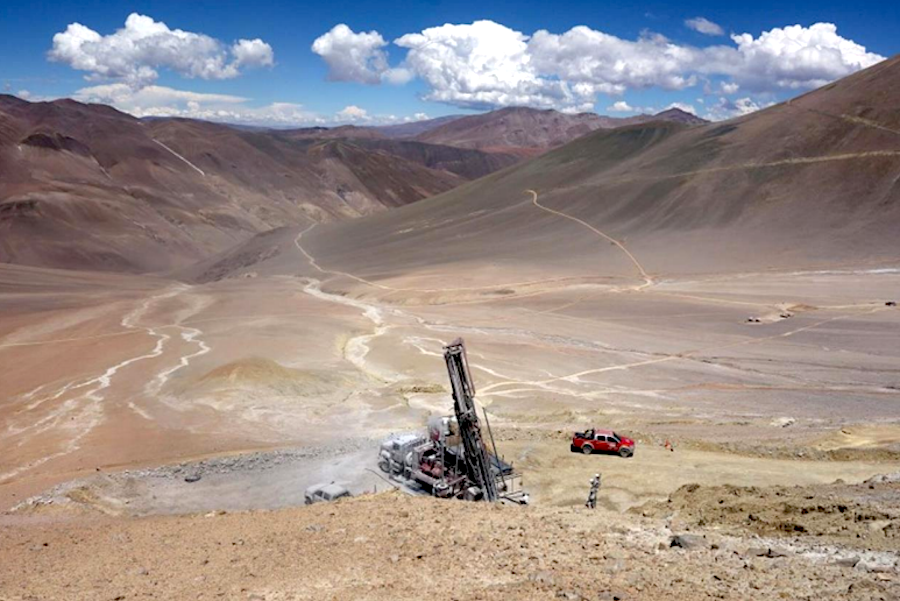
    In our database, Lundin Mining’s recent move to lift its stake in the Caserones copper operation and nearby Los Helados deposit (March 2026 piece) signals a long copper growth runway, which makes long-dated Scope 3 expectations more material for investors focused on the 75–95% emissions share tied to downstream use.

    Geotechnical Software for Modern Teams

    Centralise site data, logs, and lab results with GEODB-io, CMRR-io, and HYDROGEO-io.

    No credit card required.

    • Save and export unlimited calculations
    • Advanced data visualisation
    • Generate professional PDF reports
    • Cloud storage for all your projects

    Prepared by collating external sources, AI-assisted tools, and Geomechanics.io’s proprietary mining database, then reviewed for technical accuracy & edited by our geotechnical team.

    Related Articles

    Integra’s 74% reserve lift at Florida Canyon: project economics for mine planners
    Mining
    about 10 hours ago

    Integra’s 74% reserve lift at Florida Canyon: project economics for mine planners

    Integra Resources’ updated feasibility study for the Florida Canyon heap leach mine in Nevada lifts proven and probable reserves 74% to 1.1 million oz at 0.31 g/t, raises planned output to 82,000 oz gold per year over eight years, and boosts the 5% NPV to US$601 million using a US$4,200/oz price. All-in sustaining costs climb 43% to US$2,331/oz with recovery steady at 62%, but post-tax free cash flow is projected at US$800 million, averaging US$90 million annually. Integra is drilling 42,500 metres around the existing operation to grow resources and fund its DeLamar gold-silver project in Idaho.

    DRC critical minerals strategy: price-setting and supply risks for mine planners
    Mining
    about 10 hours ago

    DRC critical minerals strategy: price-setting and supply risks for mine planners

    Democratic Republic of Congo has shifted from price-taker to price-setter in cobalt by imposing ARECOMS-managed export quotas and planning state stockpiles of cobalt, coltan and germanium. Cobalt prices have climbed from about $21,000/t in early 2025 to just over $56,000/t, with Kinshasa forecasting $2.3 billion in fiscal revenues this year versus an estimated $617 million without intervention. Advisory input from Vectus Global and new investment moves such as Virtus Minerals’ acquisition of Chemaf signal tighter supply discipline and a push for higher value-added partnerships.

    Ground view Kazakhstan: digitised Soviet data and reserve codes for explorers
    Mining
    about 10 hours ago

    Ground view Kazakhstan: digitised Soviet data and reserve codes for explorers

    Kazakhstan is racing to digitise a vast Soviet-era geological archive, with 1960s seismic data still stored on magnetic tape that can only be read on perhaps three surviving machines using playback needles no longer manufactured since the Brezhnev era. The National Geological Service aims to convert millions of pages of hand-drawn, non-standardised maps into polygons, vectors and points for AI-driven targeting of critical minerals, while also restating Soviet GKZ-classified reserves into KAZRC, JORC or NI 43‑101, with only about 143 of 400–500 major deposits converted so far. More than US$17 billion in recent US–Kazakh trade and investment deals, plus a new memorandum with Saudi Arabia, signal that access to this “pre-paid exploration” data is becoming a key competitive factor for mid-tier and junior explorers.

    Related Industries & Products

    Mining

    Geotechnical software solutions for mining operations including CMRR analysis, hydrogeological testing, and data management.

    CMRR-io

    Streamline coal mine roof stability assessments with our cloud-based CMRR software featuring automated calculations, multi-scenario analysis, and collaborative workflows.

    HYDROGEO-io

    Comprehensive hydrogeological testing platform for managing, analysing, and reporting on packer tests, lugeon values, and hydraulic conductivity assessments.

    GEODB-io

    Centralised geotechnical data management solution for storing, accessing, and analysing all your site investigation and material testing data.

    AllGeotechnicalMiningInfrastructureMaterialsHazardsEnvironmentalSoftwarePolicy