Geomechanics.io

  • Free Tools
Sign UpLog In

Geomechanics.io

Geomechanics, Streamlined.

© 2026 Geomechanics.io. All rights reserved.

Geomechanics.io

CMRR-ioGEODB-ioHYDROGEO-ioQCDB-ioFree Tools & CalculatorsBlogLatest Industry News

Industries

MiningConstructionTunnelling

Company

Terms of UsePrivacy PolicyLinkedIn
    Projects
    Contract Award
    Sustainability

    Graphite One’s Alaska project: FAST‑41 permitting and capex lens for mine planners

    April 28, 2026|

    Reviewed by Joe Ashwell

    Graphite One’s Alaska project: FAST‑41 permitting and capex lens for mine planners

    First reported on MINING.com

    30 Second Briefing

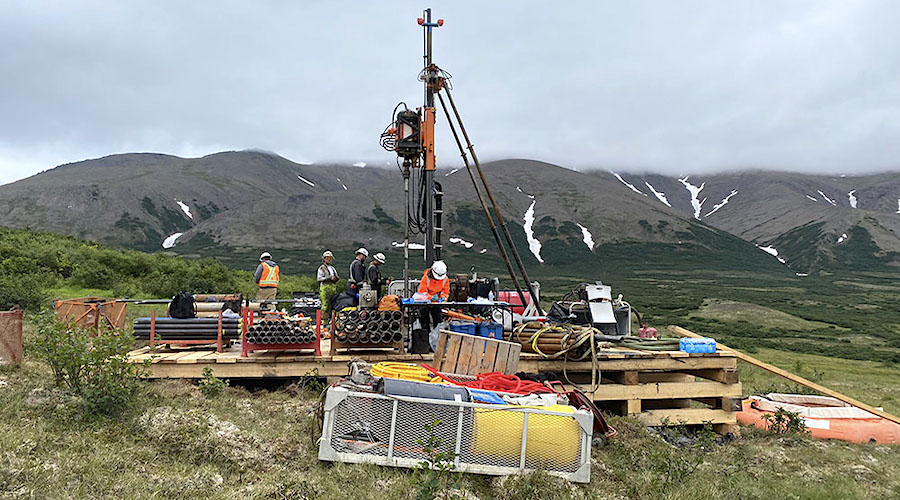
    Graphite One’s Graphite Creek project in Alaska remains on track for a FAST-41 permitting decision in September, with the U.S. Army Corps of Engineers leading a roughly 13.5‑month environmental review scheduled to conclude by 29 September 2026. The open-pit mine, 60 km north of Nome and described as the largest graphite resource in the US, is planned to produce up to 175,000 tonnes of concentrate annually over a 20‑year life from 2030, feeding a linked battery anode plant in Ohio targeting first output in mid‑2027. The US Export-Import Bank has signalled potential financing support of up to $2 billion for the integrated Alaska-to-Ohio supply chain.

    Technical Brief

    • FAST-41 inclusion followed a 60-day Coordinated Project Plan process aligning multiple federal agencies’ schedules.
    • The federal permitting timetable is publicly posted on the FAST-41 dashboard, enabling transparent milestone tracking.
    • U.S. Army Corps of Engineers is designated lead agency, coordinating all federal environmental and regulatory reviews.
    • Graphite Creek was the first Alaskan project accepted to the FAST-41 permitting dashboard framework.
    • Graphite One’s market capitalisation reached C$258.1 million after the update, with shares at C$1.27.
    • EXIM’s expressed funding interest of up to $2 billion targets the integrated Alaska–Ohio graphite supply chain.

    Our Take

    The US Export-Import Bank’s indicated funding interest of up to $2 billion for Graphite One aligns with a later related piece in our database noting EXIM lifting potential support for the Alaska-to-Ohio graphite chain to about $2.1 billion, signalling that permitting progress at Graphite Creek in Alaska is directly tied to downstream financing confidence in the US graphite supply chain.

    With Graphite One trading on the TSXV and sitting in a critical minerals space that has featured prominently in recent TSX Venture 50 coverage, the C$258.1 million market capitalisation suggests it is still mid-tier compared with some of the more explosive rare earths and silver names, leaving room for re-rating if the 13.5‑month FAST‑41 review stays on schedule.

    A 20‑year mine life for the Graphite Creek project in Alaska, combined with EXIM’s interest and a projected completion date in 2026, positions this graphite asset as a long-duration anchor in US critical minerals planning, contrasting with shorter-life or exploration-stage uranium and iron ore projects like Atlas or those around Uranium City in our database that face more uncertain development timelines.

    Geotechnical Software for Modern Teams

    Centralise site data, logs, and lab results with GEODB-io, CMRR-io, and HYDROGEO-io.

    No credit card required.

    • Save and export unlimited calculations
    • Advanced data visualisation
    • Generate professional PDF reports
    • Cloud storage for all your projects

    Prepared by collating external sources, AI-assisted tools, and Geomechanics.io’s proprietary mining database, then reviewed for technical accuracy & edited by our geotechnical team.

    Related Articles
    Integra’s 74% reserve lift at Florida Canyon: project economics for mine planners
    Mining
    about 10 hours ago

    Integra’s 74% reserve lift at Florida Canyon: project economics for mine planners

    Integra Resources’ updated feasibility study for the Florida Canyon heap leach mine in Nevada lifts proven and probable reserves 74% to 1.1 million oz at 0.31 g/t, raises planned output to 82,000 oz gold per year over eight years, and boosts the 5% NPV to US$601 million using a US$4,200/oz price. All-in sustaining costs climb 43% to US$2,331/oz with recovery steady at 62%, but post-tax free cash flow is projected at US$800 million, averaging US$90 million annually. Integra is drilling 42,500 metres around the existing operation to grow resources and fund its DeLamar gold-silver project in Idaho.

    DRC critical minerals strategy: price-setting and supply risks for mine planners
    Mining
    about 10 hours ago

    DRC critical minerals strategy: price-setting and supply risks for mine planners

    Democratic Republic of Congo has shifted from price-taker to price-setter in cobalt by imposing ARECOMS-managed export quotas and planning state stockpiles of cobalt, coltan and germanium. Cobalt prices have climbed from about $21,000/t in early 2025 to just over $56,000/t, with Kinshasa forecasting $2.3 billion in fiscal revenues this year versus an estimated $617 million without intervention. Advisory input from Vectus Global and new investment moves such as Virtus Minerals’ acquisition of Chemaf signal tighter supply discipline and a push for higher value-added partnerships.

    Ground view Kazakhstan: digitised Soviet data and reserve codes for explorers
    Mining
    about 10 hours ago

    Ground view Kazakhstan: digitised Soviet data and reserve codes for explorers

    Kazakhstan is racing to digitise a vast Soviet-era geological archive, with 1960s seismic data still stored on magnetic tape that can only be read on perhaps three surviving machines using playback needles no longer manufactured since the Brezhnev era. The National Geological Service aims to convert millions of pages of hand-drawn, non-standardised maps into polygons, vectors and points for AI-driven targeting of critical minerals, while also restating Soviet GKZ-classified reserves into KAZRC, JORC or NI 43‑101, with only about 143 of 400–500 major deposits converted so far. More than US$17 billion in recent US–Kazakh trade and investment deals, plus a new memorandum with Saudi Arabia, signal that access to this “pre-paid exploration” data is becoming a key competitive factor for mid-tier and junior explorers.

    Related Industries & Products

    Mining

    Geotechnical software solutions for mining operations including CMRR analysis, hydrogeological testing, and data management.

    CMRR-io

    Streamline coal mine roof stability assessments with our cloud-based CMRR software featuring automated calculations, multi-scenario analysis, and collaborative workflows.

    HYDROGEO-io

    Comprehensive hydrogeological testing platform for managing, analysing, and reporting on packer tests, lugeon values, and hydraulic conductivity assessments.

    GEODB-io

    Centralised geotechnical data management solution for storing, accessing, and analysing all your site investigation and material testing data.

    AllGeotechnicalMiningInfrastructureMaterialsHazardsEnvironmentalSoftwarePolicy