Geomechanics, Streamlined.
© 2026 Geomechanics.io. All rights reserved.
A successful cyber attack on 29% of the UK’s battery energy storage systems – around 400 grid‑connected units – could trigger a nationwide blackout, cybersecurity firm Centrii warns. The modelling assumes coordinated compromise of BESS control systems, allowing hostile switching and rapid withdrawal or injection of stored power, destabilising frequency across the transmission network. For grid, civil and systems engineers, the finding points to the need for hardened SCADA interfaces, segmented communications and cyber‑resilience to be treated as core design criteria for future BESS projects.
Blackpool Council has let a £200M (ex-VAT) highways surfacing and civil engineering framework to deliver multi-year upgrades across its local road network. The framework will cover carriageway and footway resurfacing, associated drainage and kerb works, and minor structures and public realm improvements, enabling packages to be called off without separate tenders. Contractors can expect a steady pipeline of asphalt, pavement rehabilitation and small civils schemes, with scope to optimise plant utilisation, material logistics and night-working strategies in a dense urban environment.
A £16M tender has been launched by the City of London Corporation for demolition, enabling works and new structural works within the Barbican Renewal Programme. The package will cover removal of existing fabric and temporary works to protect the Barbican’s complex multi-level concrete structure while new loadbearing elements and alterations are installed. Contractors will need strong experience in working around occupied buildings, managing vibration and noise limits, and sequencing heavy demolition adjacent to sensitive post-tensioned and exposed reinforced concrete.
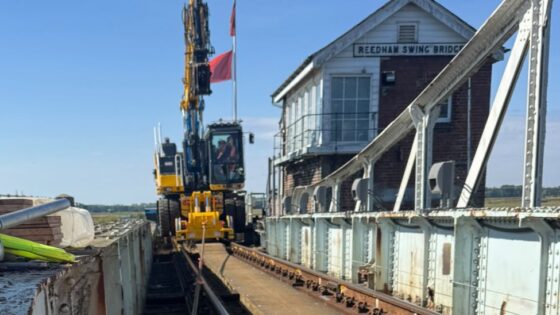
Network Rail has completed repairs to the central bearing of the 123-year-old Reedham swing bridge over the River Yare in Norfolk ahead of schedule, restoring full swing operation for larger vessels. The structure carries rail traffic on the Wherry Lines and pivots to open for river navigation, so the bearing works were critical to both rotational performance and alignment under train loading. Early completion reduces disruption to passenger and freight services while reinstating navigational clearance for commercial and leisure boats on this key Broads waterway.
Autonomous haulage systems in mining are approaching a global fleet of 10,000 trucks nearly two decades after the first commercial deployments, with OEMs now pushing beyond basic truck automation into integrated, multi-equipment fleets. Current roll-outs pair AHS trucks with autonomous blasthole drills, semi-autonomous dozers and remote-operated loaders, coordinated through fleet management platforms and high-availability private LTE networks. Miners are grappling with brownfield constraints such as legacy haul road geometry, mixed autonomous–manual traffic and variable orebody conditions, driving demand for more adaptive perception, collision-avoidance and dispatch algorithms.
Tailings 2026 in Santiago, Chile, will convene more than 160 technical presentations from practitioners and researchers across 18 countries on tailings storage facility design, monitoring and closure. Topics flagged by Katie Kruger, Manager of Tailings, Crushed Leach, include applying the Global Industry Standard on Tailings Management, integrating real-time instrumentation and remote sensing, and improving beach slope control and seepage management. Engineers can expect detailed case studies on upstream, downstream and centreline facilities, filtered tailings, and risk-based governance frameworks directly applicable to active and legacy sites.
Digital exploration workflows are exposing a new failure mode where assay values ingested into drillhole databases lose their evidentiary trail, allowing mis-keyed grades, OCR errors from scanned lab certificates, or misaligned historical drill logs to appear as authoritative inputs to machine-learning targeting. Joshua argues that algorithms ranking targets, interpolating block models, or driving prospectivity maps must treat each assay with an explicit provenance score, distinguishing original lab CSVs from hand-typed transcriptions or reconstructed intervals. For geologists and data engineers, this means redesigning schemas to store document lineage, QA/QC context and uncertainty flags, not just numeric assay fields.
Sandvik is raising recycled carbide content in its premium PowerCarbide® rock drilling grades from about 50% to as much as 75%, cutting dependence on virgin tungsten and cobalt while keeping wear resistance and penetration performance for hard-rock blasthole and drifting applications. Announced at its Future of Mining 2026 event, the move relies on closed-loop recovery of worn drill bits and inserts from mine sites. For drill-and-blast engineers, the change offers lower embedded CO₂ in consumables without altering bit selection, drilling parameters or expected service life.
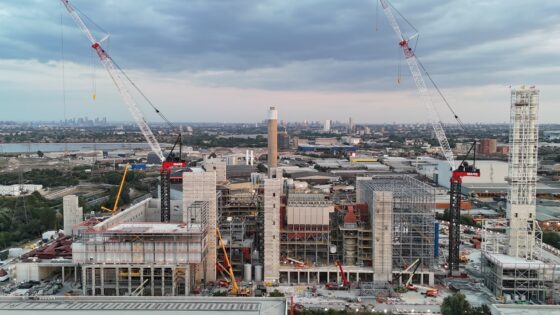
Marr Contracting has completed installation of a 100m modularised flue gas stack at the North London Heat and Power Project, using heavy-lift cranes to assemble large prefabricated sections on a constrained energy-from-waste site. The chimney stack, built from modular steel sections with integrated flues and access systems, was lifted into place to minimise work at height and reduce on-site welding and bolting. For contractors and designers, the project reinforces the viability of modular tall-stack construction on tight urban footprints with complex lifting logistics.
Anglian Water has signed a two-year extension to its condition-based monitoring framework with industrial AI firm Samotics, continuing remote health assessment of critical rotating assets such as pumps and motors across its water and wastewater network. Samotics’ system typically uses electrical signature analysis via permanently installed sensors in motor control centres to detect faults like bearing wear, misalignment and cavitation before mechanical failure. For civil and MEICA teams, the deal signals ongoing reliance on continuous, non-intrusive monitoring to cut unplanned outages and optimise maintenance scheduling on buried and hard-to-access plant.
New Civil Engineer has opened nominations for judges for its 2027 awards portfolio, covering the British Construction & Infrastructure Awards, NCE Awards and NCE Bridges Awards, as it seeks to refresh and expand its expert panels. Practitioners from infrastructure, bridge engineering, geotechnics and construction delivery are being encouraged to put forward senior professionals with direct project experience. The move signals an opportunity for firms to influence recognition of best practice in areas such as complex bridge design, major civils delivery and asset resilience.
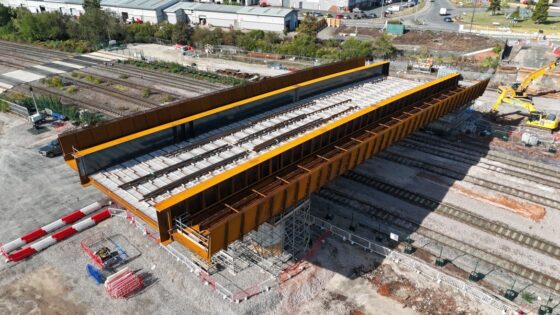
Installation of the first 55m section of the new Saltley Viaduct over the Birmingham to Derby railway lines was completed by HS2 engineers over the August Bank Holiday, marking the initial stage of replacing the existing road bridge. The steel span was lifted into place during a possession window to maintain rail operations, requiring precise coordination of heavy lifting plant and rail protection measures. For designers and contractors, the work signals upcoming interface challenges with live rail, highway tie-ins and future staged deck construction on a constrained urban site.
Five Welsh councils are preparing an £800M civil engineering framework to procure construction and related works across South West Wales, Bridgend, Neath Port Talbot, Swansea and Powys. The programme is expected to bundle highways, structures and associated infrastructure packages into a single multi-authority arrangement, giving contractors a long-term pipeline and standardised commercial terms. Ground and structural specialists should monitor for lots covering road reconstruction, bridge works and drainage upgrades, where aggregated demand could favour firms with regional plant, materials supply and design capability.
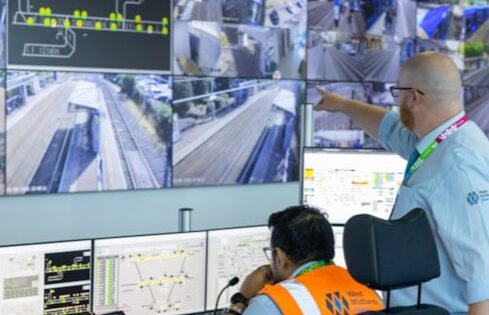
West Midlands Metro has opened a new Operational Control Centre (OCC) at its Wednesbury depot to manage operations for the forthcoming light rail extension between Wednesbury and Dudley town centre, due to open later this year. The OCC centralises real-time monitoring and control of tram movements across the extended network, integrating signalling, power systems and passenger information from a single site. For civil and systems engineers, the facility signals a shift towards more integrated control architecture ahead of further route expansions in the West Midlands.
Liontown Limited has signed a staged farm-in with NEXT Lithium Corp. to acquire up to 100% of the Centenario lithium brine project in Argentina via NEXT’s Australian subsidiary, Vertex Holdings. The structure includes an initial $5 million cash payment, $10 million in Liontown shares and a $15 million, two‑year work programme focused on drilling targets defined by transient electromagnetic surveys, earning Liontown an effective 49% interest. Located near the Pozuelos-Pastos Grandes and Centenario-Ratones projects, each targeting up to 150,000 t/y lithium carbonate, Centenario gives Liontown brine exposure alongside its Kathleen Valley hardrock operation.
New drilling at AbraSilver Resource’s Diablillos project in Salta province, Argentina, has intersected shallow gold–silver mineralisation at the Cerro Viejo target, including 27 m grading 4.6 g/t Ag and 0.58 g/t Au from 23 m in hole DDH 26-037 and 32 m at 2.8 g/t Ag and 0.29 g/t Au from 9 m in DDH 26-047. The company has now completed about 12,000 m in 54 Phase VI diamond holes, with two rigs turning and a third due this month, contributing to over 170,000 m drilled on the property. Diablillos carries a DFS-based after-tax NPV of US$4.15 billion, a 42% IRR and a 1.7-year payback, with additional upside from the Condoryacu acquisition, where initial drilling hit 72 m at 117 g/t Ag and 18.7 g/t Au.
Strike action will begin at Sibanye-Stillwater’s Stillwater East mine and Columbus metallurgical complex in Montana at 7 a.m. on 3 September, after more than four months of failed contract talks with the United Steelworkers. Around 750 employees at the underground PGM mine and associated recycling and smelting facilities are covered by the collective bargaining agreement, with Stillwater East having produced 76,334 oz of PGMs in H1 2026, about 446 oz per day. Sibanye-Stillwater warns production losses will depend on strike duration, operating arrangements, and restart time.
Copper availability is being distorted by regional trade shifts rather than absolute scarcity, with Andy Home noting that China’s buying is rapidly drawing down London Metal Exchange stocks while metal remains tied up elsewhere. He argues that fragmented flows could force distinct pricing across the LME, Shanghai Futures Exchange and CME, creating a “new age of arbitrage” based on regional differentials. For Western economies, rebuilding copper smelting and processing capacity after decades of offshoring to China will demand huge power infrastructure, with a single new US smelter consuming electricity comparable to a city the size of Boston.
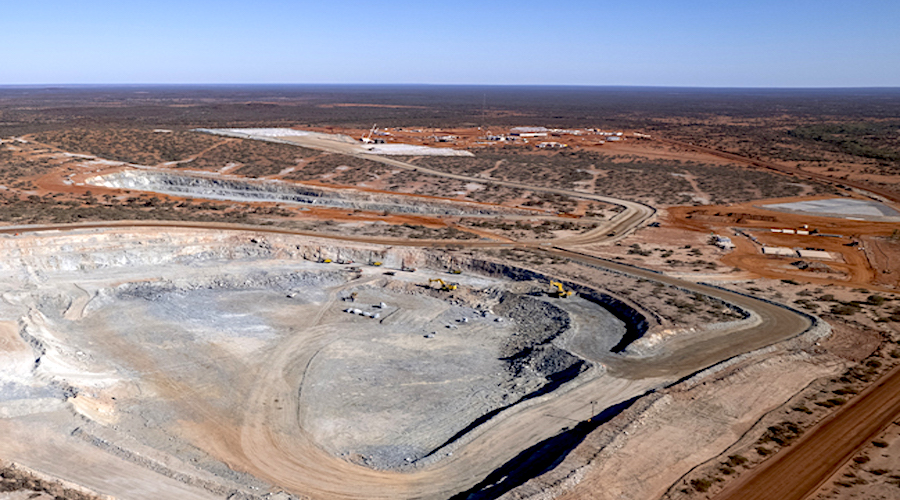
Gateway Mining has reported a fresh-rock gold discovery at its Cowza prospect in Western Australia, with the first effective reverse circulation hole CZRC057 returning 41m at 2.0g/t gold from 104m depth. The intercept includes a higher-grade interval of 9m at 7.5g/t from 105m, indicating a potentially robust mineralised zone below previously tested oxide material. For resource modellers and mine planners, the thickness and grade of this initial fresh-rock hit will drive follow-up drilling to define geometry, continuity and potential underground or deeper open-pit scenarios.
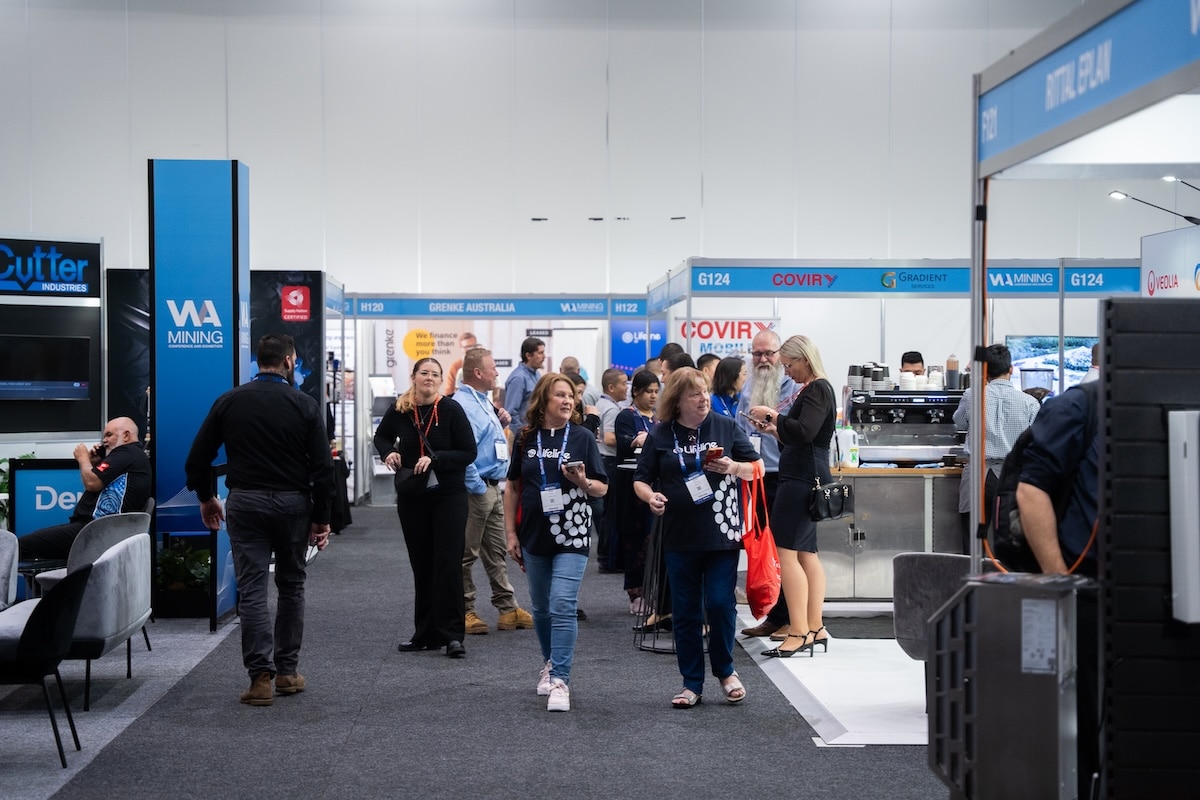
WA Mining 2026 has sold out its exhibition space at the Perth Convention & Exhibition Centre, with more than 140 exhibitors locked in for the 16–17 September event. Major mining companies and technology providers will showcase equipment, digital solutions and services across exploration, drilling, processing and mine operations. Final conference tickets are now on sale, signalling strong demand in Western Australia for in-person engagement on automation, decarbonisation and productivity-focused mining technologies.
Eldorado Gold is evaluating a 43% expansion of the McIlvenna Bay processing plant in Saskatchewan, including a new silver-lead circuit, as the underground copper-zinc-gold-silver mine ramps towards commercial production in Q3 with more than 400,000 tonnes of material stockpiled. The C$1.32 billion build-out has already delivered first copper concentrate in June and zinc and pyrite concentrates in July, with 2026 output guided at 5–10 million lb copper and 3,000–6,000 tonnes zinc. Grid power is secured via an 85 km SaskPower transmission line and substation, and 14,000 metres of drilling is targeting the Tesla zone and Bigstone deposit.
A shift away from a dollar-centred financial system towards a multipolar model with higher gold weightings in bank reserves is driving what fund manager Willem Middelkoop calls an early-stage “generational boom” in commodities, underpinned by metal shortages, geopolitical competition and currency debasement. Middelkoop says “sensible banks” are already substituting part of their bond holdings with bullion, signalling stronger structural demand for physical gold. He has recently increased his personal silver position after a technical retracement to about $55/oz and projects silver could reach $100/oz in the near term and potentially $500/oz longer term if gold trades near $5,000/oz.
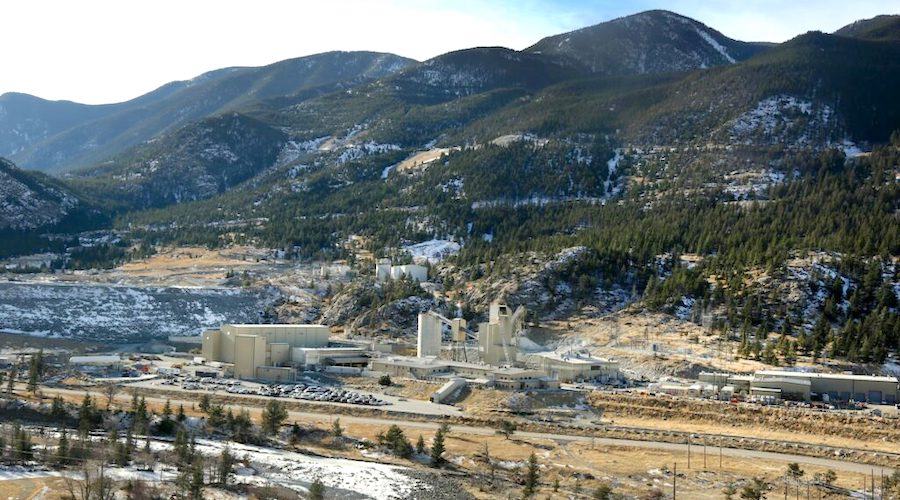
US Forest Service approval of South32 Hermosa’s Final Mine Plan of Operation clears construction of key ancillary works on federal land in southern Arizona, including a primary access road, a secondary drystack tailings storage facility, high‑voltage transmission line and water discharge points. The Hermosa district hosts one of the world’s largest undeveloped zinc deposits plus battery‑grade manganese and the Peak copper discovery, with a projected 70‑year mine life producing five federally designated critical minerals. Construction on private land is about 50% complete, with underground zinc mining targeted for late 2027 and first plant product in H1 2028.
Meeka Metals has reached its nameplate 600,000 tonnes per annum processing rate at the Andy Well gold operation in Western Australia, with the plant running at an annualised ~600ktpa through July and August and recording higher peak throughput over the period. An ore sorter is scheduled for commissioning in October, targeting higher feed grades and reduced mill load by rejecting low-grade material ahead of the existing circuit. For plant and mine planners, stable operation at nameplate before adding pre-concentration reduces ramp-up risk and supports more predictable metallurgical performance.