Geomechanics, Streamlined.
© 2026 Geomechanics.io. All rights reserved.
NOCN Group has launched a digital skills passport linked to its skills hub, giving CPCS and other card holders a secure, real‑time record of certifications, CPD, compliance and skills that employers can verify and share digitally. The integrated platform architecture is designed to sit alongside existing contractor and training systems, providing digital logbooks and API connectivity first tested in the 2021 DigiKey pilot linking skills passports to machine controls on HS2. The passport was trialled in India with Nettur Technical Training Foundation and TCS iON, signalling potential for large‑scale, cross‑project workforce competence tracking.
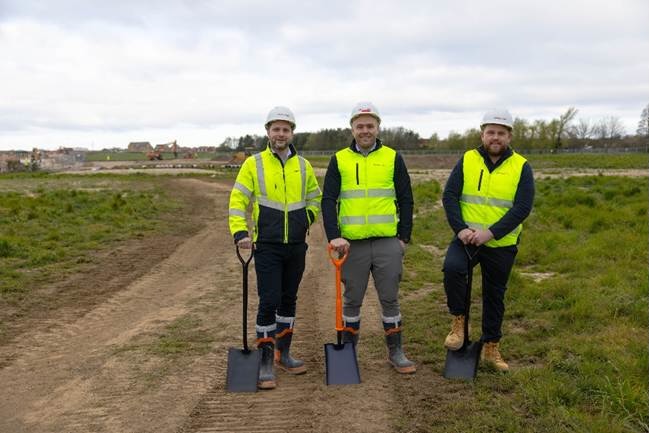
Redrow South East has broken ground on its Heritage Fields scheme in Sittingbourne, a 88-home development comprising 82 private and six affordable units as part of a wider growth masterplan. Barratt Redrow has committed over £10m through section 106 obligations to fund local infrastructure, education, healthcare and youth services, signalling substantial off-site works alongside the housing. Homes combine Arts and Crafts-inspired architecture with air source heat pumps and underfloor heating, indicating a fabric-and-systems approach to low‑carbon residential design.
BJD Crushers has appointed former RAF and Ibstock Concrete engineer Steven Kilner as technical sales engineer to support its crusher and materials-handling product lines. Kilner brings experience supervising ground equipment maintenance at RAF Leeming and RAF Coningsby and managing machinery maintenance, site upgrades and capex projects at Ibstock Concrete. His role will centre on reviewing technical data and documentation, interpreting mechanical and materials process requirements, preparing quotations, and working with suppliers and customers to scope equipment solutions and identify growth opportunities.
Willmott Dixon has secured a £61m Department for Education contract to rebuild Mosslands School in Wallasey on a 19-acre site, delivering a three-storey main block for up to 1,500 pupils plus two sports halls, a replacement all‑weather pitch, a multi‑use games area, new car park and cycle parking. The scheme will create a net zero carbon in operation campus using extensive photovoltaic panels, air source heat pumps and ground source heat pumps. Completion is scheduled for 2028 and includes full demolition of the existing school buildings, with associated site clearance and services reconfiguration.
Robertson Construction North East will deliver a five-screen cinema and leisure complex in Ashington as part of a £36m town centre regeneration, with construction due to start shortly following planning approval last year. The design-and-build scheme, procured via the Procure Partnerships Framework, also includes two restaurant units and a family-focused “competitive socialising” venue combining food, drink and indoor games. Funding comes from the UK Ministry of Housing, Communities and Local Government, Northumberland County Council and development partner Advance Northumberland, targeting higher evening and weekend footfall.
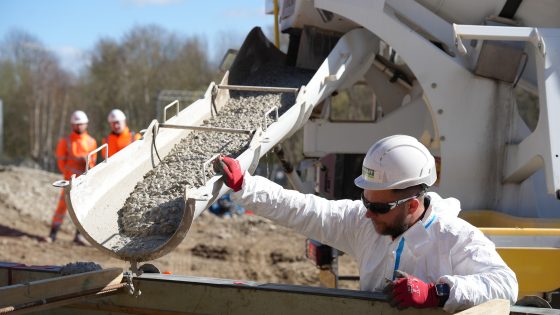
Murphy has poured low carbon concrete for permanent works at Shipley Depot on the Transpennine Route Upgrade, using limestone filler and supplementary cementitious materials (SCMs) to cut clinker content and embodied CO₂. The mix replaces a portion of CEM I with SCMs such as fly ash or GGBS and fine limestone, targeting comparable strength and durability to conventional depot slabs while reducing Portland cement usage. For geotechnical and civils teams, this signals growing client acceptance of SCM‑rich mixes in rail infrastructure foundations and depot pavements.
Re:Construction podcast’s 200th and final episode sees hosts Bishop and Taylor sign off after more than six years covering UK construction. Their last discussion touches on leadership changes at housebuilder Vistry Group and recent developments at Austrian contractor Strabag, both significant Tier 1 players on major UK and European infrastructure schemes. For practitioners, the episode closes a long-running source of commentary on contractor performance, corporate strategy and market conditions across civils and building.
Volvo has launched new FH Aero Electric trucks for deliveries with a claimed range of up to 700 km between charges, targeting long-haul and regional logistics. The next-generation FH, FM and FMX Electric models use a redesigned electric driveline delivering higher torque, aimed at heavy on-road works and construction support fleets. For civil and infrastructure contractors, the longer range and higher tractive effort make battery-electric options more viable for materials haulage and support vehicles on dispersed project sites.
Cold bitumen emulsion-based asphalt has been deployed by Roadways as a low-carbon, like-for-like replacement for conventional hot asphalt on a National Highways scheme, with no departures from existing specification. The emulsion mix is produced and laid at significantly lower temperatures than traditional 160–180°C hot-mix, cutting burner fuel use and associated CO₂ emissions while maintaining standard binder and aggregate grading requirements. For pavement designers and contractors, this signals growing scope to decarbonise surfacing works without redesigning layer thicknesses or seeking new approvals.
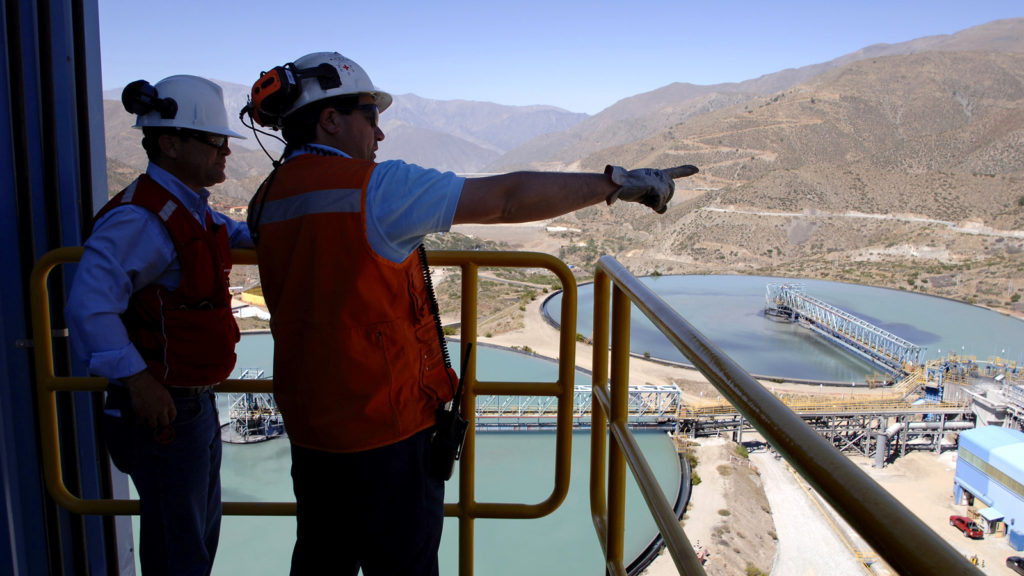
Orica has launched a next-generation GroundProbe geotechnical monitoring solution from Melbourne, integrating radar, LiDAR and AI-based data processing to deliver faster, higher-resolution slope stability measurements for open-pit mines and tailings storage facilities. The system combines real-time deformation monitoring with automated alarms and cloud-based visualisation, enabling earlier detection of wall movement and remote decision-making from control centres. For geotechnical teams, the key shift is from periodic survey checks to continuous, sensor-fused monitoring that can be scaled across multiple pits and TSFs.
Wear liners at belt conveyor transfer points act as sacrificial protection for skirtboards, preventing dents and holes that lead to spillage and dust escape, explains Daniel Marshall, Process Engineer at Martin Engineering. Marshall notes that conventional liner removal and replacement can be gruelling, often needing several workers and taking multiple days per transfer point. The discussion points to design and maintenance changes that cut change-out time and manual handling, with direct implications for confined-space work, lockout durations and dust control performance.
The Lifting Equipment Engineers Association has set Thursday 2 July 2026 for the seventh Global Lifting Awareness Day, built around the theme “Not all lifting equipment is created equal.” LEEA plans to use the campaign, run with member companies and sector partners, to push better specification and inspection of cranes, hoists and below-the-hook devices in mining and other heavy industries. The initiative will culminate in a new guidance document aimed at reducing failures linked to substandard or misapplied lifting gear.
East West Rail has set out updated design proposals for the Oxford–Cambridge line and published a revised construction timetable for the new Bedford station ahead of its final Development Consent Order consultation. The changes cover alignment refinements and station layout adjustments intended to integrate the new Bedford station with existing Midland Main Line services and local road networks. For civil and rail engineers, the timetable update clarifies phasing of major works, possessions and interface risks around live-track construction in Bedford’s constrained urban corridor.
Port of Dover has achieved carbon net-zero Scope 1 and 2 emissions in April 2026, meeting its 2025 target early and 25 years ahead of the UK Government’s 2050 maritime decarbonisation goal. The port reports eliminating or offsetting all direct fuel use and purchased electricity emissions from operations such as harbour tugs, terminal plant and shore-side facilities. For civil and port engineers, Dover now becomes a live reference case for low‑carbon power supply, equipment electrification and emissions accounting in large, high‑throughput ferry and RoRo infrastructure.
Murphy has completed the UK’s first permanent works pour using Ecocem ACT low‑carbon concrete, marking a shift from traditional CEM I mixes on a live infrastructure scheme. Ecocem ACT is a clinker‑reduced binder system designed to cut embodied CO₂ significantly while maintaining CEM I‑equivalent strength and setting performance, enabling direct substitution in structural elements. For designers and contractors, this early UK deployment provides a live reference for specification, QA testing, and durability assessment of next‑generation low‑carbon binders in permanent works.
Antofagasta’s first-quarter copper production fell 8% year-on-year to 143,000 tonnes due to lower processing rates and weaker grades at two concentrators, but net cash costs dropped 30% to $1.08/lb and 2026 guidance of 650,000–700,000 tonnes at $1.15–1.35/lb by-product cash cost remains unchanged. Capex guidance stays at $3.4 billion, with the Centinela second concentrator in pre-commissioning and Los Pelambres expected to lift output via higher ore throughput and improving grades. The miner is monitoring rising imported sulphuric acid prices linked to a Strait of Hormuz blockage while evaluating early-stage copper options in Argentina and the US.
War in Iran and Indonesia’s decision to cap 2026 nickel ore quotas at 260–270 million wet tonnes, down from 379 million tonnes, are expected to support prices, with BMI lifting its 2026 forecast to $16,600/t despite a projected 324,000‑tonne global surplus. Sulphur supply disruptions from the Middle East, critical for Indonesia’s HPAL plants, have already forced several processors to cut output by at least 10%, while higher energy costs are pressuring higher‑cost producers outside Indonesia. Demand growth is seen slowing to about 3% in 2026 as lithium iron phosphate batteries displace nickel‑rich chemistries.
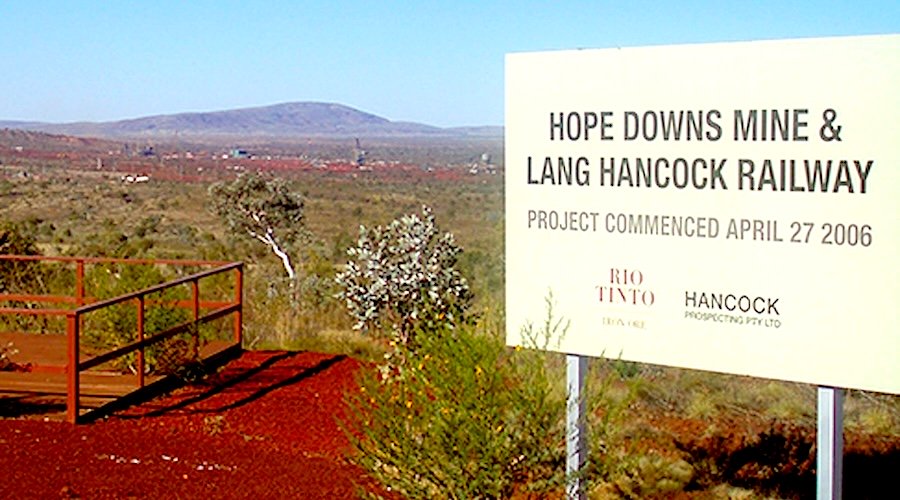
Hancock Prospecting and Rio Tinto have been ordered by the West Australian Supreme Court to pay ongoing iron ore royalties from the Hope Downs complex to Wright Prospecting and DFD Rhodes, with Hancock estimating exposure of about A$14 million and A$4 million per year respectively. The judgment confirms Hancock’s exclusive ownership of the Hope Downs and East Angelas tenements, rejecting rival title claims from Wright family entities after a 15‑year dispute over 1950s–1970s prospecting and royalty agreements. Liability for back‑dated royalties and interest will be shared between Hancock and Rio, adding a recurring cost line to a major Pilbara operation.
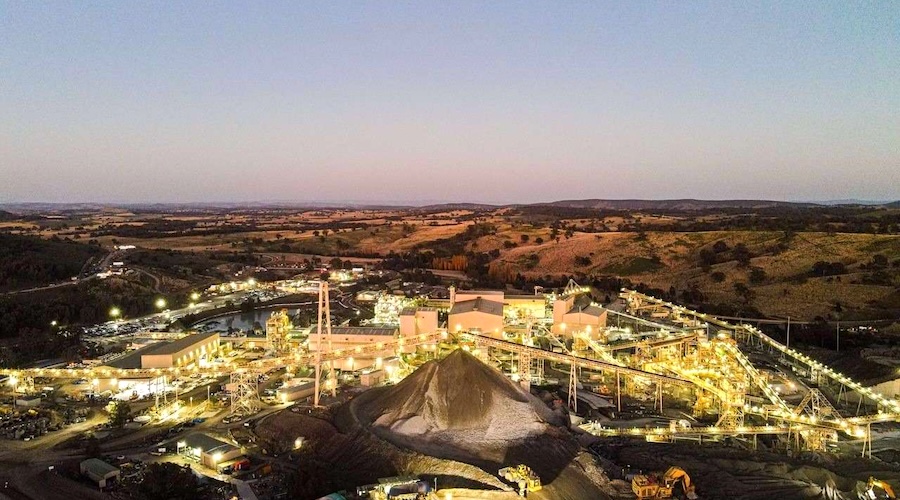
Newmont has suspended underground operations at its Cadia gold-copper mine in New South Wales after a magnitude 4.5 earthquake and two aftershocks late on 14 April, with all underground personnel safely evacuated and no injuries reported. Specialist teams are now inspecting and assessing underground infrastructure before management decides on a restart, raising the risk of short-term disruption at one of Australia’s largest hard-rock gold operations. Newmont’s NYSE-listed shares fell about 4.4% to $114.09 on the news, cutting its market capitalisation to roughly $125 billion.
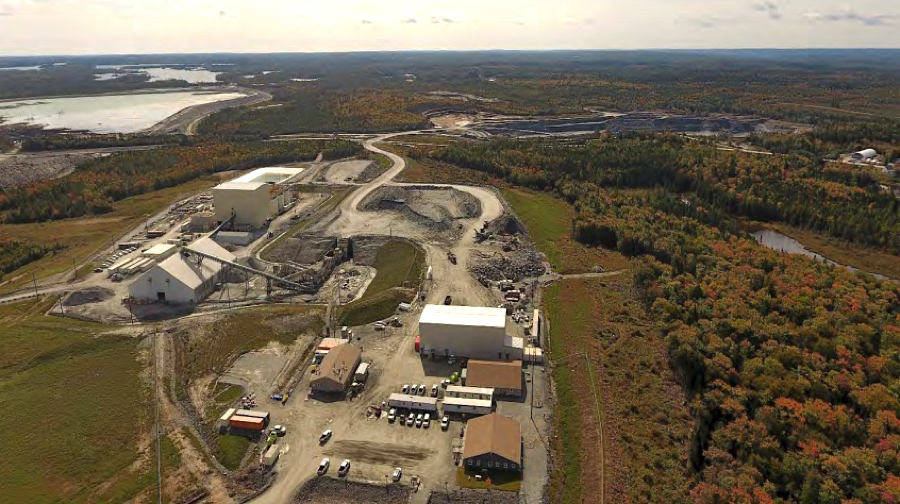
St Barbara has secured Nova Scotia approval to reprocess about three million tonnes of 0.4 g/t stockpiled ore at the closed Touquoy gold mine, targeting 38,000 oz of gold over 10–14 months with all-in sustaining costs of $1,598/oz and capital outlay of C$11.4 million to refurbish the mill. The industrial permit prohibits new mining, confines activity to the existing footprint, and requires all tailings to be backfilled into the open pit under an C$80 million reclamation bond. The campaign, expected to support 197 jobs, also underpins St Barbara’s 15‑Mile hub concept, aiming for 100,000 oz/year from 2030–2040 across 697 sq. km and 56 exploration targets.
CATL is committing 30 billion yuan (about $4.4 billion) to a new mining subsidiary that will consolidate its existing Jiangxi lithium asset, invest in lithium, nickel and phosphorus projects in China and overseas, and handle exploration, metals processing and chemical sales to secure battery raw material supply. The company has brought in Chen Jinghe, founder and former chairman of Zijin Mining Group, as an advisor to shape the upstream portfolio. The move follows lithium prices rising over 140% in a year and comes alongside a 49% year-on-year jump in CATL’s Q1 net income to 20.7 billion yuan.
Seabridge Gold has issued an initial inferred mineral resource for the Snip North deposit at its Iskut project in British Columbia’s Golden Triangle, totalling 605.7 million tonnes grading 0.47 g/t gold, 0.07% copper and 1.5 g/t silver (9.2 million oz. gold, 28.3 million oz. silver and 923 million lb. copper). Mineralisation remains open in multiple directions, with Seabridge planning further fieldwork to refine the intrusive-hosted system and test extensions. The discovery adds a large, lower-grade copper-gold-silver resource to Seabridge’s Golden Triangle portfolio, alongside its KSM-scale assets.
The US Department of Energy’s TRACE-Ga initiative is awarding about $5.4 million to five firms to design and validate flowsheets to restart primary gallium production, after nearly 40 years of zero domestic output and 100% import reliance under China’s 98% global supply dominance. PHNX Materials will target non-traditional waste streams to co-produce gallium, supplementary cementitious materials, alumina and ammonium sulphate, while Atlantic Alumina and Found Energy will apply counter-current ion exchange, electrochemistry and Direct Bayer Extraction to recover gallium from hot, dilute Bayer liquors. Kunin Technologies aims for a 12 tpa gallium pathway from high-Ga metal streams, and Indium Corporation will build recycling-based recovery from scrap, signalling new process options for alumina refineries and metallurgical residues.
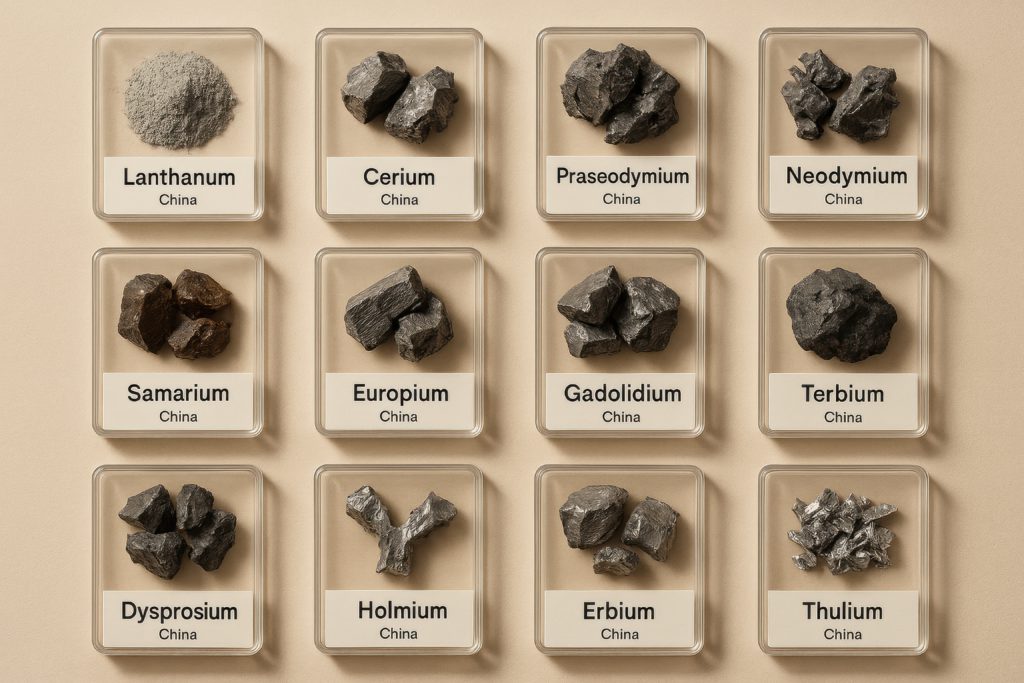
Sprott Inc. has launched the Sprott Rare Earths Ex-China ETF (Nasdaq: REXC), the first fund focused solely on rare earths companies operating outside China, tracking the Nasdaq Sprott Rare Earths Ex-China Index (NSREXC). The index covers miners, separators, refiners and producers of rare earth elements, with REXC required to hold at least 80% of assets in index constituents. Positioned around national and energy security themes, the ETF complements Sprott’s existing pure-play critical mineral funds in uranium, copper, lithium and nickel.