Geomechanics.io

  • Free Tools
Sign UpLog In

Geomechanics.io

Geomechanics, Simplified.

© 2025 Geomechanics.io. All rights reserved.

Geomechanics.io

CMRR-ioGEODB-ioHYDROGEO-ioQCDB-ioFree Tools & CalculatorsBlogLatest Industry News

Industries

MiningConstructionTunnelling

Company

Terms of UsePrivacy PolicyLinkedIn
    AllGeotechnicalMiningInfrastructureMaterialsHazardsEnvironmentalSoftwarePolicy
    Projects
    Sustainability
    Product

    London Museum calcined clay concrete: site mix lessons for structural engineers

    December 2, 2025|

    Reviewed by Tom Sullivan

    London Museum calcined clay concrete: site mix lessons for structural engineers

    First reported on New Civil Engineer

    30 Second Briefing

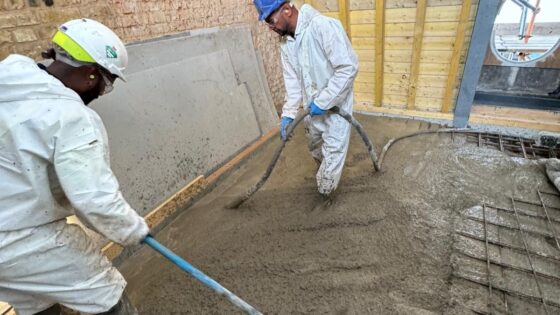
    Use of calcined clay concrete on the London Museum project, led by Sir Robert McAlpine with close input from engineers, contractors and materials suppliers, is enabling on-site deployment of a lower-clinker, lower-carbon mix rather than limiting it to precast elements. The team is adapting mix design and placing methods in real time on a live heritage-site build, addressing workability, setting time and strength-gain behaviour under typical UK site conditions. For practitioners, this signals growing confidence in calcined clay binders for mainstream structural applications where conventional CEM I would previously have been specified.

    Technical Brief

    • Experience from this live heritage project is expected to inform specification clauses for calcined clay in future UK builds.

    Our Take

    Within the Materials category, only a subset of the 292 tag-matched pieces focus on UK-based projects, so the London Museum project gives a relatively rare look at how low-clinker concretes are being trialled in a dense urban and heritage-sensitive setting.

    Sir Robert McAlpine’s involvement on this United Kingdom scheme aligns with our coverage of major contractors using high-profile public projects to de-risk lower-carbon concrete mixes before wider rollout across commercial portfolios.

    Because calcined clay systems often require mix-specific testing and on-site verification, the London Museum project is likely to generate performance data that can be reused by other UK clients and designers, potentially accelerating approvals for similar sustainable concrete products.

    Geotechnical Software for Modern Teams

    Centralise site data, logs, and lab results with GEODB-io, CMRR-io, and HYDROGEO-io.

    No credit card required.

    • Save and export unlimited calculations
    • Advanced data visualisation
    • Generate professional PDF reports
    • Cloud storage for all your projects

    Prepared by collating external sources, AI-assisted tools, and Geomechanics.io’s proprietary mining database, then reviewed for technical accuracy & edited by our geotechnical team.

    Related Articles

    Heidelberg UK CO₂‑injected concrete: performance and design notes for engineers
    Materials
    3 days ago

    Heidelberg UK CO₂‑injected concrete: performance and design notes for engineers

    Heidelberg Materials UK is trialling CarbonCure technology in ready-mixed concrete at its Greenwich plant in London, injecting pure manufactured CO₂ into fresh concrete where it mineralises permanently and allows around 5% less cement to be used. The process is claimed to cut concrete-associated emissions by 7–11 kg CO₂/m³ with no loss of performance, while potentially increasing strength through more efficient hydration. The Thameside plant also supplies calcined clay, evoBuild low carbon GGBS, crushed concrete, accelerators and evoZero near‑zero cement, positioning it as a low‑carbon materials hub.

    Latrobe Magnesium’s Hazelwood plant: mix design implications for engineers
    Materials
    3 days ago

    Latrobe Magnesium’s Hazelwood plant: mix design implications for engineers

    Latrobe Magnesium has produced its first sustainable magnesium oxide at a demonstration plant in Hazelwood North, Victoria, using proprietary technology to extract magnesium from Latrobe Valley brown coal fly ash. The process targets commercial production of both magnesium metal and supplementary cementitious material (SCM)-grade by-products, aiming to replace imported magnesia and reduce cement clinker content. For geotechnical and concrete practitioners, locally sourced MgO and SCM from waste ash could alter binder specifications, shrinkage control strategies, and durability mix designs in eastern Australia.

    FibreCoat zinc coating for reinforced concrete: durability lens for asset designers
    Materials
    5 days ago

    FibreCoat zinc coating for reinforced concrete: durability lens for asset designers

    German materials firm FibreCoat has developed zinc-coated fibres for use in reinforced concrete, claiming cathodic corrosion protection for embedded steel in highly alkaline environments where aluminium rapidly degrades. Dispersed within concrete mixes for marine and coastal structures, the zinc fibres could, subject to testing, extend asset service life by 20–30 years at a fraction of the cost of titanium fibre reinforcement. Chief executive Robert Brüll positions the heavier, less reflective zinc coating as a structural, durability-focused alternative for multi-storey car parks, docks, ports and bridges.

    Related Industries & Products

    Mining

    Geotechnical software solutions for mining operations including CMRR analysis, hydrogeological testing, and data management.

    Construction

    Quality control software for construction companies with material testing, batch tracking, and compliance management.

    CMRR-io

    Streamline coal mine roof stability assessments with our cloud-based CMRR software featuring automated calculations, multi-scenario analysis, and collaborative workflows.

    HYDROGEO-io

    Comprehensive hydrogeological testing platform for managing, analysing, and reporting on packer tests, lugeon values, and hydraulic conductivity assessments.

    GEODB-io

    Centralised geotechnical data management solution for storing, accessing, and analysing all your site investigation and material testing data.