Geomechanics, Streamlined.
© 2026 Geomechanics.io. All rights reserved.
Oxfordshire County Council has appointed contractor Graham to deliver the Clifton Hampden Bypass, a key section of the Housing Infrastructure Fund-backed HIF1 scheme serving Didcot and surrounding growth areas. The bypass will divert A415 traffic away from Clifton Hampden village and its constrained river crossing, improving capacity and resilience on a corridor currently carrying both local and strategic movements. For geotechnical and civils teams, the package is expected to involve new highway earthworks, junction tie-ins and structures over floodplain-prone ground adjacent to the Thames.
Thames Water has been fined £10,000 after unsafe street works in London left the public “put at significant risk”, following prosecution by the local highway authority under the New Roads and Street Works Act. Inspectors found inadequate traffic management and site protection, with insufficient barriers and signing around open excavations on a live carriageway. The case signals tighter enforcement on utility street works, with contractors likely to face closer scrutiny of temporary works design, traffic management plans and compliance with Chapter 8 requirements.
Ed Miliband has pledged to “double down” on clean energy by decoupling UK electricity prices from gas and opening public land, including underused railway sites, for renewables. Network Rail and other public estate owners are expected to host solar PV arrays and onshore wind where grid access and rail safety clearances allow, potentially turning station roofs, sidings and depot land into generation hubs. For civil and geotechnical engineers, this signals upcoming work on foundation design near live tracks, grid-connection civils, and structural checks on existing rail assets for additional loading.
Plans for a new Birmingham–Manchester railway will not be developed until both HS2 and Northern Powerhouse Rail are completed, the Department for Transport has confirmed, effectively pushing any design or route safeguarding work into the long term. The decision keeps current investment focused on the HS2 spine and NPR east–west corridors, leaving no committed north–south upgrade between the West Midlands and Greater Manchester beyond existing West Coast Main Line enhancements. For consultants and contractors, this delays potential major tunnelling, viaduct and station packages on this corridor for many years.
An AI-driven data analysis model has identified up to 1.2M buildings in England located outside existing flood defences and therefore exposed to future flood risk. The model combines Environment Agency flood maps with property location data to pinpoint undefended assets, including homes, critical infrastructure and commercial premises. For civil and geotechnical engineers, the findings signal pressure to prioritise resilience upgrades, reassess design flood levels and drainage capacity, and target nature-based or structural defences to specific high-risk clusters.
National Highways has removed a 25t maintenance gantry from the Prince of Wales Bridge (formerly the Second Severn Crossing), lowering the steel structure from the deck to the sea in a single controlled lift. The operation on the M4 crossing between England and Wales required precise load management on the cable-stayed structure and careful coordination with tidal conditions in the Severn Estuary. For bridge engineers, the work illustrates practical constraints of heavy lifting over water on a live strategic route.
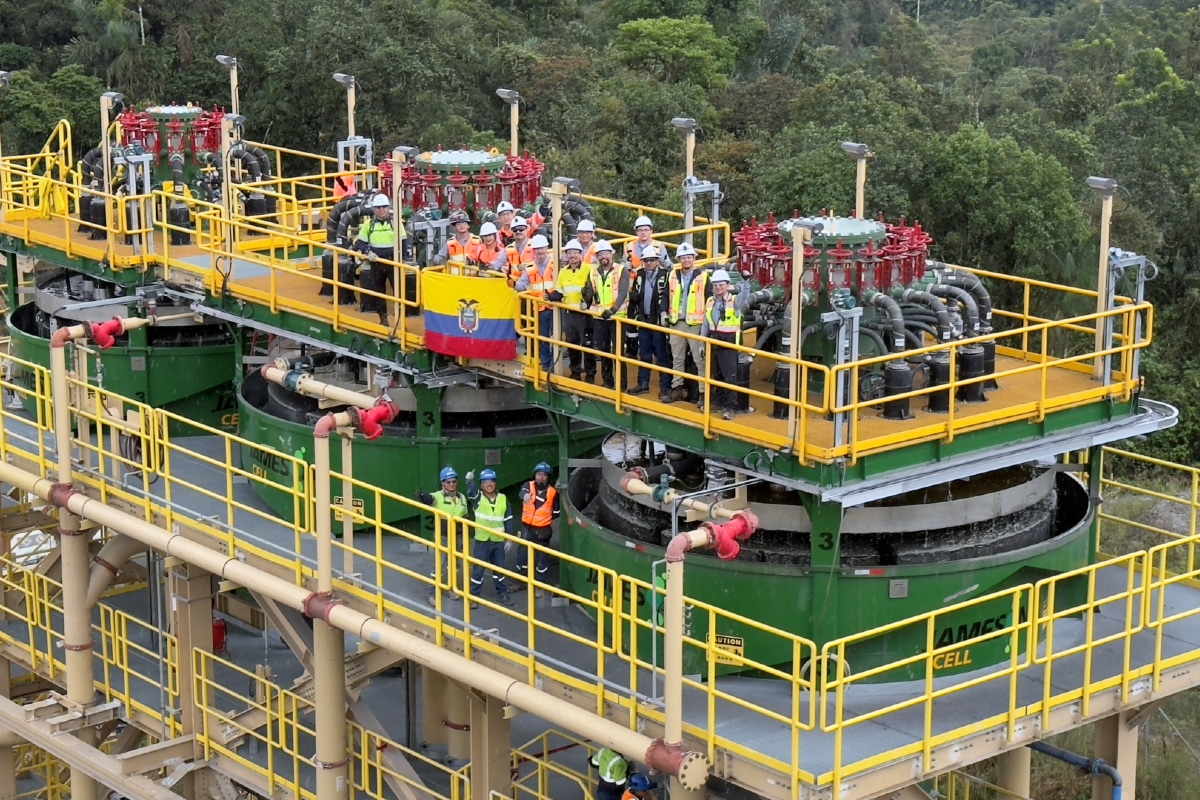
Glencore Technology is pushing its Jameson Cell from traditional cleaner/scavenger roles into primary rougher flotation duties to lift recovery and cut energy use in constrained concentrators. Recent installations, including at Lundin Gold’s Fruta del Norte plant in Ecuador, use the cell’s downcomer-based, high-intensity aeration and small footprint to debottleneck existing rougher banks without major civil works. For plant designers, this signals growing interest in retrofitting compact, low-maintenance flotation units to handle higher throughputs within fixed grinding and tailings capacities.
Trilogy Metals’ Ambler Metals JV has triggered federal permitting for the Arctic copper‑zinc‑lead‑gold‑silver project in Alaska by filing a Clean Water Act Section 404 application and will seek FAST‑41 status to compress timelines for the 13‑year mine outlined in its 2023 feasibility study. The 35.7 million‑tonne indicated resource grades 2.98% Cu, 4.09% Zn and 0.79% Pb, supporting projected annual output of 149 million lb copper and 173 million lb zinc, with capex of about $1.3 billion and an after‑tax NPV8 of $1.5 billion. A fully financed 2026 field season will drill 40–45 holes over at least 5,650 m for final engineering and geotechnical design, while the 340‑km Ambler Access Road and nearby Bornite deposit (1.9 billion lb Cu over 17 years) remain central to a potential 30+‑year district‑scale development.
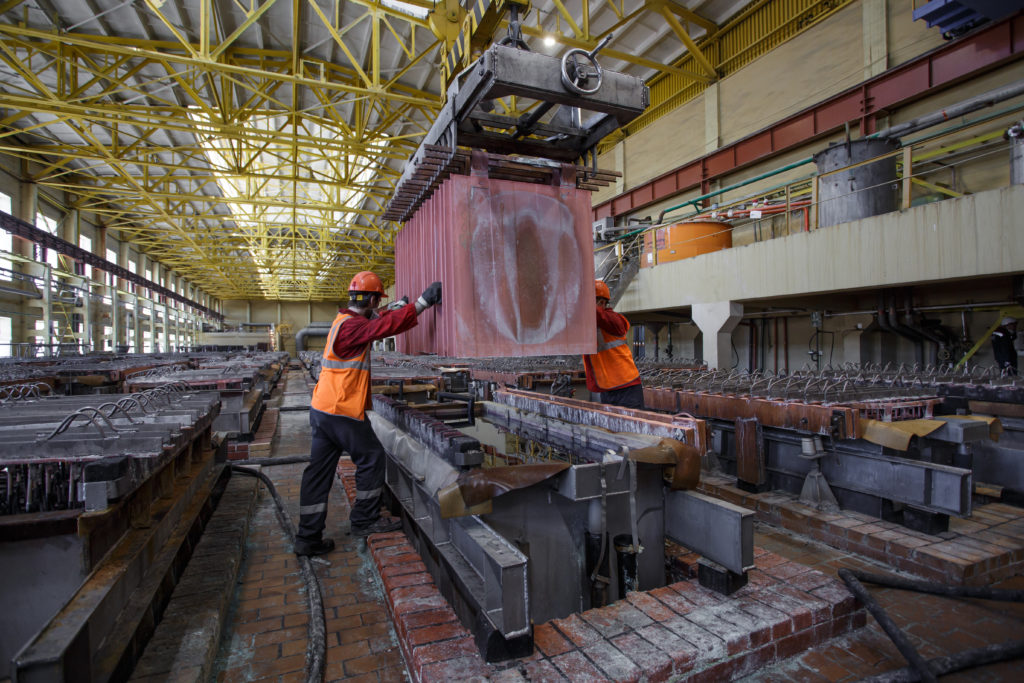
Copper is trading above $13,200/t after briefly topping $13,300, with four consecutive weekly gains driven by sulphuric acid shortages from the Strait of Hormuz closure and China’s ban on acid exports from 1 May, which affects about one-fifth of primary refined copper output. Goldman Sachs is holding its 2026 average price forecast at $12,650/t despite a projected 490,000 t surplus, warning that extended disruptions could cut 125,000 t of DRC production and put 200,000 t in Chile at risk, particularly SX-EW operations producing 1.125 Mt. Commodity trader Traxys, led by CEO Mark Kristoff, is more bullish, targeting $15,000/t within 24–36 months.
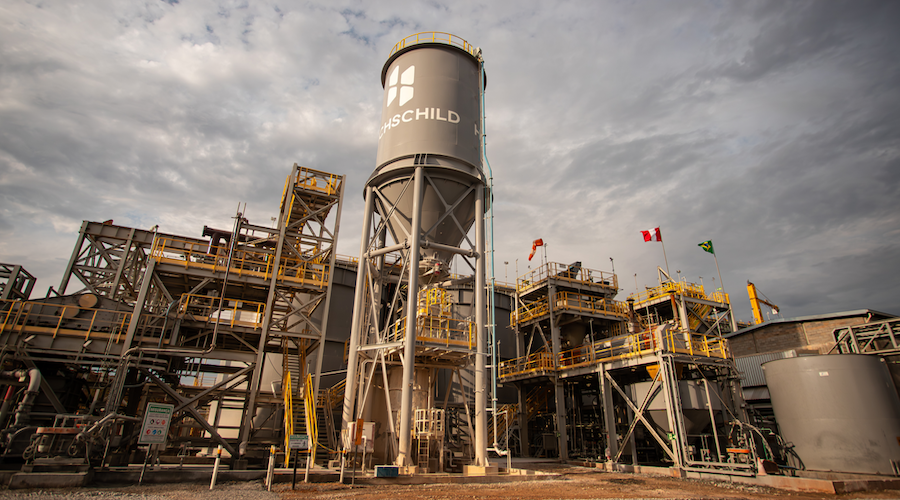
Hochschild Mining shares rose over 3% to 663.5p after first-quarter attributable production reached 75,600 gold-equivalent oz, beating BMO’s 69,200 oz estimate and supporting reaffirmed 2026 production and cost guidance. Average realised gold price jumped to $4,471/oz from $2,708 a year earlier, driving cash and equivalents to about $412 million and swinging the balance sheet from $23 million net debt at end-2025 to roughly $95 million net cash. Engineering work is advancing at the Monte Do Carmo gold project in Brazil and the Royropata silver project in Peru, despite Peru’s ongoing political uncertainty.
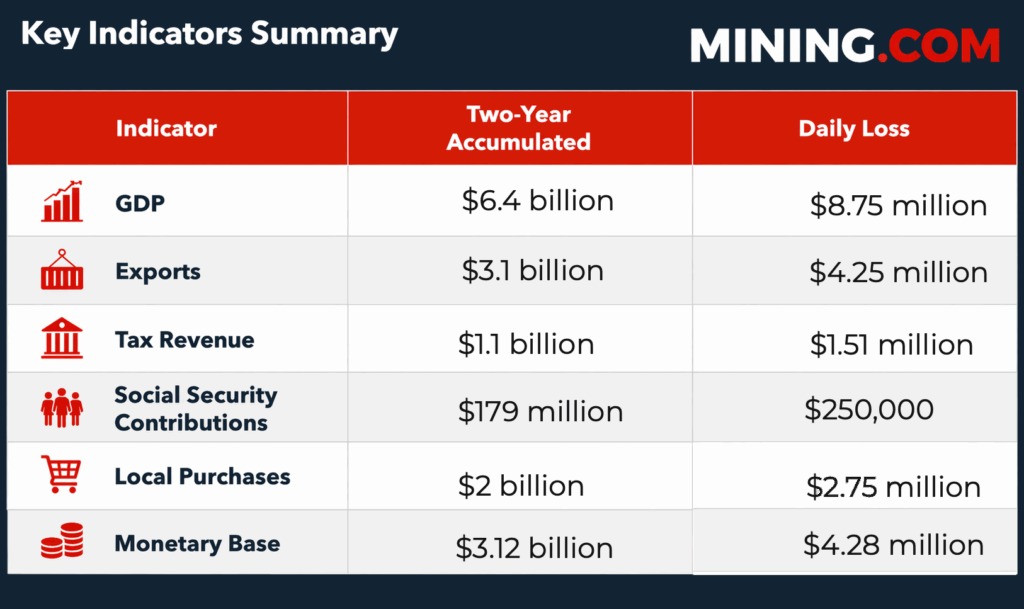
Panama’s 2023 shutdown of First Quantum Minerals’ Cobre Panamá open-pit copper mine has removed roughly 5% of national GDP and 7% of export earnings, with CONEP estimating about $2 billion in lost exports and more than 40,000 direct and indirect jobs affected across contractors, logistics and services. Government income from corporate tax, royalties and related payments has dropped, constraining infrastructure and social spending and exposing dependence on a few high-impact sectors. The government has now approved processing of on-site ore stockpiles to produce about 70,000 tonnes of copper over a year, but the loss of a mine that once supplied nearly 2% of global copper continues to weigh on long-term growth, FDI and industrial capability.
Gold prices stabilised on Wednesday, with spot gold briefly up 1.1% before settling just above $4,700/oz after US President Donald Trump announced an extended ceasefire with Iran, easing fears of further disruption in the Strait of Hormuz. Bullion is still down more than 10% since the war began nearly two months ago, but remains 8.5% higher year-to-date and about 60% above 2025 levels. DWS Group’s Darwei Kung reports “cleaner” positioning and an overweight stance in gold, while BMO notes three weeks of consistent ETF inflows but selling pressure in Asia around $4,850/oz.
Uzbekistan’s state uranium miner Navoiyuran has begun commercial production at its Qizilkok in-situ recovery project in the Navoi region, a 9,400-tonne reserve with a 15-year mine life and now the company’s third-largest operation after Sugrali and Uchkuduk. Qizilkok uses a low-reagent in-situ leaching process that relies on higher oxygen dosing rather than chemicals, which Navoiyuran says boosts recovery and can cut costs by up to threefold compared with conventional ISR. The new output supports Navoiyuran’s 7,000-tonne natural uranium production in 2025, a 35% year-on-year increase that cements its claimed sixth-place global ranking.
Quaise Energy is advancing Project Obsidian in Oregon, aiming to build the first superhot geothermal plant by drilling into rock above 300°C and delivering a baseload 50 MW from only a handful of wells by 2030. A modelling analysis presented at the 2026 Stanford Geothermal Workshop by senior mechanical engineer Daniel W. Dichter indicates higher subsurface temperatures could ultimately support 250 MW in phase two, with a regional goal of 1 GW. The confirmation well is due online later this year, with lab work at Oregon State University recreating extreme downhole geochemical conditions.
Canaccord Genuity forecasts a “material” lithium market deficit from 2026 through to at least 2035, as constrained mine investment fails to match EV battery demand growth even under scenarios of higher prices in 2027–28. The outlook assumes no further supply disruptions beyond the recent suspension of a major Chinese operation and Zimbabwe’s ban on raw lithium exports, both of which have already driven prices sharply higher. Analysts say “significant” long-term capital deployment into new hard-rock and brine projects will be required to stabilise supply.
Silver Crown Royalties has partnered with Emergency Material Services to expand a US-focused silver royalty platform using structured, non-dilutive financing instead of direct mine ownership. Capital will be deployed via net smelter return royalties, gross revenue royalties and silver streaming agreements across mining, recycling, smelting and refining, giving Silver Crown exposure to production and price upside while avoiding cost overruns and technical risk. For operators, the model provides upfront funding without issuing equity, which could be attractive for brownfield expansions and mid-tier producers needing balance-sheet flexibility.
A magnitude 7.7 offshore earthquake struck northern Japan on 20 April 2026, generating initial tsunami waves up to 0.8 m and triggering warnings for possible 3 m run-up along the Pacific coast, rapid evacuations and temporary suspension of Shinkansen sections due to power loss. Inspections at Fukushima Daiichi and Fukushima Daini confirmed no operational abnormalities, with vertical evacuation routes enabling staff to move from seawall zones to elevated safe areas within minutes. For geotechnical and coastal engineers, the event tests post-2011 Tohoku upgrades, exposing ongoing overtopping risk and the need for conservative coastal defence design, redundant power and tightly integrated tsunami warning links.
A landslide in northern Peru has forced the evacuation of more than 170 residents after continued ground movement destabilised a hillside settlement, with local authorities warning the slope remains active and at risk of further failure. Civil defence teams report tension cracks and progressive deformation upslope of the initial slip, prompting a red alert and temporary closure of nearby access roads. Geotechnical teams are now monitoring displacement and rainfall, with short-term controls focused on exclusion zones rather than immediate slope stabilisation works.
Syntax has completed an SAP S/4HANA-based transformation for Rio2 Limited, creating a single digital core to manage construction, production, maintenance and finance at the Fenix gold mine in Chile. The cloud-hosted system integrates mine planning, procurement and asset management workflows, replacing multiple legacy tools and spreadsheets as the project moves from build-out to steady-state operations. For engineers, the platform should tighten cost control on earthworks and plant upgrades, standardise maintenance data for mobile and fixed assets, and simplify scaling as Fenix ramps up.
A new highwall mining machine from Gainwell Engineering was inaugurated on 19 April 2026 at the Sharda Open Cast Mine in SECL’s Sohagpur Area, adding to Coal India’s growing fleet of highwall units. SECL has used highwall mining since the early 2010s, applying the method to extract residual coal from exposed highwalls where dragline or shovel–dumper operations have reached economic or geotechnical limits. The additional unit should increase recovery from existing highwalls while deferring new box-cutting and overburden removal.
Engineering firm Salko UK has secured a 12‑month contract extension with Redpath Deilmann to continue supplying mechanical labour at Anglo American’s Woodsmith polyhalite mine in North Yorkshire, set to become Europe’s deepest mineshaft. A dedicated Salko team will support ongoing shaft and materials-handling installations, working alongside Redpath Deilmann’s specialist sinking crews. The extension signals continued demand for experienced mechanical contractors as Woodsmith advances critical underground infrastructure for large-scale polyhalite extraction.
Cleanova has launched the patent-pending OMNI™ feed interface system, targeting slurry entry as a key bottleneck in filter press performance and designed for universal compatibility across existing press designs. By re-engineering the feed zone rather than the plates or cloths, OMNI™ aims to improve cake formation, reduce cycle time and cut energy use in high-throughput dewatering circuits. The system is positioned for brownfield retrofits in tailings, concentrate and industrial mineral applications where press capacity is constrained by feed distribution rather than installed filtration area.
Approval of Watkin Jones’ 484‑bed purpose‑built student accommodation on Malago Road, Bristol, at Gateway 2 allows construction, which started in early 2026, to move into the next phase on the brownfield site 100 metres from Bedminster station. The three‑block scheme, funded via a joint venture with Maslow Capital, will provide studios and 30 non‑ensuite rooms, partly under a nomination agreement with the University of Bristol for its Temple Quarter campus. Target ratings are BREEAM Excellent, EPC B and WiredScore Platinum, with completion aimed for the 2028 academic year.
Colliers has appointed chartered quantity surveyor Ben Hulland as a director in its cost management team to strengthen delivery on large, complex, multi-sector projects. Hulland brings more than 18 years’ experience as a project director at Quartz Project Services and Paragon Building Consultancy, with earlier roles at Turner & Townsend, Gleeds and Mace. His remit includes expanding Colliers’ cost management capability and developing internal talent, signalling continued investment in high-level commercial and cost planning expertise for major infrastructure and building programmes.