Geomechanics, Streamlined.
© 2026 Geomechanics.io. All rights reserved.
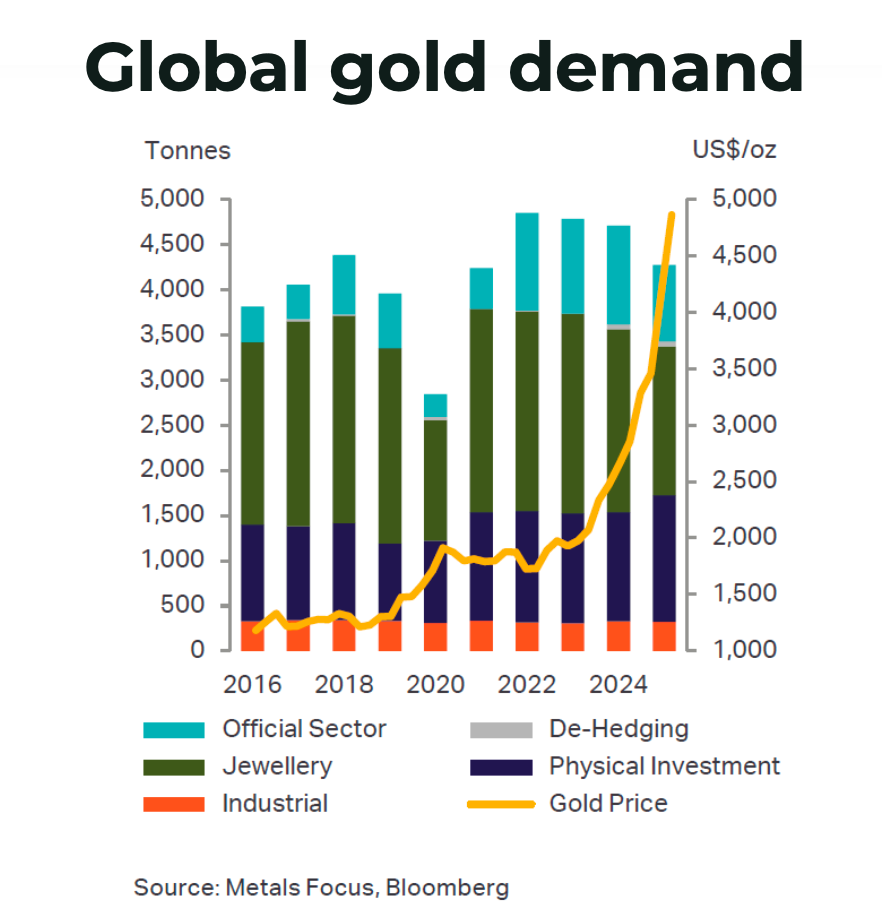
Gold prices are forecast by Metals Focus to average a record $4,920/oz in 2026, with total supply up 3.1% as mine production rises 2.4% to 3,907 tonnes and recycling grows 5.1%. Physical investment, which jumped 16% in 2025 and drove 803 tonnes of ETF inflows, is expected to overtake jewellery as the largest demand segment, while fabrication falls another 11% after a 19% drop to 1,646 tonnes last year. Central bank net purchases are seen staying high at 848 tonnes despite a 22% decline, reinforcing bullion’s role as a macro hedge.
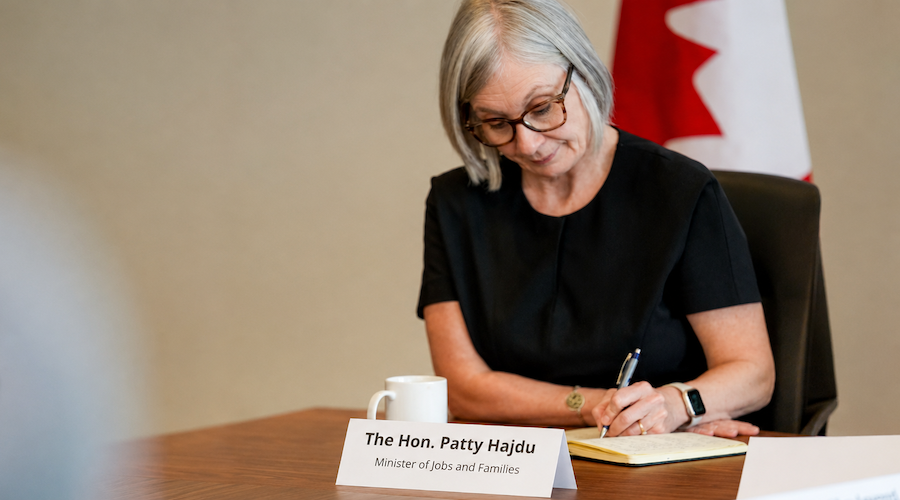
Canada has launched an industry-led Mining and Minerals Workforce Alliance, led by the Mining Industry Human Resources Council with Mining Association of Canada support, to tackle labour shortages across critical minerals, advanced manufacturing and major infrastructure projects. Backed by C$81 million over five years as one of six national workforce partnerships, the initiative targets a sector that contributed C$112 billion to GDP in 2024 and directly employs about 438,000 workers. Success hinges on converting employer–educator–Indigenous collaboration into concrete training, apprenticeship and recruitment pipelines for specialised trades, technical roles and remote operations.
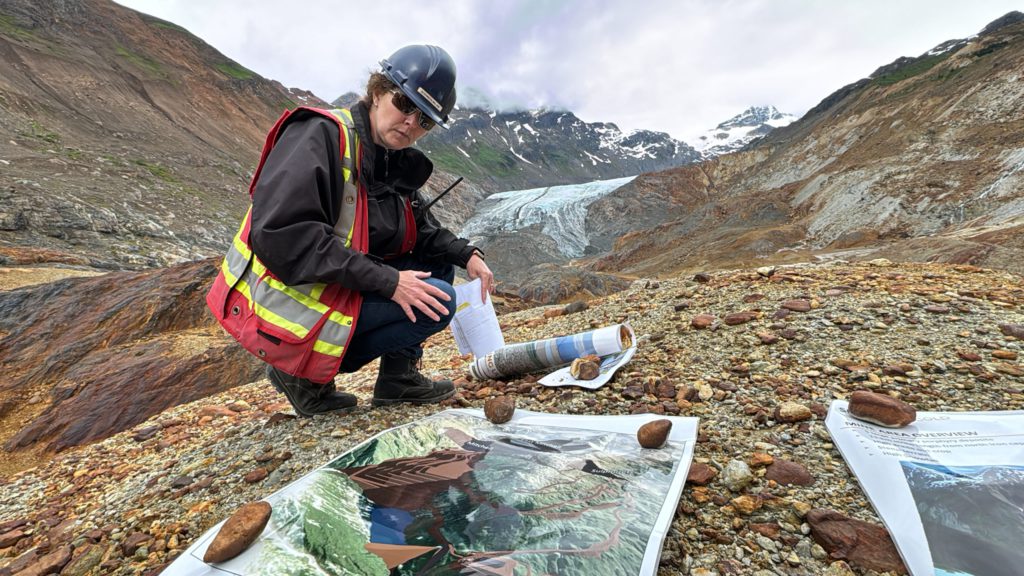
Seabridge Gold’s C$8.8 billion KSM project in B.C.’s Golden Triangle remains unbuilt 12 years after federal and provincial environmental approvals, despite 2.29 billion tonnes of reserves grading 0.64 g/t gold and 0.14% copper, as a 12.5 km Mitchell Treaty Tunnel segment crosses Tudor Gold’s Treaty Creek mineral claims. The province has invested C$1.2 billion in early works at KSM and designated it a priority, while Tudor advances a PEA on the 912.3 million tonne Goldstorm deposit (0.85 g/t Au, 5.07 g/t Ag, 0.15% Cu). Parallel federal reforms, including proposed one-year review timelines and ministerial approvals for fish-bearing tailings impoundments and Navigable Waters permits, aim to cut years from major mine permitting but leave DRIPA-related Indigenous rights risks unresolved.
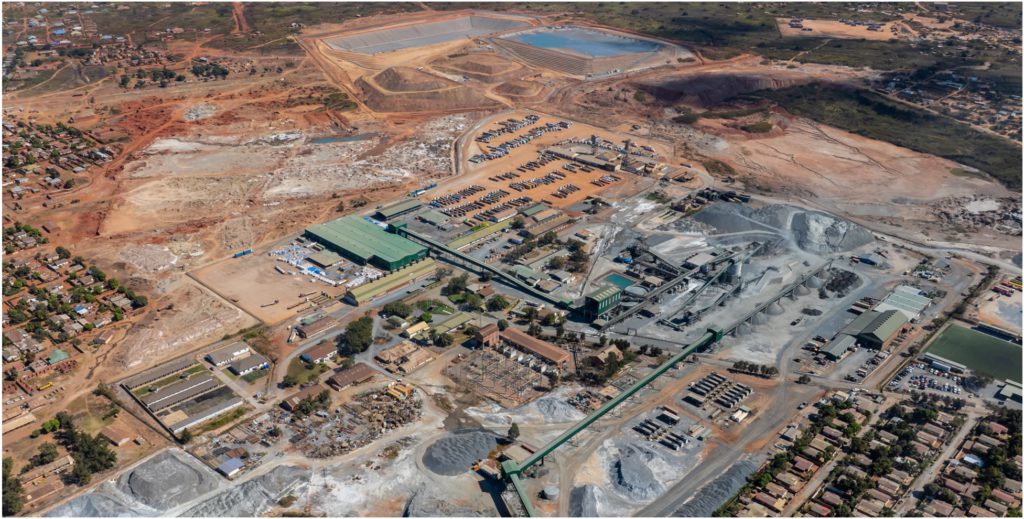
Ivanhoe Mines’ Kipushi operation in the DRC set a new monthly record in May with 25,677 tonnes of zinc concentrate, driven by 72,003 tonnes milled at 36.2% Zn feed grade and 93% recovery, putting year-to-date output at about 110,000 tonnes. At this run rate, Kipushi would rank as the world’s fourth-largest zinc producer in 2026, within guidance of 240,000–290,000 tonnes, while a second tailings storage facility is 90% complete with first deposition targeted for October 2026. The performance comes as LME zinc trades near $3,630/t, close to a four-year high.
Operations at Orla Mining’s Camino Rojo open-pit, heap-leach gold mine in Zacatecas are set to restart within hours after talks with Mexico’s Department of Federal Labour Conciliation and union leaders deemed this week’s production-blocking protest illegal. The stoppage began Monday over disputes on a worker productivity bonus and statutory profit-sharing, temporarily halting output at a site expected to produce 110,000–120,000 oz. of gold in 2026 after delivering 96,764 oz. in 2025. Orla, valued at about C$5.5 billion with shares rebounding 3.5% to C$16.09, is proceeding with its planned $18.5 billion merger with Equinox Gold.
Silver X Mining has acquired Barrick’s Lily 19 concession, giving it 100% ownership of the early-stage Ccasahuasi gold project in Peru for US$30,000 plus a net smelter return royalty with partial buyback. Ccasahuasi, located 1 km from the producing Tangana mine and within the 204.7 sq. km Nueva Recuperada land package, hosts an inferred 42,303 oz gold resource defined by just under 1,000 m of drilling over a 13.5 sq. km gold system. Limited drilling to date includes three holes with >26 m intercepts above 0.7 g/t Au and a 40 m-thick mineralised body interpreted to extend toward Tangana.
EnergyX and Wildcat Discovery Technologies plan a more than $230 million lithium iron phosphate (LFP) cathode active material plant in Hooks, Texas, co-located with EnergyX’s Project Lonestar lithium brine facility over 50,000 acres of Smackover formation mining rights. Phase 1 design capacity is about 15,000 tpa of LFP cathode material on a 330-acre TexAmericas Center site with rail access and existing utilities, targeting energy storage, EV, and defence platforms. EnergyX will supply discounted, price-banded lithium carbonate, while Wildcat brings a high-throughput cathode R&D platform and roadmap for higher-density, cobalt- and nickel-free chemistries.
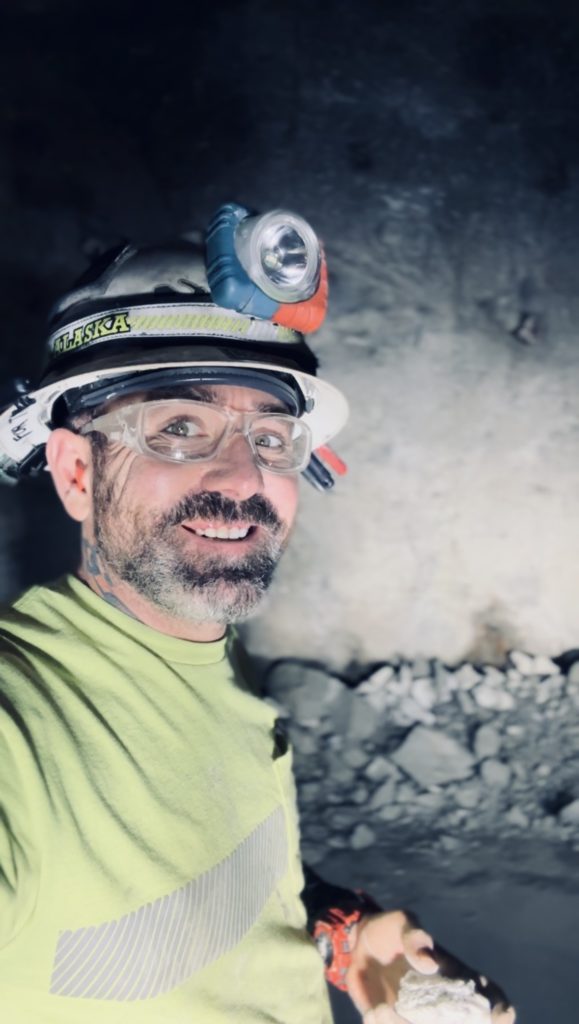
Mining influencers on TikTok and other platforms are rapidly building audiences, with Colombian mining and metallurgy student “Paula Mineria” reaching 110,600 TikTok followers and 1.6 million likes through site-visit videos filmed at operations in Colombia, Japan, Chile, Panama, Canada and the US. Underground miner Cory Rockwell has amassed 117,100 followers and 5 million likes by posting detailed clips of scaling walls, refuge chambers and explosives rounds at sites including Barrick’s Turquoise Ridge and Coeur’s Kensington gold mine. Their content, often company-approved and safety-PPE compliant, is being used by operators and recruiters to counter negative perceptions and showcase modern, regulated mining work.
Carlyle has agreed to sell Flender, the Bocholt-headquartered global supplier of mechanical drive technology for conveyors, mills and hoists, to Triton Fund 6 advised by Triton Partners, with closing targeted for Q4 2026 subject to regulatory approvals. Flender’s portfolio spans gear units, couplings and condition monitoring systems widely used in high-torque mining applications, including overland conveyor drives and grinding mill gearboxes. The change of ownership signals continued private equity interest in critical drivetrain OEMs, with potential implications for service models and aftermarket support at large mine sites.
PT Freeport Indonesia’s Grasberg underground complex has received its 15th Caterpillar R2900 XE diesel-electric LHD from dealer Trakindo, consolidating one of the world’s largest fleets of Cat underground loaders at a single copper-gold operation. The 15 t-class R2900 XE couples a diesel engine to an electric drive train, cutting fuel burn and heat load versus conventional mechanical-drive R2900 units, which is critical for deep, high-production stopes. New deployments in the Democratic Republic of the Congo signal growing interest in diesel-electric loading for African hard-rock mines facing ventilation and power-cost constraints.
BHP and the Global Centre for Maritime Decarbonisation have bunkered a B100 biodiesel blend, derived from used cooking oil and waste animal fats, into a BHP‑chartered bulk carrier on an existing iron ore route. The pilot will test combustion performance, fuel stability and engine compatibility of the multi‑feedstock fuel in a conventional marine diesel system without hardware modifications. Results will inform future large‑scale deployment of drop‑in biofuels across BHP’s dry bulk fleet and similar long‑haul iron ore supply chains.
Sandvik has secured a 45-unit underground fleet order from Chinese contractor JCHX Mining Management for deployment at MMG’s Khoemacau Copper Mine in Botswana, booked in Q2 2026. The package includes Toro LH621i loaders, Toro TH663i trucks and Sandvik DD422i development drills, giving JCHX a fully integrated load–haul–drill fleet on a single automation-ready platform. The deal signals continued investment in high-capacity, intelligent equipment at Khoemacau, with implications for fleet standardisation, digital maintenance planning and future autonomous operation.
Metso has launched three new primary crushers – the Primarok™ gyratory, Optirok™ jaw and Durarok™ sizer – targeting high-capacity, modern mining plants. The range combines large primary throughput with designs aimed at safer maintenance, such as improved access to wear parts and reduced need for manual intervention around the crushing chamber. For mine planners and plant engineers, the trio broadens options for matching crusher type to ore characteristics and downstream circuit design without changing supplier.
Weir has relocated its Perth Minerals Division operations to a new 14,500 sq.m purpose-built facility in Hazelmere, marking a major expansion of its Western Australia footprint. The larger site increases capacity to service and rebuild critical mining equipment such as pumps, crushers and slurry handling systems, enabling shorter overhaul and refurbishment cycles for iron ore and gold operations. Faster turnaround on heavy equipment maintenance is likely to reduce downtime risk for remote WA mines that rely on tight shutdown windows and high utilisation rates.
Cobre Las Cruces S.A.U. has completed its sale from First Quantum Minerals to Global Panduro, controlled by Resource Capital Funds, in a deal valued at up to US$190 million, clearing the way for the Polymetallurgical Refinery (PMR) project near Seville. The PMR is designed to process complex polymetallic ores on site rather than exporting concentrates, shifting the operation from conventional open-pit copper cathode production towards an integrated hydrometallurgical flowsheet. For engineers, the ownership change signals continuity for permitting, plant design and potential underground transition planning at this brownfield Iberian Pyrite Belt asset.
Volvo Autonomous Solutions and Boliden have completed an autonomous haulage project for tailings dam construction at the Garpenberg zinc mine in Sweden, the first deliverable under their 2023 memorandum of understanding. Volvo’s autonomous haul trucks operated on a defined haul road between the open pit and the tailings facility, integrating with existing conventional fleets and site traffic management. The trial provides data on cycle times, berm and ramp design, and interaction rules needed to scale autonomous haulage for future dam lifts and other overburden movements on Boliden sites.
Epiroc has secured an order from Heidelberg Materials to deploy its LinkOA autonomous haulage system on driverless haul trucks at an Australian quarry, extending the platform from large open-pit mines into the quarrying and aggregates sector. The project will adapt LinkOA’s mine-proven fleet management, collision avoidance and traffic control capabilities to shorter haul cycles, tighter geometries and mixed-traffic quarry conditions. For quarry operators, this signals accelerating interest in OEM-agnostic autonomy retrofits on existing haul fleets to cut operating costs and manage labour constraints.
Alkane Resources has started diamond drilling at the historic Nagambie mine in Victoria under an earn-in agreement with Nagambie Resources, targeting expansion of the antimony–gold resource. The initial program covers mining licence MIN 5412 and exploration licence EL 5511, marking the first exploration phase that could lead to a formal joint venture. For geologists and mine planners, the work will refine antimony–gold grade distribution and geometry, informing potential underground designs and metallurgical testwork for complex Au–Sb mineralisation.
Medallion Metals has reported further high-grade intercepts at the Lounge Lizard deposit within its Forrestania gold project in Western Australia, including 11m at 6.94g/t gold from drilling beneath and adjacent to the historical open pit. The results extend mineralisation down-dip and along strike, reinforcing the potential to transition the pit to an underground operation and leverage existing surface disturbance. For mine planners and geotechs, the data support re‑evaluating pit wall designs, underground access geometry and cut-off grades for a possible restart scenario.
Saturn Metals has increased the Apollo Hill gold project mineral resource in Western Australia by 590,000 ounces to 2.83 million ounces, now reported as 174 million tonnes at 0.51g/t Au. The estimate is reported above a 0.15g/t cut-off, indicating a large, low-grade open-pit style inventory typical of bulk-tonnage WA gold systems. For mine planners and geotechs, the scale and grade profile point to high-volume, low-grade processing strategies and extensive pit slope optimisation work in weathered Archean host rocks.
Emerald Resources is backing the creation of Manda Resources, a new north Queensland explorer that will control a 1.33Moz gold resource and a consolidated package of gold–antimony assets. The vehicle will combine projects including Pacgold’s Alice River and other north Queensland tenements into a single portfolio targeting resource growth and new discoveries. For miners and contractors, the move signals potential future demand for drilling, resource definition, and mine studies focused on structurally controlled gold and associated antimony mineralisation in the region.
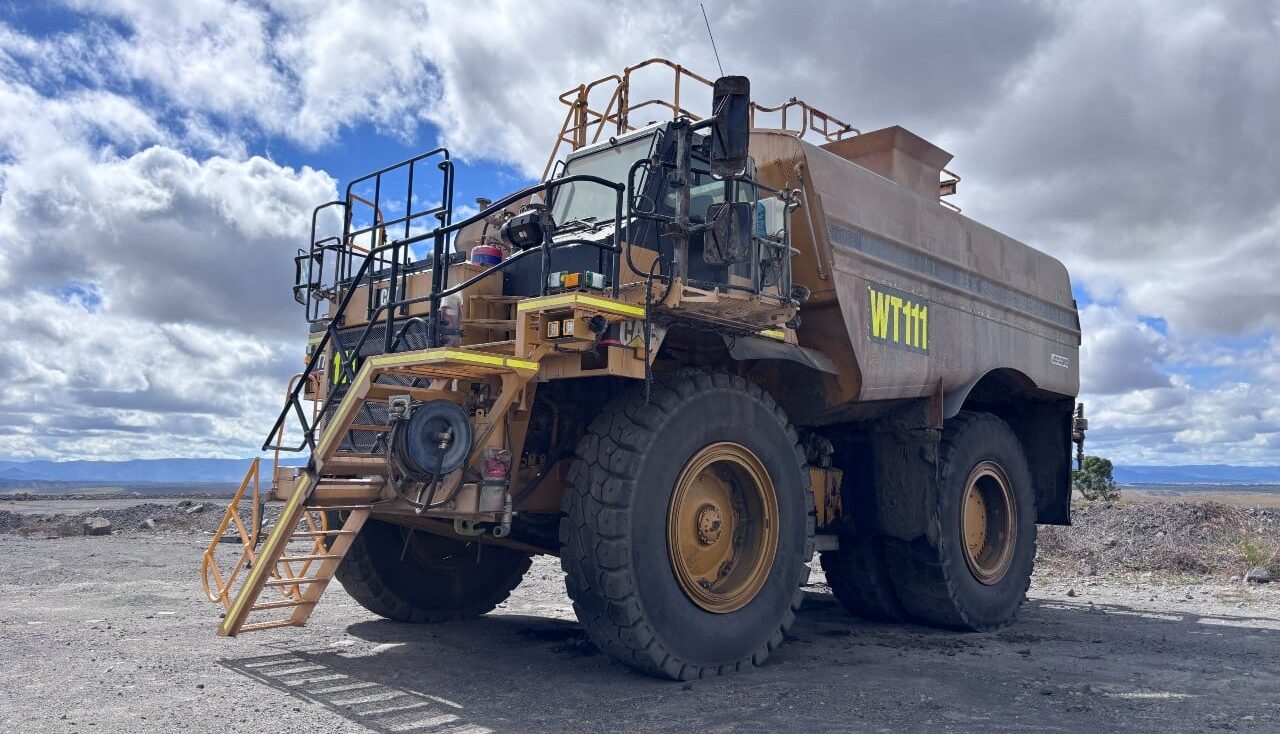
Slattery Auctions is staging a central Queensland major used mining equipment sale featuring heavy machinery assets suited to rebuild programmes, on-site maintenance workshops and access to Tier-1 parts suppliers. Key lots include large mobile plant such as a 2004 Cat 777D water truck, positioned for heavy component recovery rather than immediate deployment. The event offers mining and civil contractors a route to lower capex on haulage and support fleets by sourcing rebuildable units and OEM-grade components through a single auction process.
Surge Battery Metals has secured at least C$30 million in a private placement at C$0.60 per unit, with C$0.90 warrants and an upsize option to C$36 million, to advance its Nevada North lithium project (NNLP) and support a planned Nasdaq listing as Lithium X2 Mining. The funding, led by SAF Group’s Brian Paes-Braga and Hess Capital’s Michael Hess, is expected to leave about C$70 million in treasury, fully funding NNLP’s 5,265-hectare, 685-claim clay-hosted resource of 10.5 million tonnes LCE. A 2023 PEA outlines a 42-year operation producing 86,300 tonnes LCE per year, with after-tax NPV of $9.17 billion, 22.8% IRR and $5.32 billion capex.
Glencore’s Cerrejón coal complex in La Guajira, Colombia has restarted after a 10‑day rail blockade to Port Bolivar forced a full shutdown and force majeure, with operations resuming at 18:00 on 2 June once critical supplies were restored. The mine has already faced nearly 80 blockades this year and recorded 333 in 2024—equating to 135 lost operating days—contributing to a 12% year‑on‑year drop in 2024 output to 16.8 Mt and plans to cut a further 5–10 Mt/y amid Atlantic market oversupply. Persistent community‑driven rail disruptions and uncertainty over a temporary 1% export tax are now central design and risk factors for mine planning, logistics resilience and investment decisions across Colombia’s coal sector.