Geomechanics, Streamlined.
© 2026 Geomechanics.io. All rights reserved.
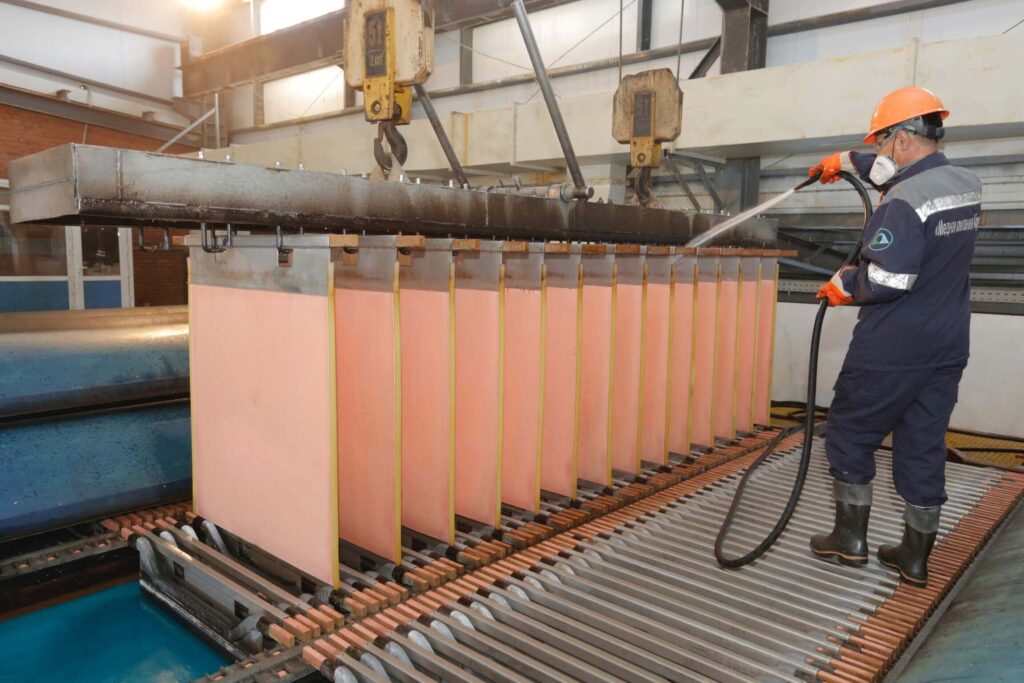
Central Asia Metals increased January–May output to 5,141 tonnes of copper from the Kounrad dump-leach operation in Kazakhstan and 7,566 tonnes of zinc in concentrate from the Sasa mine in North Macedonia, while benefiting from average realised prices of $13,076/t for copper (up ~40%) and $3,299/t for zinc (up 19%). Historically low, now negative, lead treatment charges supported Sasa revenues despite slightly lower realised prices on 11,142 tonnes of lead concentrate. The group maintains 2026 guidance of 12,000–13,000 t Cu, 18,000–20,000 t Zn and 26,000–28,000 t Pb, and plans to acquire Cygnus Metals’ high-grade copper-gold project in Quebec.
Chile’s Sierra Gorda mine and BHP’s Spence operation have signed a memorandum of understanding to explore joint supply-chain and operating-process initiatives in the Sierra Gorda district, targeting economies of scale as both operations confront declining grades and reduced output. Spence is progressing a US$600 million concentrator expansion, including a new flotation circuit to manage ore variability, after producing 254,795 tonnes of fine copper in 2025. Sierra Gorda plans an SX-EW heap-leach project for about 30,000 tonnes of copper cathode per year over 10 years, alongside a US$400 million tailings facility upgrade and a potential US$700 million fourth grinding-line expansion.
A mass shooting that killed 12 people in the Cleveland settlement, about 6 km east of central Johannesburg, is intensifying scrutiny of violent illegal gold mining networks around the city. At least 10 gunmen reportedly moved through the informal settlement on Tuesday night, firing at multiple locations before fleeing in a white vehicle; 11 victims died on site and one later in hospital, with no arrests yet made. The area hosts extensive zama zama activity around abandoned workings, where rival groups contest residual gold, prompting recent army deployments and weapons seizures.
Schneider Electric and Torngat Metals have signed a non-binding MoU to develop an integrated rare earths value chain centred on the Strange Lake project in Nunavik, with supporting infrastructure in Labrador and a planned separation plant at Sept-Îles, Quebec. Strange Lake’s B-zone hosts indicated resources of 278.1 million tonnes at 0.93% TREO, 1.92% ZrO₂ and 0.18% Nb₂O₅, plus 214.4 million tonnes inferred at 0.85% TREO, notable for heavy rare earths dysprosium and terbium. The partnership will leverage Schneider’s electrification, automation and digital systems to design “next-generation” mining and processing operations.
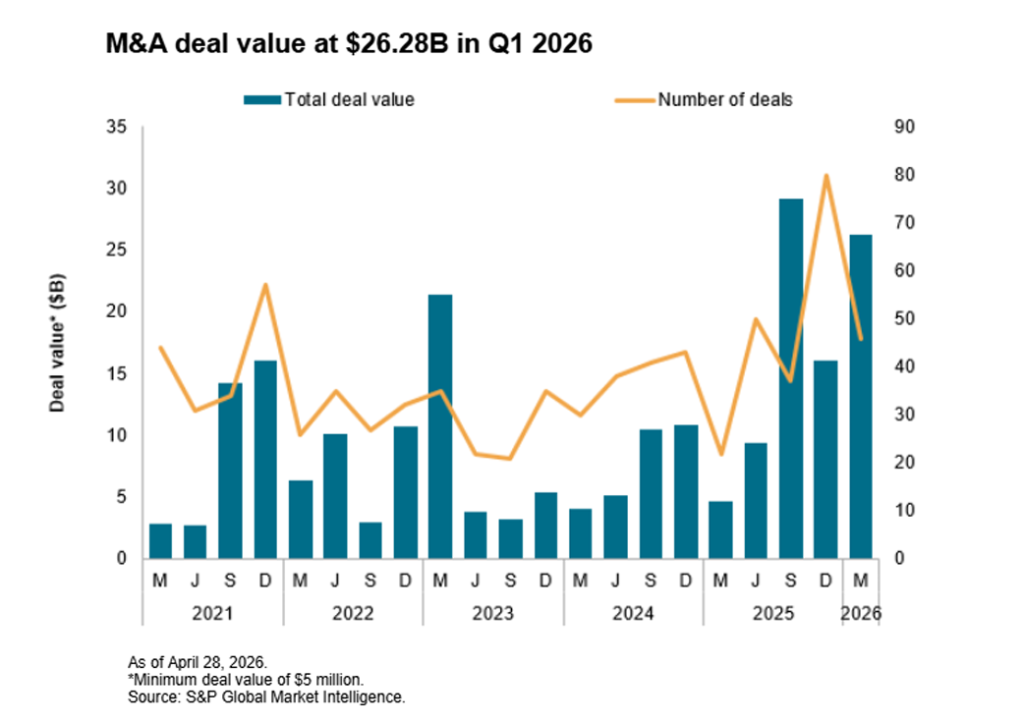
Global mining M&A in Q1 2026 reached US$26.28 billion, up 63% quarter-on-quarter and the second-highest quarterly value since 2013, driven by corporate-level deals such as the US$10 billion acquisition of BlueScope Steel after S&P Global began including steel transactions. Deal volume slumped to 46 transactions, roughly half the December quarter, with 30 company acquisitions versus 16 asset purchases as miners chase immediate scale and long-term supply. Asset deals totalled US$3.35 billion, 221% higher year-on-year, supported by the US$1 billion sale of the Çöpler gold mine in Turkey and continued focus on copper-gold targets.
MP Materials’ chief operating officer Michael Rosenthal has increased his stake in the NYSE-listed rare earth producer, buying 10,000 shares at US$54.30 each via his family trust, bringing his holding to 136,622 shares. The move comes as MP Materials, owner of the Mountain Pass mine in California – currently the only operating rare earths mine in the US – trades around US$53 per share with a market capitalisation of about US$9.5 billion. The stock has halved from its October peak of US$100.25 but is nearly double its level a year ago, supported by a US$400 million Department of Defense equity investment.
Weir has secured a multimillion‑dollar contract with a major Chinese non‑ferrous metals company to supply WARMAN® pumps for the Phase III expansion of a Xizang copper mine. The package comprises two WARMAN MCR® 450 cyclone feed pumps and nine WARMAN AHPP 20/18 tailings transfer pumps serving the grinding circuit and tailings system. For engineers, the deal signals continued preference for high‑capacity slurry and tailings pumping solutions in large‑scale Chinese copper concentrator expansions.
Bradken has expanded its MillSafe® range with a new MillSafe Worn Liner Removal System developed jointly with Russell Mineral Equipment (RME) to automate and control the extraction of worn mill liners during relining. The system integrates with RME’s existing relining technologies to handle liners remotely rather than relying on manual oxy-cutting and cranage close to the charge. For operators, the key gains are reduced exposure of crews inside large SAG and ball mills, shorter shutdown durations, and more predictable relining schedules.
GR Engineering Services has been named preferred EPC contractor by Venturex Sulphur Springs, a Develop Global subsidiary, for the 1.5 Mt/y Sulphur Springs copper-silver-zinc processing plant 144 km south-east of Port Hedland in Western Australia. The appointment follows Develop’s final investment decision on the project, clearing the way for detailed engineering, procurement and construction planning. Plant design and construction choices will be critical for handling polymetallic sulphide ore and managing remote-site logistics in the Pilbara environment.
Danfoss Scotland has validated its Dextreme Max digital hydraulic architecture on a 30 t battery-electric excavator, cutting power consumption by 35% under test conditions using a £4.29 million UK Government grant. The system replaces conventional valve-controlled hydraulics with digitally controlled flow and pressure management, reducing throttling losses and improving overall drivetrain efficiency. For mine operators, the results point to smaller or fewer battery packs for the same duty cycle, longer run time per charge, and lower heat rejection demands on cooling systems.
DHL Supply Chain Australia has been appointed strategic 3PL partner for Metso, taking over warehousing operations from Berrinba in Brisbane to handle inbound logistics, storage and outbound movement of heavy equipment and mineral processing machinery for Queensland mines. The Berrinba facility will act as a central hub for crushers, screens, mill components and wear parts, consolidating inventory closer to major coal and metals operations in the Bowen and Surat basins. Faster parts availability and streamlined freight routing should cut unplanned downtime risk and simplify maintenance planning for Metso’s mining customers.
Thiess has extended its joint operating agreement with explosives supplier AECI to December 2030, covering blasting services and product supply at the Lake Vermont, Olive Downs Complex and Mount Pleasant coal operations in Australia. The deal secures continuity of bulk explosives, initiation systems and on-bench blasting support across multiple large-scale open-cut pits in Queensland and New South Wales. For mine planners and drill-and-blast engineers, the extension reduces supply risk for explosives and maintains consistent blast performance parameters over the medium term.
Proactive maintenance strategies from Multotec are extending the service life of process samplers and high‑G centrifuges that are critical for representative sampling, solid–liquid separation and dewatering in mineral processing plants. The company stresses scheduled inspections of cutter edges, drive assemblies and wear liners on samplers, and close monitoring of vibration, bearing condition and bowl wear on centrifuges to avoid unplanned stoppages. For plant engineers, the message is to treat these units as production-critical assets, integrating condition monitoring and OEM spares into planned shutdowns.
The Northern Territory Government has committed a record $4.09 million in co-funding to 34 exploration projects under Round 19 of its Geophysics and Drilling program, signalling strong support for new lithium, gold and critical mineral targets. NT Minister for Mining and Energy Gerard Maley announced the funding alongside Tivan Limited executive chairman Grant Wilson and Prodigy Gold managing director Mark Edwards, emphasising greenfields drilling and advanced geophysics. For geoscientists and drill contractors, the grants reduce early-stage risk and should accelerate data acquisition across underexplored basins and mineral provinces.
Core Lithium has signed a second offtake deal with Glencore to sell lithium fines from stockpiled material at its Finniss project in the Northern Territory, providing additional cashflow ahead of a planned restart. Managing director Paul Brown said the agreement strengthens liquidity as ramp‑up activities progress, effectively monetising low‑grade or previously marginal fines. For mine planners and process engineers, the move signals continued reliance on stockpile reprocessing and fines marketing to bridge revenue gaps during restart and commissioning phases.
Aeris Resources has reported further high-grade gold intercepts at its Golden Plateau deposit in Queensland, including 14.2m at 9.1g/t from 172.2m and 2.5m at notably higher grades in the Main lode, with additional strong hits in the North and East lodes. The mineralisation extends across multiple lodes at depth, reinforcing the potential for underground mining scenarios rather than shallow open-pit only. For geotechs and mine planners, the continuity of high-grade zones at >170m depth will drive focus on stope design, ground support and costed access development.
EQ Resources has agreed to acquire Sunshine Metals’ Hodgkinson tenement package for $250,000, adding six exploration permits covering about 365km² directly adjacent to its Mt Carbine tungsten mine in far north Queensland. The ground is described as relatively unexplored and contiguous with existing mining leases, giving EQ Resources scope to extend known tungsten mineralisation and test regional structures without relocating processing infrastructure. For geologists and mine planners, the deal materially enlarges the brownfield exploration footprint around an established tungsten operation at minimal upfront cost.
Komatsu is expanding its western US support network with a new mining parts distribution facility in Mesa, Arizona, aimed at boosting regional availability of components for large haul trucks, loaders and drills. The site will serve dealers and mine operators across key copper and gold districts in Arizona, Nevada and neighbouring states, cutting lead times for critical items that currently ship from distant hubs. Faster delivery of high-wear parts such as GET, hydraulic components and drivetrain assemblies is intended to reduce unplanned downtime and improve fleet maintenance planning.
Remote control mining excavator specialist BuilderX, led by founder Shaolong Sui, argues that excavation—not haulage—has become the main bottleneck to further mine automation, even as autonomous haul trucks move from pilots to large fleets with clear ROI. Sui positions teleoperated and semi-autonomous excavators as the next step to unlock productivity gains where manned digging still constrains fully automated truck fleets. For mine planners and OEMs, the message is to prioritise interface standards, control latency, and operator ergonomics at the shovel face rather than only optimising haulage.
Eldorado Gold is committing a further C$20.6 million to Amex Exploration to restore its 27% stake, taking its total investment close to C$100 million as the Perron gold project in Quebec advances on the back of a strong April feasibility study. Perron’s stage-one plan outlines 147,000 oz/y gold output for five years at an all-in sustaining cost of $910/oz, 1.9 Mt of reserves grading 12.1 g/t at the Champagne zone, initial capex of C$193.9 million and a post-tax NPV5 of C$1.1 billion at $3,500/oz gold. The project is fully permitted for a 40,000-tonne bulk sample, is targeting toll milling at nearby facilities such as Eldorado’s Lamaque-Sigma complex, and has funding in place for up to 100,000 metres of drilling across the expanded 570 km² land package.
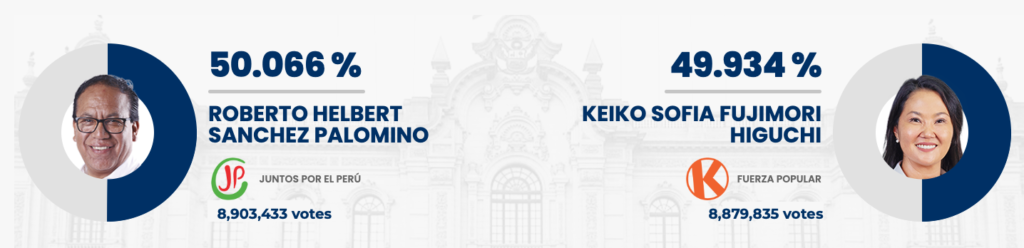
Peru’s presidential race remains effectively tied with 95.8% of ballots counted, as left-wing Roberto Sánchez edges Keiko Fujimori 50.0% to 49.9%, putting billions of dollars in mining investment in the world’s third-largest copper producer under scrutiny. Sánchez has pledged to rewrite the constitution, review mining tax agreements, phase out open-pit mining and potentially shorten terms for unused concessions, directly affecting operators such as Glencore, Anglo American, Freeport McMoRan, MMG and Southern Copper’s contested Tía María project. Fortescue’s recent C$139-million acquisition of Alta Copper’s Cañariaco project, planned at 140,000 t/y copper output, now faces a more uncertain regulatory outlook.
Rio Tinto is increasing annual contributions to its Rio Tinto Canada Fund by 30% to C$13 million, extending support for community, Indigenous and environmental projects nationwide, particularly around its Iron Ore Company of Canada operations in Labrador/Newfoundland and aluminium plants in Saguenay–Lac-Saint-Jean. Since 2008 the fund has channelled nearly C$190 million into more than 600 organisations, backing programmes in healthcare innovation, mental health, food security and environmental stewardship. The move tightens social licence and workforce links as Rio advances its Nemaska Lithium partnership at Whabouchi and RTIT titanium dioxide operations in Sorel-Tracy.
Sigma Lithium has overturned a lower-court ruling in Minas Gerais, removing a potential $10 million legal collateral linked to alleged irresponsible waste disposal at its Grota do Cirilo lithium operation near Aracuai. The appeals court relied on 12 months of independently collected dust, noise and vibration data from nearby communities, while still requiring Sigma to retain an independent technical advisory firm for ongoing environmental monitoring. The decision clears a key hurdle for expansion of Grota do Cirilo from 270,000 t/y to a contemplated 520,000 t/y of lithium oxide concentrate, underpinned by its Greentech plant’s 100% water reuse and zero-tailings flowsheet.
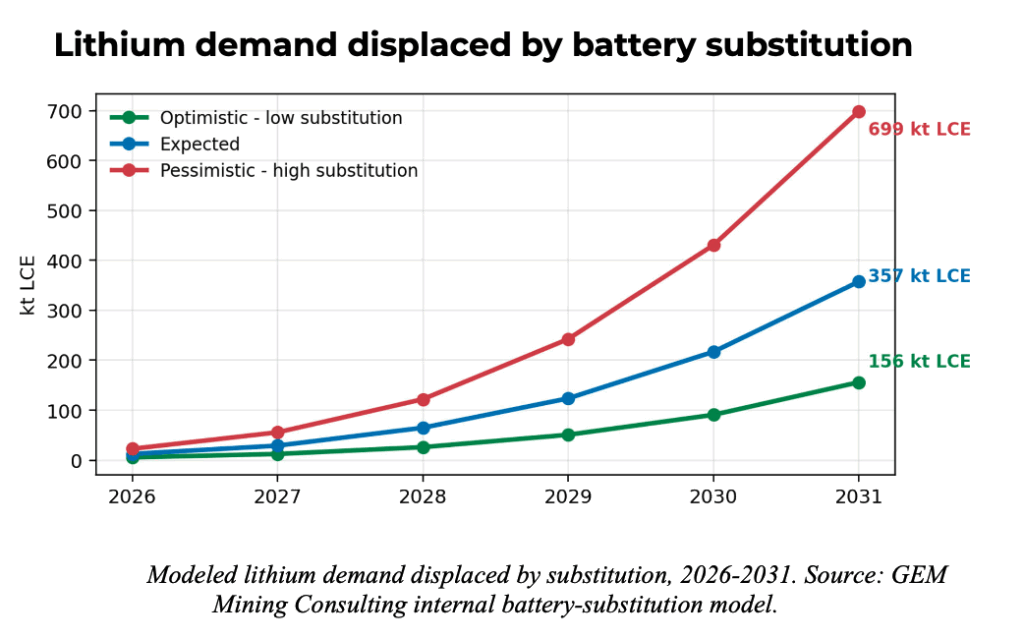
Battery substitution between 2026 and 2031 will cap lithium’s pricing power rather than displace it, with GEM Mining Consulting CEO Juan Ignacio Guzmán estimating sodium-ion and other chemistries could remove 357,000 tonnes LCE demand by 2031, about 12.5% of projected battery use. Sodium-ion, iron–air and flow batteries are gaining ground in stationary storage, low-cost mobility and industrial backup where energy density is secondary to cost, safety and cycle life. Chile’s brine rents, Argentina’s project pipeline valuations and Australia’s hard-rock margins all become more exposed to lower-for-longer lithium prices, pushing producers towards tighter cost control and process innovation.