Geomechanics, Streamlined.
© 2026 Geomechanics.io. All rights reserved.
Hancock Prospecting’s Brilliant at the Basics (B@TB) occupational health and safety program is driving sustained improvements in incident rates by hard‑wiring personal accountability and “values‑driven” behaviours into daily iron ore operations. Led by Hancock Iron Ore head of health and safety Paul Slocombe, the framework centres on simple, repeatable controls such as pre‑start risk checks, critical control verification and peer‑to‑peer interventions rather than complex new systems. For geotechnical and processing teams, the approach means frontline supervisors own controls around pit wall inspections, isolation and lock‑out on fixed plant, and contractor management on high‑risk tasks.
Alligator Energy has completed a key construction plan for the Samphire uranium project near Whyalla in South Australia, advancing its in-situ recovery (ISR) development pathway. The company is progressing regulatory approvals and detailed design for wellfields and processing infrastructure at the Blackbush deposit, targeting ISR extraction from shallow sandstone-hosted mineralisation. Work across its broader South Australian portfolio, including the Big Lake and Nabarlek South exploration areas, is being aligned to support a longer-term uranium production strategy.
Queensland’s resources sector generated over $115 billion for the state economy in the last financial year, accounting for roughly one quarter of gross state product and supporting extensive coal, gas and critical minerals operations. The industry’s footprint spans Bowen Basin metallurgical coal, Surat Basin gas and emerging North West Minerals Province copper and rare earths, with associated rail and port infrastructure such as the Goonyella and Blackwater systems running near capacity. For engineers, the figures signal continued demand for mine expansions, tailings and water management upgrades, and heavy-haul transport projects across regional Queensland.
Heritage survey clearance of a previously registered site at Victory Metals’ North Stanmore rare earths project in Western Australia opens additional ground for drilling and resource definition. The project, centred on clay-hosted rare earth mineralisation near Cue in the Murchison region, can now extend exploration beyond the original cleared envelope. For geotechnical and mine planners, the expanded footprint enables more flexible pit or in-situ leach layouts and better assessment of overburden characteristics and haul road alignments.
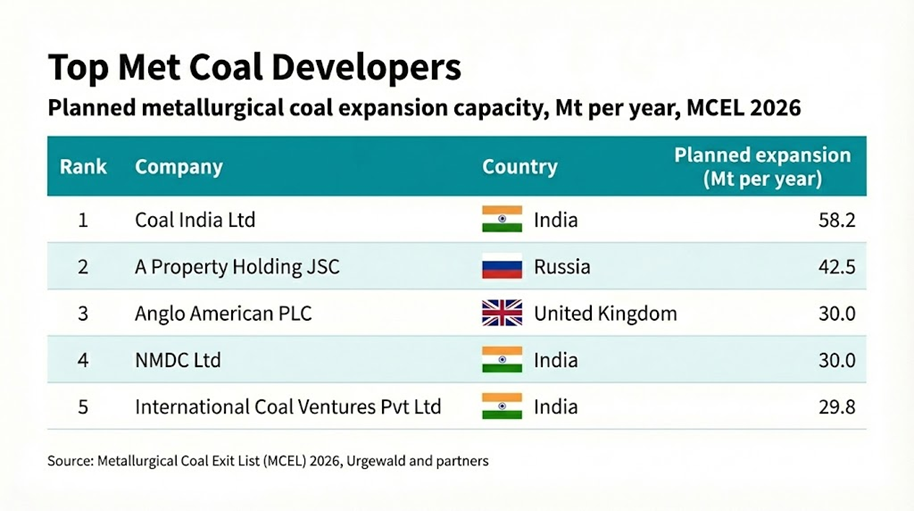
A new assessment by German NGO Urgewald finds 273 metallurgical coal projects planned or under construction across more than 20 countries, adding up to about 580 Mtpa of potential new capacity this decade, despite IEA forecasts of demand slipping from 1,114 Mt to 1,061 Mt by 2030. Australia leads the pipeline, with Queensland’s Moranbah South in the Bowen Basin flagged as the largest proposed pure met coal mine at 18 Mtpa, even as BHP drops the Saraji East expansion and Whitehaven shelves Blackwater North. Urgewald links the buildout to environmental impacts such as selenium contamination in Elk Valley, British Columbia, and notes over 150 financial institutions now use its Metallurgical Coal Exit List, with investors like Ilmarinen moving to divest from met coal developers.
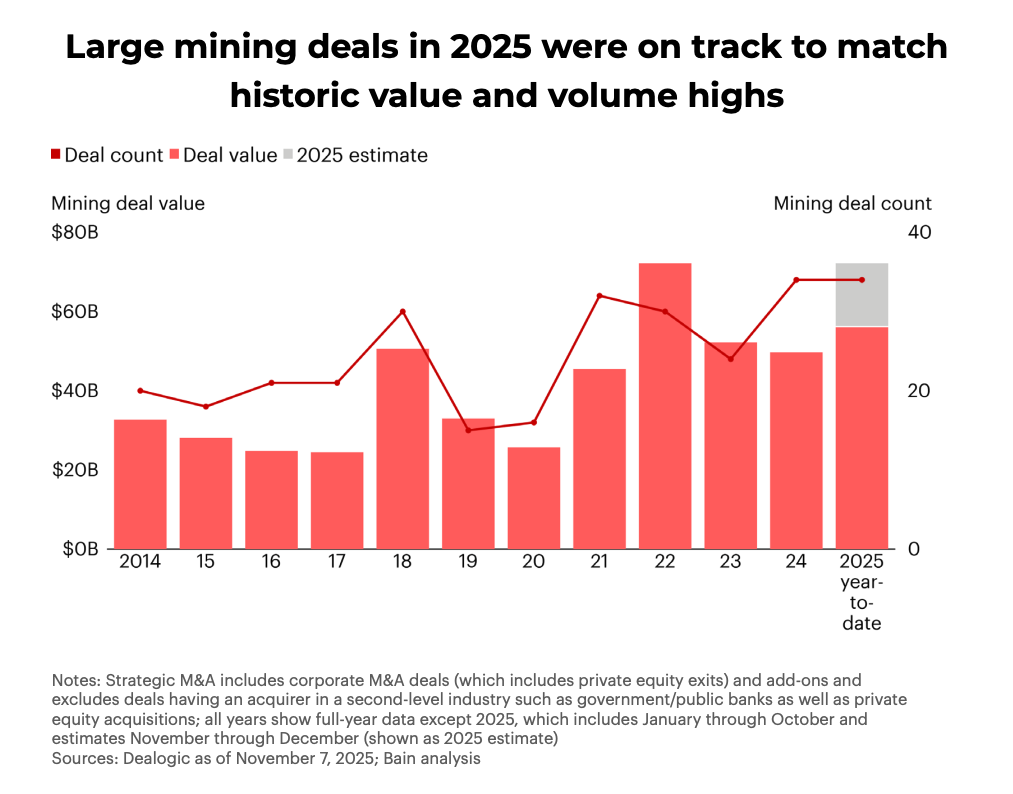
Global mining M&A deals above $500 million jumped about 45% in 2025, with Canada’s total deal value up 30% to $178 billion and strategic energy and natural resources transactions surging 133%, according to Bain & Company’s 2026 Global M&A Report. Anglo American’s proposed $24 billion takeover of Teck, creating a roughly $53 billion group, and Agnico Eagle’s $10.7 billion merger with Kirkland Lake Gold—targeting $800 million to $2 billion in synergies—illustrate the pivot from greenfield builds to scale acquisitions. Bain flags execution risk, timing and peak-cycle pricing as critical constraints on value.
Latin America’s mineral-rich frontiers are being recast as security zones as the US-backed shift in Venezuela and Bolivia’s November 2025 election of President Rodrigo Paz pull lithium, copper and other critical minerals into a sharper geopolitical contest. Bolivia holds an estimated 23 million tonnes of lithium resources at Uyuni, but high magnesium-to-lithium ratios (~20:1) and 300+ mile port logistics, combined with unbankable contracts and volatile fuel-price protests that killed Decree 5503 in under a month, keep project finance on hold. State miner YLB’s underperforming 2023 industrial plant and new DLE-related patent filings on 23 January 2026 signal technical ambition, yet investors still demand arbitration clauses, phased drawdowns and political risk cover before backing large-scale extraction.
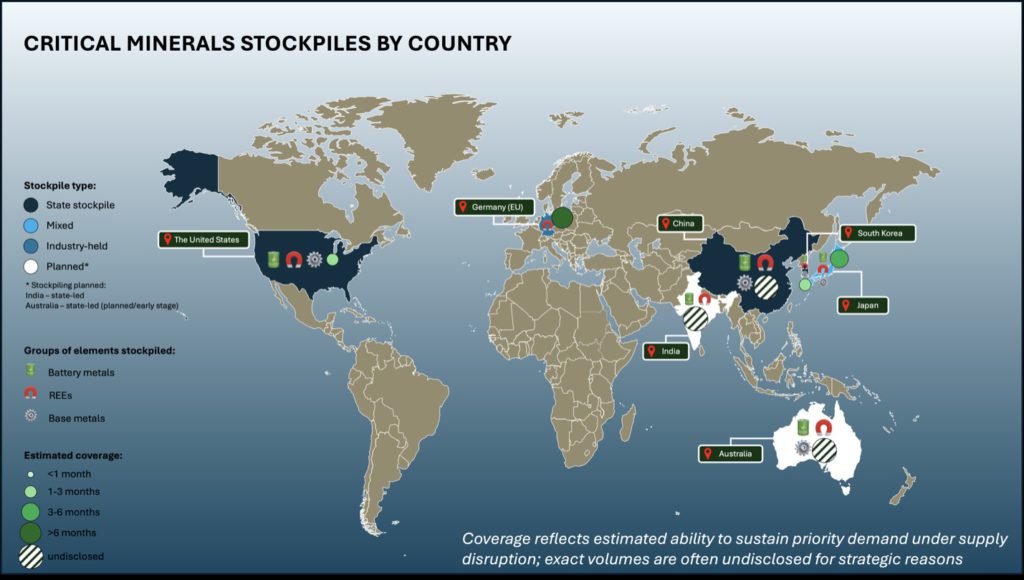
Critical mineral stockpiles would keep most major economies operating for only weeks in a sudden global supply halt, with China the clear outlier thanks to dominant mining and processing capacity plus large state reserves of rare earths and battery metals backed by recent export controls on gallium, germanium and graphite. Japan’s post‑2010 system now covers several months of cobalt and nickel demand, while South Korea holds roughly two months of reserves with rapid-release mechanisms, but US defence‑oriented stockpiles and Europe’s still‑nascent schemes offer only limited civilian coverage. For miners, critical minerals are increasingly priced as strategic assets shaped by resilience planning and geopolitics, not just cost curves.
Hecla Mining is selling the Casa Berardi gold mine and nearby Quebec exploration ground to Orezone Gold for up to $593 million, comprising $160 million cash at closing, about 65.7 million Orezone shares, deferred payments and royalties, to refocus capital on high‑grade silver and gold projects in Alaska, Yukon and Nevada. Casa Berardi currently hosts 14.4 million proven and probable tonnes at 2.79 g/t Au (1.3 Moz contained) plus 2.4 million inferred tonnes at 6.01 g/t Au (0.5 Moz) and is forecast to generate $425 million free cash flow over 2026–27 at $5,000/oz gold. Orezone will fund the upfront cash via a $100 million gold stream with Franco‑Nevada, delivering 1,625 oz/quarter for five years then 5% of production, while targeting underground extensions, new open pits and satellite deposits along 37 km of the Casa Berardi fault.
Germany is facing renewed political pressure to repatriate about 1,200 tonnes of gold currently stored at the New York Federal Reserve, worth roughly $128 billion at this week’s record price above $5,100/oz. Former Bundesbank research head Emanuel Mönch and European Taxpayers Association chief Michael Jäger argue that Trump’s renewed presidency, aggressive trade stance and even pressure to seize Greenland make US vault storage strategically unsafe. Ifo Institute president Clemens Fuest counters that large-scale transfers from New York, London and Paris could strain transatlantic relations and trigger wider financial repercussions.
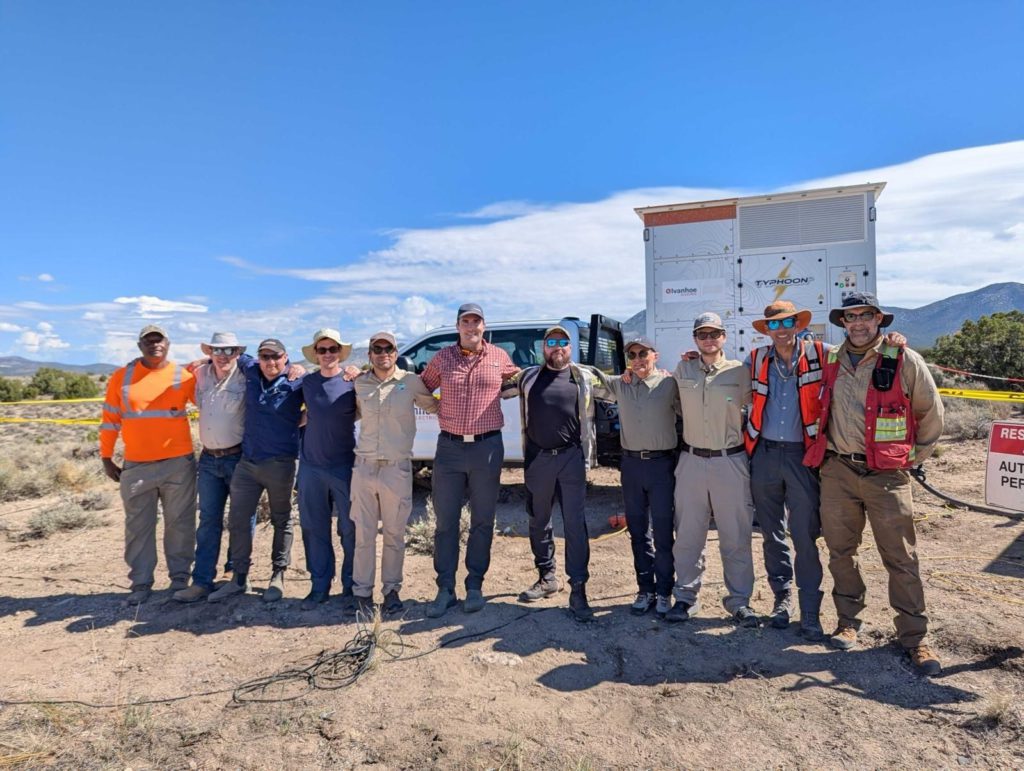
Ivanhoe Electric has partnered with SQM to explore copper on 2,000 km² of caliche-covered concessions in Chile’s Atacama Desert using the high-power Typhoon geophysical system with Computational Geosciences Inc.’s inversion software to image sulphide targets beneath highly resistive cover. SQM will fund US$9 million of work over three years, with Ivanhoe operating Typhoon surveys and SQM running follow-up drilling on porphyry copper and polymetallic manto belts adjacent to major existing mines. Any discovery exceeding 1 million tonnes copper (or equivalent) gives Ivanhoe a 50/50 JV option by reimbursing twice SQM’s exploration spend.
Thor Explorations’ pre-feasibility study for the Douta gold project in southeast Senegal outlines a 12.6-year, two-phase open-pit operation producing an average 82,000 oz. per year, front-loaded to more than 400,000 oz. in the first four years from oxide and transitional ore. The study is based on 36.6 million tonnes of probable reserves at 1.03 g/t (1.2 million oz.) within a total indicated resource of 50.6 million tonnes at 1.04 g/t, and assumes project capital of $253.5 million. At a $3,500/oz. gold price, Douta delivers an after-tax NPV5 of $633 million, 61% IRR and sub-one-year payback, with a 40,000-metre 2026 drilling programme targeting additional oxide material at Makosa, Makosa Tail, Baraka 3 and nearby permits.
Equinox Gold has closed the sale of its Aurizona, RDM and Bahia Complex (Santa Luz and Fazenda) mines in Brazil to a CMOC Group subsidiary for up to $1 billion, receiving $900 million in cash plus up to $115 million in production-linked payments due January 2027. Proceeds will fully repay a $500 million term loan, clear $300 million owed to Sprott and other obligations, and cut senior debt to about $580 million and net debt to $150 million, materially lowering interest costs. The streamlined portfolio now centres on Greenstone and Valentine, with a development pipeline targeting an extra 450,000–550,000 oz of annual gold output on top of 2026 guidance of 700,000–800,000 oz.
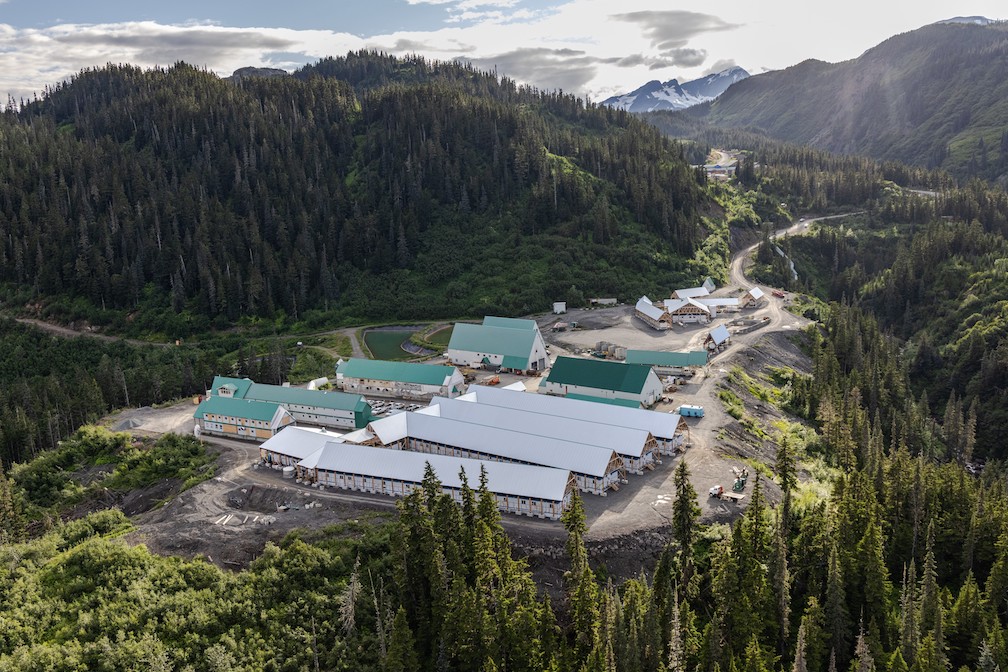
British Columbia has issued an environmental assessment certificate for Skeena Gold & Silver’s restart of the Eskay Creek gold-silver mine in Tahltan territory, with federal approval under the Impact Assessment Act and a requirement to substantially start by 2036. The 12-year open-pit operation is expected to produce about 320,000 oz gold-equivalent per year (455,000 oz gold in the first five years), with C$713 million in capex, roughly 1,000 peak construction jobs and 770 peak operating jobs. The certificate embeds Tahltan Nation consent via a Section 7 agreement and imposes 38 binding conditions, including co-developed measures on water, fish, air quality, human health and traffic impacts.
A custom PLAXIS 3D workflow for Technip Energies has cut repetitive suction pile analyses from multiple manual runs to a single automated “one-and-done” sequence, enabling rapid variation of pile diameter, skirt length and soil parameters. The scripted process standardises boundary conditions, load cases and mesh settings, reducing analyst time and input errors while keeping full 3D finite element rigour. Earlier-stage feasibility teams can now screen more pile geometries and soil scenarios, bringing advanced geotechnical modelling into concept selection rather than reserving it for detailed design.
GGH Hire has ordered 150 Kubota compact excavators in a multi-million-pound deal, ranging from sub-1-tonne KX008-5 units to 8.5-tonne KX085-5 machines supplied via dealer Boss Plant Sales. Around 100 excavators will replace the existing hire fleet, with 50 additional units expanding capacity to service higher demand for small-plant earthworks on constrained urban sites. The investment follows Enfield-based GGH Hire’s acquisition by St Albans-based Herts Tool Company in December 2025, with both brands continuing to operate separately under local management.
Formaldehyde limits for MDF and other wood-based panels in the EU will tighten on 6 August 2026 under Annex XVII of REACH, cutting the emission threshold from E1 (0.124mg/m³) to E05 (0.062mg/m³), with the same rules applying in Northern Ireland but not Great Britain. Irish producer Medite Smartply says all MEDITE MDF will meet the E05 limit by early April 2026, four months ahead of the deadline, and will issue updated declarations of performance, safety data sheets and product datasheets. CPR markings will still state E1, with supporting documentation used to evidence E05 compliance, so UK specifiers will need to check paperwork rather than labels.
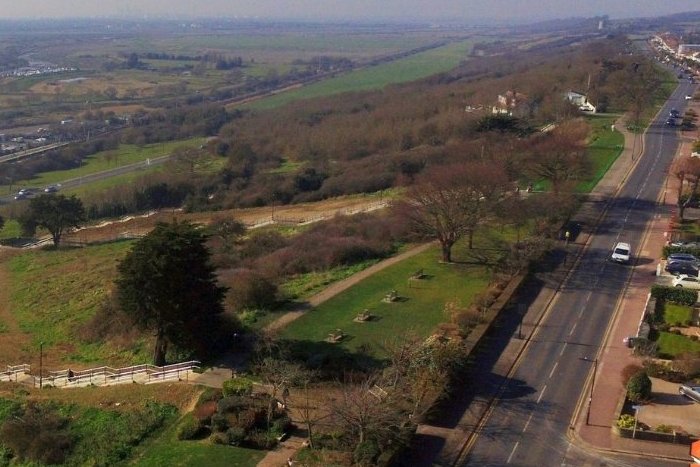
Southend-on-Sea City Council has renewed Marlborough Highways’ term maintenance contract from April 2026 on a £15m‑per‑year basis for an initial seven years, with an option to extend to 14 years total. The scope covers carriageways, footways and street lighting, plus traffic management upgrades, car park and foreshore works, delivery of civil engineering schemes and a full winter service. For contractors and consultants, the long horizon and bundled scope signal steady demand for highways asset management, minor civils and coastal public realm works in the Essex coastal city.
Civic Engineers has acquired Edinburgh-based Quattro Consult Limited (including Stuart McTaggart Limited), adding 15 structural and civil engineers and technicians and deepening its presence in Scotland’s residential, hotel, industrial/logistics and heritage sectors. The deal is Civic’s third since 2024, following the purchases of planning consultant New Practice and building services firm Watt Energy & Consulting Engineers, signalling a push towards integrated, design-led delivery. Quattro’s existing client base, including Artisan, GSS Developments and Buccleuch Property, gives Civic an immediate pipeline and stronger local footing in Edinburgh.
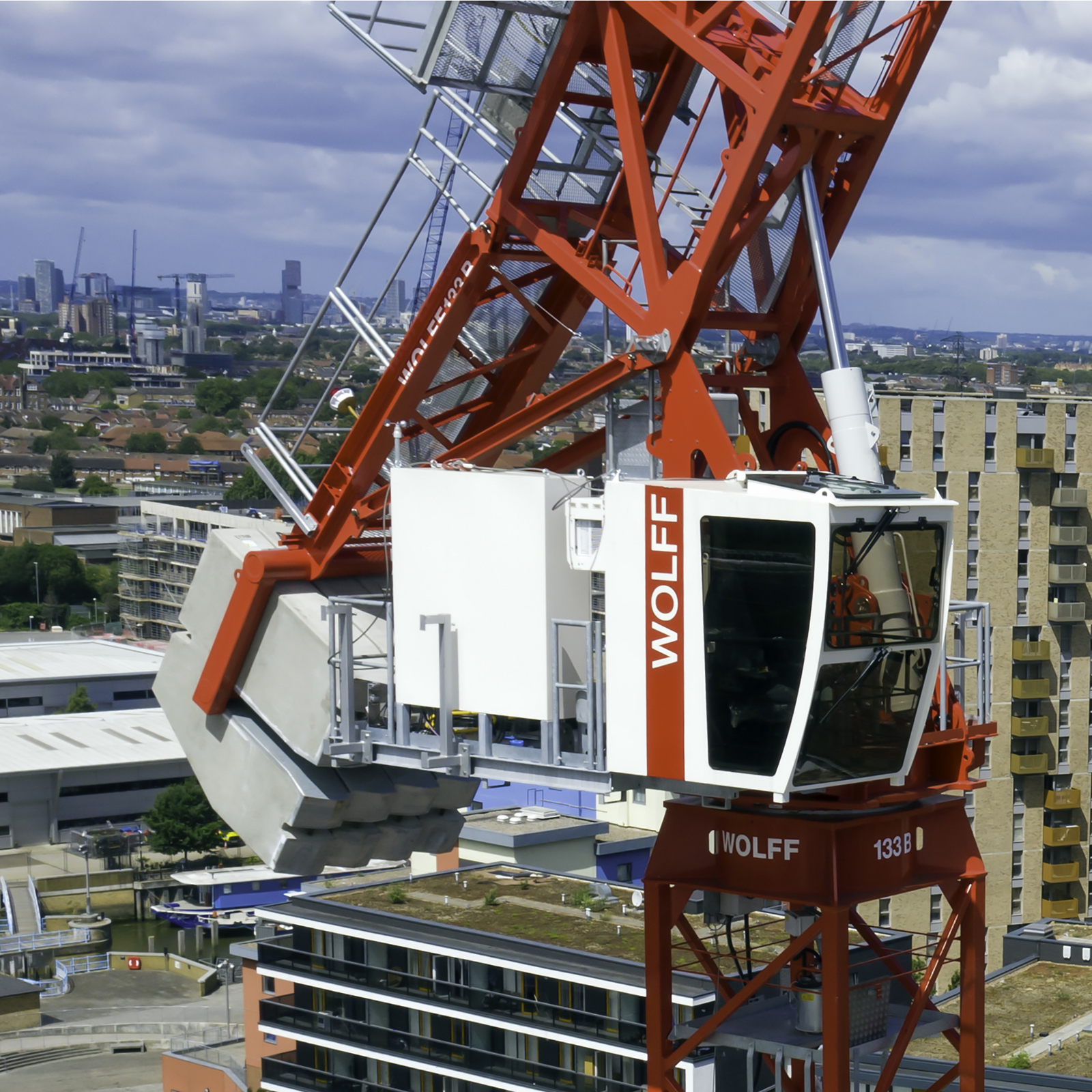
Around 100 Wolffkran tower crane operators, averaging nearly £66,000 a year with top earners just under £110,000, have begun intermittent strike action across major UK projects including the Grenfell Tower deconstruction, Cambridge Science Park and the new ECMWF headquarters in Berkshire. Operators, whose par rates have risen 38.3% over 10 years but been frozen for the past three, have rejected the latest pay offer and will select strike days fortnightly to maximise disruption. Wolffkran, which has seen crane utilisation fall 26% and hire fleet drop about 40% since 2016, blames Unite’s “inflexibility” for the dispute.
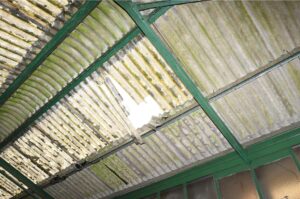
A sole-trader roofer, Daniel Jenner trading as Jenner Roofing & Building Services, has received an eight‑month suspended sentence, 280 hours’ unpaid work and £500 costs after a subcontractor fell approximately 4 m through a rooflight on an industrial estate in High Wycombe on 12 August 2023. The worker, operating alone on gutter and drain cleaning, stepped onto a fragile rooflight beside unguarded roof edges and suffered life‑changing injuries including skull, cheekbone, leg and wrist fractures. HSE found no edge protection, no fragile‑roof controls and no fall‑prevention or mitigation systems, leading to a guilty plea under Regulation 6(3) of the Work at Height Regulations 2005.
Costain has secured a £100m, five-year contract under National Highways’ Regional Delivery Partnership to design and build a new M5 junction 22A in Somerset between Burnham-On-Sea and Bridgwater. The junction, with north-facing slip roads, will connect directly to the planned Gravity Smart Campus and Agratas’ £4bn EV battery gigafactory, expected to be the UK’s largest. WSP will act as design partner, with the scheme intended to relieve congestion on the M5 south of the Huntspill river and upgrade strategic access for heavy industrial traffic.
A major landslide in Pasir Langu village, West Bandung, West Java has left at least 17 people confirmed dead and dozens missing, triggering large-scale search and recovery operations using excavators, drones and K9 units on steep, rain-saturated slopes. Continuous heavy rainfall and highly weathered volcanic soils are complicating access to buried houses and farm structures, with rescuers reporting repeated minor slope failures and debris up to roof level. Authorities are assessing the stability of adjacent hillsides and considering temporary evacuation zones and traffic restrictions on nearby rural roads.
Costain has secured a £100M, five-year design-and-build contract for a new junction on the M5 near Bridgwater, Somerset, to provide direct access to a planned gigafactory site. The scheme will require complex tie-ins to live motorway carriageways and associated slip roads, with staging and traffic management critical on this heavily trafficked strategic corridor. For geotechnical and civils teams, early ground investigation, settlement control around existing pavements, and drainage upgrades to motorway standards will be key risk drivers.