Critical minerals in a supply shock: stockpile realities for mine planners
Reviewed by Joe Ashwell
First reported on MINING.com
30 Second Briefing
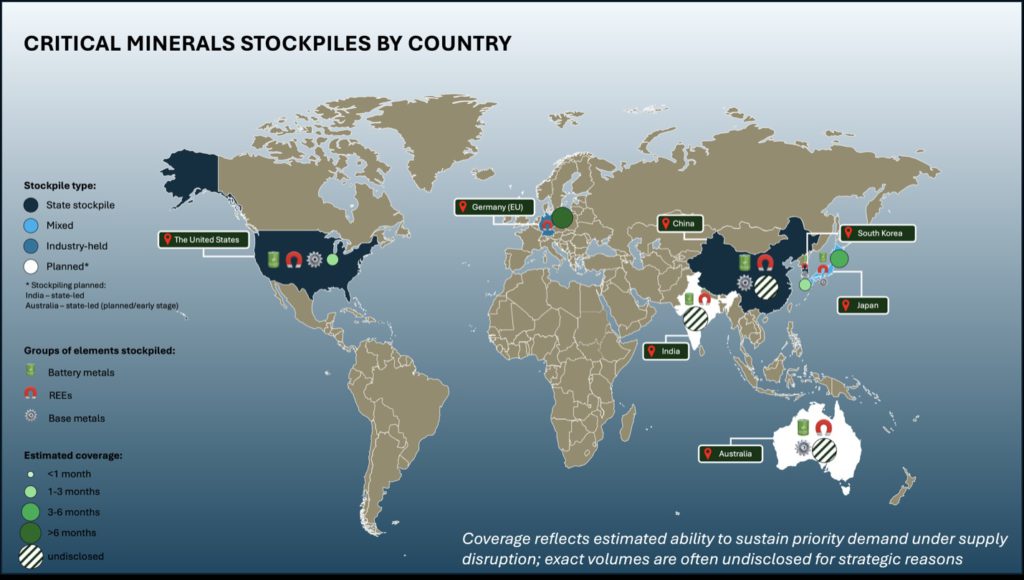
Critical mineral stockpiles would keep most major economies operating for only weeks in a sudden global supply halt, with China the clear outlier thanks to dominant mining and processing capacity plus large state reserves of rare earths and battery metals backed by recent export controls on gallium, germanium and graphite. Japan’s post‑2010 system now covers several months of cobalt and nickel demand, while South Korea holds roughly two months of reserves with rapid-release mechanisms, but US defence‑oriented stockpiles and Europe’s still‑nascent schemes offer only limited civilian coverage. For miners, critical minerals are increasingly priced as strategic assets shaped by resilience planning and geopolitics, not just cost curves.
Technical Brief
- Export controls on gallium, germanium and graphite show how quickly stockpile leverage can be weaponised.
- South Korea designs its reserves around rapid-release protocols, prioritising logistics speed over sheer tonnage.
- US stockpiles emphasise defence applications, leaving civilian manufacturing chains largely uncovered in a broad disruption.
- Europe’s Critical Raw Materials Act currently focuses on coordination debates rather than defined physical reserve volumes.
- Australia’s model ties strategic reserves directly to domestic mine output of rare earths, antimony and gallium.
- Effective coverage depends on sectoral prioritisation rules, substitution limits and price responses, not warehouse tonnes alone.
Our Take
In our database of 766 Mining stories, cobalt and copper repeatedly appear in pieces about processing bottlenecks and permitting delays, which suggests that even well-funded stockpiles for the US or South Korea will be constrained by how fast new upstream capacity can actually be brought online.
Coverage of BC and the Tahltan Nation, often linked to projects like the Eskay Creek mine, shows that First Nations agreements and regional approvals can materially lengthen lead times for new copper and gold output, limiting how quickly North American supply can respond to a sudden critical minerals shock.
The Pentagon’s move toward a roughly $1 billion critical minerals stockpile contrasts with several recent copper- and lithium-focused project stories in Latin America and Australia, where developers are still struggling to secure offtake and financing, implying that defence-driven demand may start to compete directly with commercial buyers for early production from new mines.
Prepared by collating external sources, AI-assisted tools, and Geomechanics.io’s proprietary mining database, then reviewed for technical accuracy & edited by our geotechnical team.
Related Articles
Related Industries & Products
Mining
Geotechnical software solutions for mining operations including CMRR analysis, hydrogeological testing, and data management.
Construction
Quality control software for construction companies with material testing, batch tracking, and compliance management.
CMRR-io
Streamline coal mine roof stability assessments with our cloud-based CMRR software featuring automated calculations, multi-scenario analysis, and collaborative workflows.
QCDB-io
Comprehensive quality control database for manufacturing, tunnelling, and civil construction with UCS testing, PSD analysis, and grout mix design management.
HYDROGEO-io
Comprehensive hydrogeological testing platform for managing, analysing, and reporting on packer tests, lugeon values, and hydraulic conductivity assessments.