Geomechanics, Streamlined.
© 2026 Geomechanics.io. All rights reserved.
Atlas Copco’s X-Air 410-12 PACE portable compressor, distributed by CEA, targets road and infrastructure works with a single unit delivering variable pressure via its PACE (Pressure Adjusted through Cognitive Electronics) control system. The machine is fitted with a Stage IIIA Caterpillar engine to cut fuel consumption and operating costs while maintaining high free air delivery for applications such as pavement breaking, shotcreting and sandblasting. For contractors, the key gain is higher utilisation from one compressor across multiple pressure/flow regimes instead of running several fixed-pressure units.
New research on Australian expansive clays warns that more frequent intense rainfall and drought cycles are accelerating differential movement and cracking in lightweight buildings, pavements and transport corridors founded on shrink–swell soils. The work points to heave and settlement driven by deep moisture fluctuations, with particular concern for lightly loaded slabs, shallow footings and low-volume roads where historical climate data underestimates design suction changes. Engineers are urged to revisit site classification, footing depth, drainage and moisture barriers, and to integrate updated climate projections into geotechnical design for new and existing assets.
Road maintenance planning in the City of Bendigo has been overhauled using GBM Konect integrated directly with the council’s asset management system, linking live field data from graders, patching trucks and concreting crews to central asset records. Crews now capture condition data, photos and completed works on mobile devices in real time, feeding GIS-based maps that prioritise pavement interventions and reduce duplicated site visits. For contractors and councils, the approach shows how tighter integration between field data capture and asset registers can sharpen programming of resurfacing and rehabilitation works.
Technicians suspended on ropes have completed nine consecutive nights of at-height inspections on Liverpool’s 138m St Johns Beacon, requiring night-time closure of surrounding city centre streets. Rope access teams inspected exposed concrete and structural steelwork on the tower’s shaft and viewing pod, carrying out non-destructive testing to assess material condition and any localised deterioration. Findings will inform future maintenance and potential strengthening strategies for the 1960s structure, where access constraints make rope techniques more practical than large temporary scaffolds or crane platforms.
Mineral Resources has begun full operations at its Onslow Iron port facilities at the Port of Ashburton, using purpose-built transhippers to move ore from a 220,000t enclosed storage facility to deep-water capesize vessels offshore. The system is designed for low-dust handling, with covered conveyors and a fully enclosed shiploader feeding 20,000t transhippers that shuttle to a 25m-deep anchorage. For port, civil and materials engineers, the project showcases large-scale, low-footprint iron ore export using off‑shore loading rather than traditional long trestle wharves.
Liontown Resources has signed a new spodumene concentrate offtake agreement with Chinese cathode producer Canmax Technologies, shortly after running its first online auction for product from the 3Mtpa Kathleen Valley lithium project in Western Australia. The deal adds a major long-term buyer alongside existing contracts with Tesla and LG Energy Solution, diversifying sales away from purely fixed-price arrangements. For miners, the move signals growing use of auction platforms and mixed pricing structures to manage spodumene price volatility and counterparty risk.
Wildcat Resources has extended its Bolt Cutter Central lithium discovery in Western Australia, with new drilling indicating a larger mineralised system than initially defined. Recent reverse circulation and diamond holes have expanded the strike and depth continuity of spodumene-bearing pegmatites, suggesting potential to grow the existing resource footprint. For mine planners and geotechs, the results point to a more substantial open-pit or potential underground scenario, with further infill and step-out drilling likely to refine geometry, grade distribution and pit shell economics.
Thiess has secured a $700 million alliance agreement with Harmony Gold Mining to deliver multiple work packages for the Eva copper project in north-west Queensland. The contract covers mine development and operations support at the planned open-pit operation, including drill-and-blast, load-and-haul, and associated mining services over a multi-year term. The deal signals continued contractor-led development of large-scale copper assets in the Mount Isa–Cloncurry district, with Thiess likely to deploy its existing large truck–shovel fleet and technical services teams already active in the region.
A new $25,000 scholarship package is targeting Whitsundays school leavers to study science and environmental disciplines at James Cook University’s Townsville campus, building a local pipeline of skills for mining and resources projects in North Queensland. The funding is structured to support undergraduate study in areas such as environmental science, geology and related STEM fields that directly feed into mine planning, rehabilitation and water management roles. For operators in the Bowen and Galilee basins, this signals a stronger regional talent base for environmental approvals, closure planning and ESG reporting.
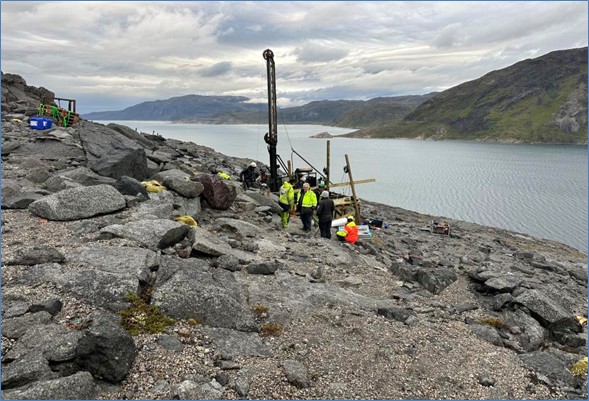
Critical Metals has signed a term sheet to form a 50:50 carried-interest joint venture with Romanian state-owned processor FPCU, securing long-term offtake rights for 50% of concentrate from the Tanbreez heavy and medium rare earth project in Greenland with no capex, debt or equity issuance required for the new plant. The JV will design, finance, build and operate a rare earth processing facility in Romania, supplying NATO-aligned feedstock to EU advanced manufacturing, electrification and defence sectors. This deal follows an October letter of intent with US processor REalloys for a 10-year offtake covering a further 15% of Tanbreez production.
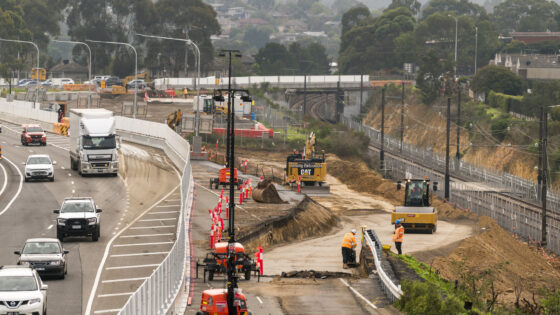
Spark NEL, the consortium delivering Victoria’s multi‑billion‑dollar North East Link road scheme, has appointed UK-based nPlan to provide AI-led schedule assurance and risk management as the project enters its final phases. nPlan’s platform will analyse thousands of historic construction programmes to stress-test the remaining schedule, flagging high‑risk activities and likely delay chains across tunnelling, major interchanges and arterial road upgrades. For contractors and clients, this signals growing use of data-driven schedule forensics to manage programme risk on large, complex highway PPPs.
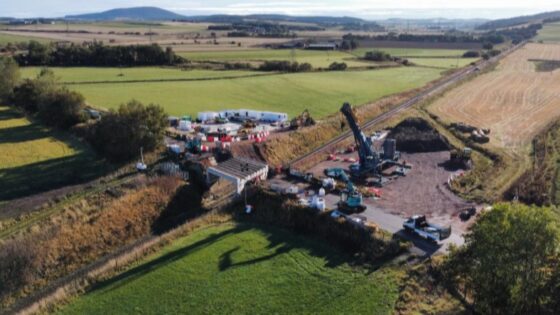
Network Rail has completed the rebuild of the Banff Turnpike railway bridge near Keith, enabling the A95 trunk road to reopen around two weeks ahead of programme. The scheme involved full bridge renewal over an operational rail corridor, requiring coordinated possessions, temporary traffic management on the A95 and staged reconstruction to maintain rail integrity. Early reopening reduces disruption for freight and local traffic on this key north-east Scotland route and signals that remaining works are now largely confined to rail-side finishing and monitoring activities.
Luton Airport’s expansion, including raising its passenger cap from 18M to 32M a year and adding a new terminal, can proceed after the High Court dismissed a legal challenge to the transport secretary’s development consent order. The scheme, promoted by Luton Rising, entails significant airfield, apron and landside works, plus upgrades to the M1–A1081 corridor and local rail/bus interchanges. Campaign group LADACAN is now considering an appeal, prolonging uncertainty for detailed phasing, surface access design and environmental mitigation commitments.
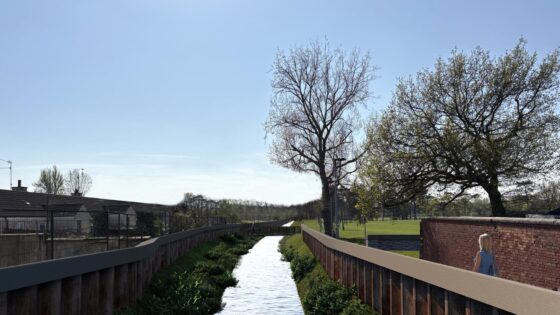
The Department for Infrastructure has opened procurement for a £48M first-phase flood‑alleviation scheme in Portadown, targeting repeated inundation along the River Bann and its tributaries. The works will form part of a long‑planned programme to protect the town, which has seen multiple significant flood events over recent decades affecting residential, commercial and transport assets. Contractors will be bidding into a DfI‑led framework where fluvial hydraulics, floodwall and embankment design, and integration with existing river defences will be central to winning strategies.
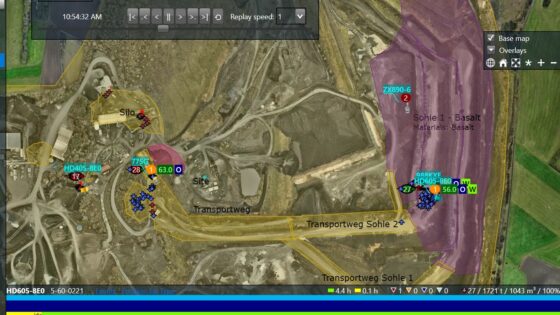
Modern quarry sites are being forced to overhaul operational management as rising diesel and lubricant prices, escalating maintenance on large haul fleets and crushers, and persistent labour shortages erode already tight margins. Operators are turning to tighter fuel burn monitoring on 50–100 t rigid dump trucks, predictive maintenance on primary jaw and cone crushers, and closer cycle-time analysis on loading–hauling circuits to cut idle time. Stricter blasting, dust and traffic-safety regulations are also driving more formalised traffic management plans and data-led risk assessments across benches, haul roads and processing areas.
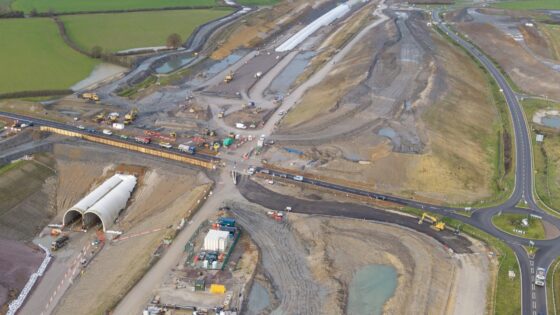
Work to extend HS2’s longest cut-and-cover “green tunnel” near Greatworth, West Northamptonshire has advanced after engineers realigned a local road to create the working width needed for the next excavation phase. The realignment allows construction teams to continue forming the reinforced concrete box that will later be buried and landscaped to restore agricultural land and visual screening over the railway. For designers and contractors, the sequence underlines the importance of early highway diversions to maintain traffic while maximising safe access for deep excavation and heavy plant.
The Department for Energy Security and Net Zero is assessing options for a new floating storage and regasification unit (FSRU) and a strategic geological gas storage facility to bolster UK gas resilience. An FSRU would provide ship-based LNG storage and regasification at an import terminal, while geological storage would likely use depleted gas fields or salt caverns for high-volume, seasonal buffering. The work signals potential demand for large-diameter offshore pipelines, high-pressure injection wells and long-term integrity management of underground gas containment.
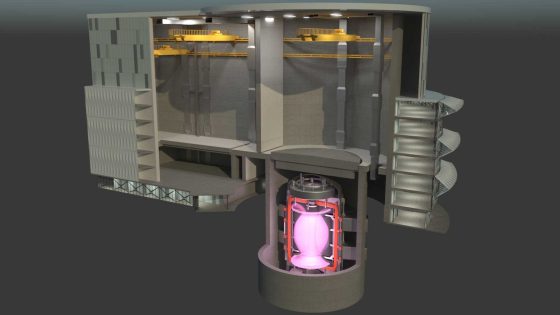
Procurement for an engineering partner to deliver the UK’s Spherical Tokamak for Energy Production (Step) fusion power plant at West Burton, Nottinghamshire, will restart in 1–2 years after the initial tender process collapsed, while selection of a construction partner is said to be close. The Step project, led by the UK Atomic Energy Authority and targeting a grid-connected prototype fusion plant, will demand complex nuclear-grade civil works, deep excavations and heavy-shielded structures around the spherical tokamak. Engineers can expect future tenders to emphasise constructability under stringent nuclear safety, thermal loading and electromagnetic compatibility constraints.
Sandfire’s MATSA complex in Huelva, south‑western Spain, runs a 4.7 Mt/y central processing plant fed by three underground polymetallic mines: Aguas Teñidas, Magdalena and Sotiel. The operation in the Iberian Pyrite Belt is deploying new technology across this hub‑and‑spoke layout, integrating underground production with the concentrator to optimise ore flow and metal recovery. For geotechnical and mining teams, the scale and multi‑mine feed emphasise ground control, backfill management and precise grade control to keep the plant at nameplate capacity.
Fluor Corporation has secured the engineering, procurement and integrated construction management (EPCM) contract for Teck Resources’ Highland Valley Copper Mine Life Extension (HVC MLE) project near Logan Lake, British Columbia. The undisclosed-value award, booked in Fluor’s third-quarter results, covers brownfield works to sustain one of Canada’s largest open-pit copper-molybdenum operations beyond its current mine plan. Geotechnical and civil scopes are expected to centre on pit pushbacks, tailings and water management upgrades, and plant debottlenecking to support extended ore throughput.
Boart Longyear has launched the Stingray™ DHM/full face diamond bit, a US‑designed bit engineered specifically for downhole motor and full-face drilling in exploration applications. The bit uses a new crown geometry combined with Boart Longyear’s durable diamond technology to increase penetration rates compared with conventional diamond bits. For drill contractors, the design targets faster advance per hour and reduced bit trips, particularly in hard, abrasive ground where DHM systems are already favoured for directional control and high rotary speeds.
Madison Technologies is deploying industrial-grade networking to keep remote, renewable microgrids online at Australian mine sites exposed to heat, dust and vibration that routinely defeat standard IT hardware. Its solutions combine hardened Ethernet switches, fibre backbones and wireless links to connect pit operations, processing plants and accommodation villages into a single operational technology network. For engineers, the focus is on deterministic communications for SCADA, power management and condition monitoring, with designs that tolerate brownouts, electrical noise and long cable runs typical of large open-cut operations.
BHP has entered a $US2 billion ($A3 billion) agreement with Global Infrastructure Partners, part of BlackRock, to inject new capital into its Pilbara iron ore operations centred on Port Hedland. The deal targets brownfield infrastructure such as export terminals, rail links and associated materials handling assets that move more than 280 million tonnes per annum of iron ore from inland mines to deepwater berths. For geotechnical and civil contractors, the structure signals sustained demand for port dredging, rail formation upgrades and heavy-duty pavement and foundation works in the Pilbara.
Komatsu has launched the PC950-11 hydraulic excavator for large-scale earthmoving, pairing a high-capacity front shovel with a Tier 4 Final/Stage V-compliant engine to cut fuel burn against previous PC-series models. The machine targets ultra-class truck loading with an operating weight in the 90–100-tonne class and a bucket size suited to 40–65-tonne haul trucks, aiming to shorten cycle times on bulk overburden and ore movement. Komatsu is also pushing operator-focused design, with upgraded cab ergonomics, digital monitoring and optimised hydraulic controls for smoother, more precise digging.