Geomechanics, Streamlined.
© 2026 Geomechanics.io. All rights reserved.
Metso is reporting strong early uptake of its performance-based Life Cycle Services (LCS) contracts for slurry and process pumps, bundling condition monitoring, wear-part supply and remote performance management into multi-year agreements. The model shifts customers from ad hoc maintenance to guaranteed availability and efficiency targets, with Metso using installed sensors and analytics to optimise impeller, liner and seal replacement intervals. For mine operators, the approach concentrates risk and accountability with a single OEM, with potential to stabilise pump uptime on critical dewatering, tailings and mill-circuit duties.
Hitachi Construction Machinery has shortlisted 10 global start-ups, including Australian firm LANDCROS, to pitch mining technologies at its Mining Innovation Challenge in Brisbane on 27 March. Finalists will present solutions spanning AI-based fleet optimisation, autonomous haulage support and predictive maintenance for ultra-large excavators and rigid dump trucks used in large open-pit operations. For mine operators, the event signals where OEM-backed innovation is heading on topics such as interoperability with existing fleet management systems and reducing unplanned downtime on high-capex mobile assets.
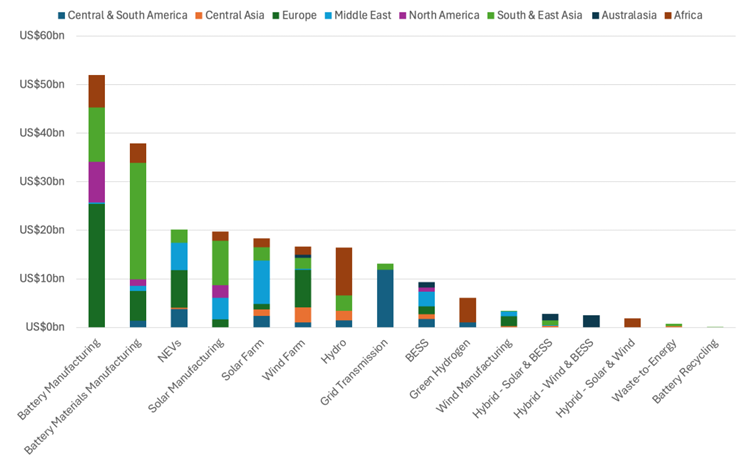
China has deployed more than $120 billion into overseas mining and upstream processing since 2023, targeting lithium, copper, nickel, rare earths and bauxite, alongside over $220 billion into downstream assets such as battery plants, EV manufacturing, grids and solar and wind projects, according to Climate Energy Finance. The strategy gives Beijing control of about 90% of rare earth refining, roughly 60% of lithium processing and more than 70% of cobalt refining, with major positions in DRC copper–cobalt, Indonesian nickel and Zimbabwean lithium. For project developers, this means Chinese capital is increasingly tied to in-country processing, rail, port and power infrastructure in exchange for long-term offtake.
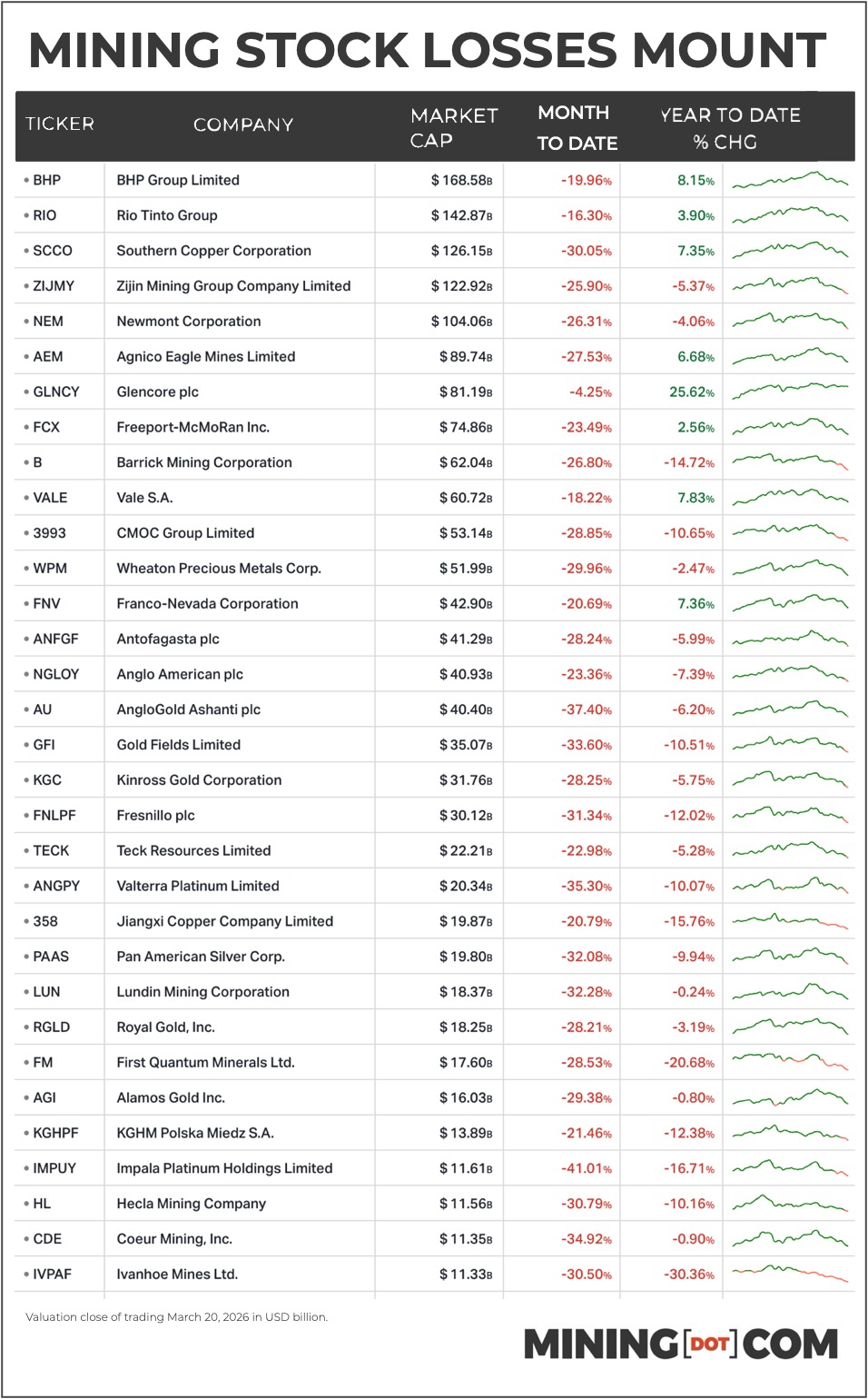
Billions were wiped off mining equities as gold, silver and copper all entered technical bear markets, with gold futures dropping $225/oz on Friday to $4,492/oz (down over 20% from the 29 January peak), silver sliding 44% from its high and copper losing nearly $2,800/t from its record. Newmont, Barrick and AngloGold Ashanti are down 26–37% since the Iran war began, while copper-focused majors such as Freeport-McMoRan, Southern Copper and First Quantum have fallen 23–31%, despite growth projects like Freeport’s proposed $7.5 billion El Abra expansion to add 300,000 t/y of copper. Glencore is the notable outlier, off only 4.3% since hostilities started and up 25.6% year-to-date, supported by trading around 4 million boe/d and exposure to surging coal and oil prices.
Epiroc has secured a SEK380 million (US$40.7 million) order in Africa for a fleet of autonomous, cable-electric Pit Viper 275 E blasthole drill rigs, booked in Q1 2026. The Pit Viper 275 E platform supports fully autonomous drilling and high-precision blasthole control, with electric drive reducing diesel use and associated ventilation and fuel logistics. The deal signals accelerating deployment of large-scale electric drill fleets in African surface mines, with implications for mine power distribution design and autonomous drill–fleet integration.
Echion has launched a commercial range of fast-charging, high‑power lithium‑ion batteries using its niobium‑based XNO® anode technology, produced in partnership with GUS Technology at GUS’s Zhongli manufacturing facility in Taiwan. The XNO® chemistry targets applications needing very high charge rates and power density, such as mining haul trucks, drills and underground fleets where current graphite‑anode packs struggle with rapid cycling and peak load demands. For mine electrification projects, the move signals growing availability of alternative anode chemistries that can better tolerate high C‑rates and harsh duty cycles.
SANY Group has signed a CHF 100 million, five-year procurement framework with Holcim in Guangzhou to supply a 100-strong fleet of electrified construction machines and commit to 20 autonomous mining trucks. The deal centres on large-scale deployment of battery-electric equipment and autonomy-ready haulage, targeting Holcim’s quarrying and aggregate operations where high-duty cycles and short-haul profiles favour electrification. For mine and quarry operators, the agreement signals accelerating OEM support for full electric fleets and integrated autonomous haul systems in brownfield materials operations.
A £350m first-lot framework to deliver part of Edinburgh’s 25,000-home New Build Housing programme is now live, with site sub-lots of 1–30, 31–100 and over 100 units structured to draw in SMEs rather than only major contractors. Fleming Buildings, A S Homes and Campion Homes secured the smallest-site band, while CCG, McTaggart, Cruden, Robertson and Ogilvie feature on the larger two bands, under a wider £600m framework. Bids were scored 70% on quality and 30% on cost, with Arcadis providing external cost evaluation and all contractors required to pay the council’s real living wage.
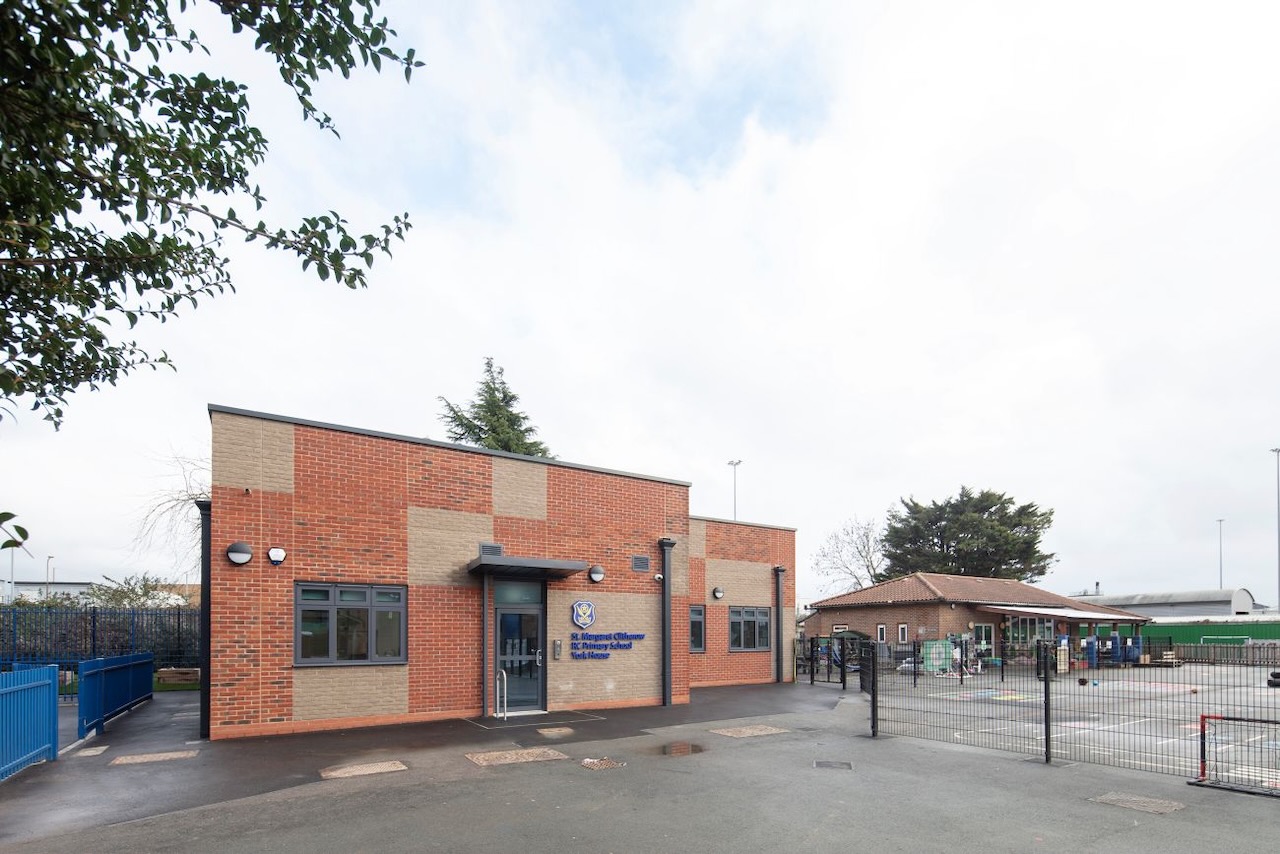
Morgan Sindall has completed three SEN school expansions in Brent via the SCAPE framework, adding 48 specialist places across Newman Catholic College, Preston Park Primary School and St Margaret Clitherow RC Primary School, with project values of £3.2–£3.4m each. All extensions use a structural insulated panels timber frame with brick façade, offsite manufacture and timber internal walls to cut concrete use, save 38.3 tCO₂e and shorten programmes on live school sites. Additional measures include replacing concrete manholes with plastic units, removing concrete paving, using a bigfoot roof support system, and assessing embodied carbon with the CarboniCa tool.
Future Homes Hub has created an Embodied Carbon and Resource Efficiency Board (ECREB) to lead delivery of the New Homes Sector Transition Plan on embodied emissions from materials, transport and construction processes. The board, co‑chaired by Department for Business and Trade deputy director Fergus Harradence and Barratt Redrow group sustainability director Bukky Bird, convened its first meeting on 16 March. Early work will focus on resource efficiency and waste reduction to cut embodied carbon and cost, complementing the forthcoming Future Homes Standard for operationally zero‑carbon‑ready homes.
A historical focus on water quantity over water quality in sustainable drainage systems (SuDS) is leading to poor sediment management, argues Stuart Crisp, UK manager at Advanced Drainage Systems (ADS). Crisp points to designs that size attenuation tanks and oversized pipes for peak flow while neglecting silt capture, pre-treatment and accessible maintenance points, allowing fine sediments to clog geocellular units and perforated pipes. He calls for SuDS layouts that integrate upstream sediment forebays, filter media and realistic maintenance access to protect long-term hydraulic capacity and water quality performance.
Affinity Water’s Grand Union Canal Transfer (Guct) scheme will move raw water from the Midlands to the Southeast by adapting existing canal infrastructure with a mix of novel and conventional civil works. Engineers are planning interventions such as new intake and discharge structures, canal bank strengthening and localised lining, plus pumping and control facilities sized to handle strategic transfer flows without building a full-length new pipeline. The approach reduces new land-take and excavation volumes but will demand careful geotechnical assessment of historic canal embankments and tight hydraulic control to manage leakage, settlement and navigation levels.
Atlantic Lithium has secured Ghanaian parliamentary ratification of a 15‑year mining lease for the Ewoyaa lithium project, introducing a sliding royalty on spodumene concentrate from 5% below $1,500/t to 12% above $3,200/t in place of a flat 10%. The mine and processing plant are planned to deliver 3.6 Mt of concentrate over 12 years, with 50% of output already committed to Elevra Lithium, the merged Piedmont–Sayona entity. The approval unlocks project financing and positions Ewoyaa as Ghana’s first lithium operation and a US‑aligned alternative to Chinese‑backed African supply.
Idaho has agreed to align state permitting for Liberty Gold’s Black Pine oxide gold project with the US FAST-41 framework, creating the first US precious metals mine reviewed under a single, coordinated state–federal schedule integrated into the FAST-41 permitting dashboard and NEPA process. The project, a past-producing run-of-mine heap leach site in southeastern Idaho near the Utah border, is being advanced toward a modern open-pit operation with a feasibility study due in H2 2026. A prior pre-feasibility outlined a 17-year life, 2.2 million oz total production and US$327 million initial capex, while Liberty Gold’s market value sits around C$500.9 million.
Sasquatch Resources is targeting roughly 300,000 tonnes of sulphide-bearing waste rock at the historic Mount Sicker copper-gold district on Vancouver Island, where legacy piles with a neutralisation potential of 0.2 and open shafts up to 200 feet deep continue to generate acid runoff and physical hazards. Modern sampling of the surface waste has returned average grades of about 2 g/t gold plus copper, silver and zinc, and the company plans to crush and process the material using density and X-ray fluorescence (XRF) ore-sorting in a closed-loop, reagent-free circuit. Because the project involves large-scale reprocessing without new mining, Sasquatch is working with regulators to craft a bespoke permitting pathway that could be replicated across an estimated 2,000 legacy mine sites in British Columbia.
Mining companies are redrawing 2026 technology roadmaps around cloud ERP platforms such as SAP, shifting from legacy spreadsheets and siloed systems to a single financial and operational backbone spanning finance, capital management, procurement, supply chain and maintenance. Clean-core architectures with extensibility and open interfaces are being used to plug in geology asset management, environmental monitoring and safety applications without heavy customisation, cutting technical debt and easing upgrades. With harmonised master data and automated consolidations delivering near real-time views of cash, capex and asset performance, miners can support AI-driven predictive maintenance and tighter working-capital control across multi-jurisdictional portfolios.
Lynas Rare Earths has produced its first on-spec samarium oxide at its Malaysian plant, making it the only non-Chinese supplier of this heavy rare earth used in high-performance magnets for electronics and aerospace. The A$180 million plant expansion is designed to separate up to 5,000 tonnes per annum of heavy rare earth feedstock, with initial capacity for samarium, gadolinium, dysprosium, terbium, yttrium and lutetium expected within two years. Lynas has also signed a four-year binding letter of intent to supply light and heavy rare earth oxides to the US Department of Defense.
Researchers at ETH Zurich and Empa have developed a recyclable sawdust–struvite composite board that is stronger in compression perpendicular to grain than spruce and shows cone calorimeter ignition times of 45 seconds, around three times longer than untreated timber. The material uses an enzyme from watermelon seeds to control crystallisation of struvite from newberyite, forming large crystals that infill voids between sawdust particles and act as an inorganic flame retardant, potentially matching cement‑bonded particleboard fire classes with only 40% binder by weight. Panels can be mechanically ground, heated to just over 100°C to release ammonia, and fully separated for reuse or as a phosphorus fertiliser, with future cost reductions possible by sourcing struvite from sewage treatment plant deposits.
A 19-year-old labourer, Renols Lleshi, died after stepping onto a ventilation shaft on the 12th-floor roof garden at the Ark Soane Academy residential block in Mill Hill Road, London W3, where the opening was covered only with plasterboard and roofing foam before he fell six floors. Jerram Falkus Construction Limited admitted breaching Regulation 4(1) of the Work at Height Regulations 2005 and was fined £42,200, plus a £2,000 surcharge and £5,000 costs at City of London Magistrates Court. HSE found routine site inspections excluded the roof garden, so the fragile, non-loadbearing cover and fall hazard were never identified or controlled.
SME house-builders are sharply curbing speculative development, with 70% of Home Builders Federation members saying current market conditions limit their ability to start new sites and 27% expecting to cut land acquisitions in the next three months. Only 41% expect to increase housing starts in the next quarter, sentiment is strongly negative in London (57% negative, 14% positive), and firms building fewer than 75 homes a year are the least optimistic. Developers face compounding cost pressures from a doubling Landfill Tax, a new £340m-per-year levy on new homes, Biodiversity Net Gain, the Residential Property Developer Tax, Building Safety Levy and the forthcoming Future Homes Standard adding an estimated 3–8% to build costs.
Steel import quotas will be cut by 60% from 1 July 2026, with any volumes above the new limits facing a 50% tariff, as the UK government seeks to lift domestic steel’s share of national demand from 30% to 50%. While producers such as 7 Steel UK back the move as support for “high quality, low carbon” UK output, the British Constructional Steelwork Association warns it will raise input prices for fabricators and frame contractors. Chief executive Jonathan Clemens predicts higher costs on government and private projects, tighter margins for downstream steelwork firms already hit by volatile energy prices, and potential job losses.
Freeport has submitted an Environmental Impact Assessment to Chile’s SEIA for a US$7.5 billion project to extend Minera El Abra’s Sulfolix sulphide heap leach operations and build a new concentrator plant. The plan includes a full transition from current water sources to desalinated seawater, requiring major new desalination and water conveyance infrastructure on site. For mine planners and process engineers, the shift implies re-optimisation of leach–concentrator integration, water balance, and permitting timelines for long‑term copper production in northern Chile.
Cardiff’s £multi-million coastal defence scheme is being delivered by Knights Brown and Cardiff Council to protect the city’s industrial bay from rapid shoreline erosion and overtopping risk. Works focus on upgrading ageing sea walls and revetments along key sections of the bay frontage, integrating higher crest levels, improved wave return details and more durable armour units to cope with increasingly energetic storm conditions. For geotechnical and marine designers, the project signals tighter performance demands on foundation stability, scour protection and long-term maintenance access in a heavily developed waterfront corridor.
The UK government has issued a £746M export finance guarantee for refurbishment of two of Nigeria’s busiest ports, channelling several hundred million pounds of contracts to UK-based suppliers including British Steel. The programme will focus on upgrading quay walls, heavy-duty pavements and cargo-handling infrastructure to increase berth capacity and accommodate larger vessels, with associated works on cranes, fenders and mooring systems. For UK civil and materials firms, the package signals strong demand for port-grade steel products, marine concrete solutions and geotechnical ground improvement in tropical coastal conditions.