Geomechanics.io

  • Free Tools
Sign UpLog In

Geomechanics.io

Geomechanics, Simplified.

© 2025 Geomechanics.io. All rights reserved.

Geomechanics.io

CMRR-ioGEODB-ioHYDROGEO-ioQCDB-ioFree Tools & CalculatorsBlogLatest Industry News

Industries

MiningConstructionTunnelling

Company

Terms of UsePrivacy PolicyLinkedIn
    AllGeotechnicalMiningInfrastructureMaterialsHazardsEnvironmentalSoftwarePolicy
    Projects
    Safety
    Product

    EDF chimney NDT by wall-climbing robots: inspection lessons for asset engineers

    November 27, 2025|

    Reviewed by Tom Sullivan

    EDF chimney NDT by wall-climbing robots: inspection lessons for asset engineers

    First reported on New Civil Engineer

    30 Second Briefing

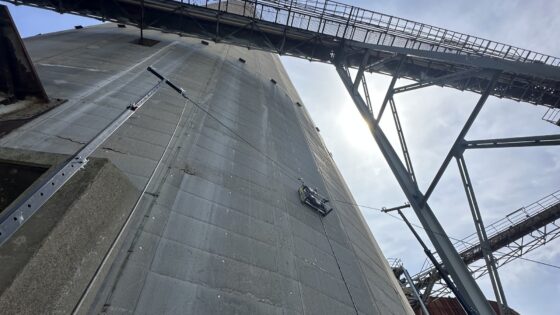
    Wall-climbing robots from a Birmingham-based firm have completed non-destructive testing on a 200m-tall reinforced concrete chimney at an EDF facility, proving they can adhere and manoeuvre on near-vertical surfaces at height. The trials focused on remote NDT data capture on the external shell, replacing rope-access technicians for ultrasonic and visual inspection passes over large areas in a single deployment. For asset managers, the approach points to faster condition assessments, reduced working-at-height exposure, and more frequent monitoring of tall stacks and cooling structures.

    Technical Brief

    • Magnetic or vacuum adhesion systems (not detailed publicly) are implied to sustain attachment on smooth concrete shells.
    • Remote operation keeps personnel outside the chimney’s fall and exclusion zones during inspection campaigns.
    • Consistent robotic scan paths improve repeatability of ultrasonic coverage versus variable rope-access technician positioning.
    • Data are captured digitally at source, enabling traceable inspection records aligned with typical asset integrity management systems.
    • Reduced need for scaffold or extended rope access shortens site occupation, easing interface with live power operations.

    Our Take

    Within the 78 Infrastructure stories in our database, very few Safety‑tagged pieces involve robotic inspection at heights approaching the 200 m scale, so EDF’s chimney trials sit at the more advanced end of remote NDT deployment.

    For operators of tall industrial stacks comparable to EDF’s 200 m structures, shifting NDT to wall‑climbing robots typically reduces the need for scaffolding or rope access, which can materially cut outage durations and work‑at‑height exposure on large power sites.

    Among the 191 tag‑matched Projects/Safety/Product items, most safety innovations focus on tunnels and bridges rather than vertical chimneys, suggesting this application could open a niche market for robotic vendors targeting legacy power infrastructure.

    Geotechnical Software for Modern Teams

    Centralise site data, logs, and lab results with GEODB-io, CMRR-io, and HYDROGEO-io.

    No credit card required.

    • Save and export unlimited calculations
    • Advanced data visualisation
    • Generate professional PDF reports
    • Cloud storage for all your projects

    Prepared by collating external sources, AI-assisted tools, and Geomechanics.io’s proprietary mining database, then reviewed for technical accuracy & edited by our geotechnical team.

    Related Articles

    DSIT’s CNI cybersecurity drive: design and monitoring lessons for engineers
    Infrastructure
    3 days ago

    DSIT’s CNI cybersecurity drive: design and monitoring lessons for engineers

    The Department for Science, Innovation and Technology has expanded its Cyber Runway Critical National Infrastructure programme with innovation accelerator Plexal to bring more cybersecurity SMEs into protecting UK energy, transport, water and digital networks. The scheme targets operational technology and industrial control systems used in assets such as substations, treatment works and tunnels, where legacy SCADA and remote monitoring are increasingly exposed to cyber-physical attacks. For civil and infrastructure engineers, this signals closer integration of cyber risk into asset design, condition monitoring and resilience planning.

    Gatwick PAS 2080 certification: whole-life carbon lessons for project teams
    Infrastructure
    3 days ago

    Gatwick PAS 2080 certification: whole-life carbon lessons for project teams

    London Gatwick has become the first airport globally to achieve PAS 2080:2023 certification for carbon management across its buildings and infrastructure assets. The BSI-verified standard requires quantified whole-life carbon baselines, option appraisal and reduction pathways for capital works, including terminals, piers, pavements and associated civil engineering. For designers and contractors working at Gatwick, future schemes will need to evidence embodied and operational carbon performance alongside cost, influencing material choices, construction methods and asset renewal strategies.

    Northern Ireland DfI AI road stock-take: asset management lessons for engineers
    Infrastructure
    3 days ago

    Northern Ireland DfI AI road stock-take: asset management lessons for engineers

    Northern Ireland’s Department for Infrastructure has commissioned mapping specialist Gaist to deliver a network-wide digital stock-take of its road assets using AI-based condition assessment. High-resolution imaging and machine-learning classification will be used to catalogue carriageway defects, drainage features and street furniture, creating a georeferenced inventory to support maintenance planning amid a mounting roads backlog. For asset managers and pavement engineers, the move signals a shift towards data-driven prioritisation of resurfacing, patching and drainage interventions across the regional network.

    Related Industries & Products

    Construction

    Quality control software for construction companies with material testing, batch tracking, and compliance management.

    Mining

    Geotechnical software solutions for mining operations including CMRR analysis, hydrogeological testing, and data management.

    CMRR-io

    Streamline coal mine roof stability assessments with our cloud-based CMRR software featuring automated calculations, multi-scenario analysis, and collaborative workflows.

    HYDROGEO-io

    Comprehensive hydrogeological testing platform for managing, analysing, and reporting on packer tests, lugeon values, and hydraulic conductivity assessments.

    GEODB-io

    Centralised geotechnical data management solution for storing, accessing, and analysing all your site investigation and material testing data.