Geomechanics.io

  • Free Tools
Sign UpLog In
Built byBoxcut Studio

Geomechanics.io

Geomechanics, Streamlined.

© 2026 Geomechanics.io. All rights reserved.

Geomechanics.io

CMRR-ioGEODB-ioHYDROGEO-ioQCDB-ioFree Tools & CalculatorsBlogLatest Industry News

Industries

MiningConstructionTunnelling

Company

Terms of UsePrivacy PolicyLinkedIn
    Projects
    Sustainability
    Product

    Fortescue’s first BYD BESS in the Pilbara: design and operations notes for mine engineers

    December 4, 2025|

    Reviewed by Tom Sullivan

    Fortescue’s first BYD BESS in the Pilbara: design and operations notes for mine engineers

    First reported on Australian Mining Review – News

    30 Second Briefing

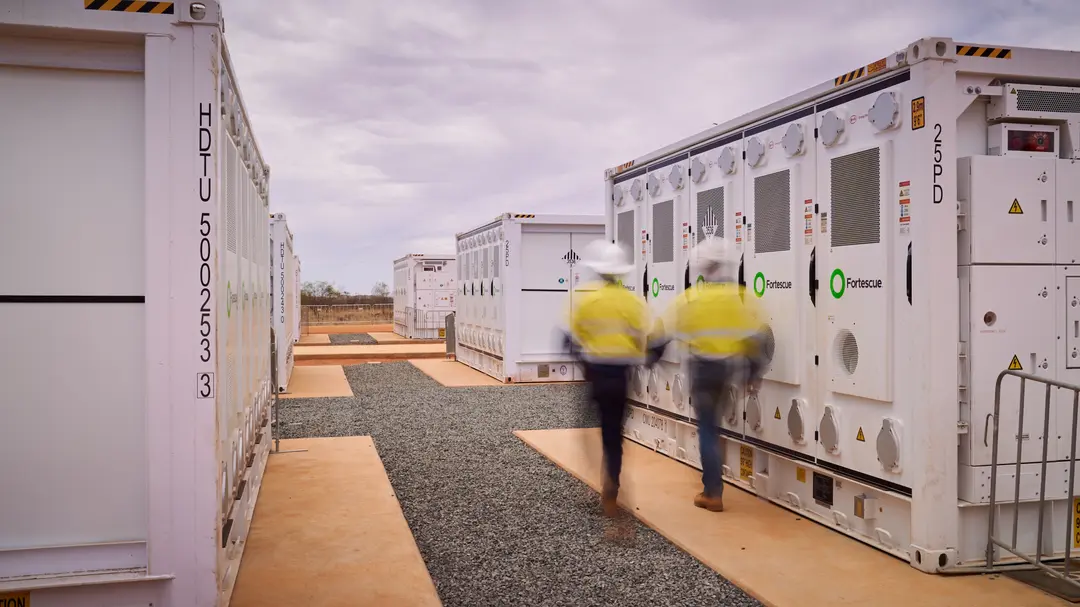
    Fortescue has installed its first large-scale BYD Battery Energy Storage System at North Star Junction in the Pilbara, a 250MWh, 50MW installation using 48 Blade Battery containers designed for high-temperature, heavy-duty mining conditions. The system will charge from daytime solar and feed Fortescue’s Pilbara Energy Connect network overnight, forming the first stage of a planned 4–5GWh storage rollout under its Real Zero strategy. A further 120MWh BESS is scheduled for Eliwana by early 2026, alongside the 190MW Cloudbreak Solar Farm now nearing 50% completion.

    Technical Brief

    • Fortescue’s NSJ BESS directly targets diesel and gas displacement in its iron ore power mix.
    • Stored energy is dispatched into the Pilbara Energy Connect (PEC) network rather than islanded mine microgrids.
    • Integration of a 190MW solar plant with multi-hundred-MWh BESS indicates a shift towards firmed renewables for remote mining.
    • Fortescue’s Real Zero programme is framed as one of the most ambitious mining decarbonisation efforts globally by BYD.

    Our Take

    The 250 MWh NSJ BESS at North Star Junction sits at the upper end of what our database shows for single-site storage in Australian iron ore operations, signalling Fortescue’s intent to run Pilbara iron ore mines on grid-like stability rather than typical islanded diesel microgrids.

    With a 4–5 GWh storage rollout planned across Pilbara Energy Connect by early 2026, Fortescue is effectively building a utility-scale storage fleet; this gives it optionality to integrate larger variable renewables at Eliwana and Cloudbreak Solar Farm without relying on new gas peakers.

    The related December 2025 item on Fortescue reshaping its Pilbara decarbonisation strategy suggests a pivot away from in-house battery pack manufacturing, so this BYD-supplied NSJ BESS likely marks a move towards partnering with established OEMs for mine power while Fortescue Zero focuses on other green technology lines.

    Geotechnical Software for Modern Teams

    Centralise site data, logs, and lab results with GEODB-io, CMRR-io, and HYDROGEO-io.

    Cancel at any time.

    • Save and export unlimited calculations
    • Advanced data visualisation
    • Generate professional PDF reports
    • Cloud storage for all your projects

    Prepared by collating external sources, AI-assisted tools, and Geomechanics.io’s proprietary mining database, then reviewed for technical accuracy & edited by our geotechnical team.

    Related Articles

    KSM project support from Nisga’a, Tahltan: permitting risks and schedule notes for engineers
    Mining
    about 5 hours ago

    KSM project support from Nisga’a, Tahltan: permitting risks and schedule notes for engineers

    Nisga’a and Tahltan Nations have reaffirmed their support for Seabridge Gold’s massive KSM copper-gold project in northwestern British Columbia after a 19 November BC Supreme Court ruling sent the project’s “substantially started” designation back to the province. The court ordered the government to conduct “deep consultation” with the Tsetsaut Skii km Lax Ha Nation before confirming the status, a key condition for maintaining KSM’s environmental assessment certificate. The decision injects permitting uncertainty and potential schedule risk into one of Canada’s largest undeveloped mining projects.

    Tudor’s $2.3B Treaty Creek mine: project economics and design risks for engineers
    Mining
    about 5 hours ago

    Tudor’s $2.3B Treaty Creek mine: project economics and design risks for engineers

    Tudor Gold’s Goldstorm deposit at Treaty Creek in northwestern British Columbia carries a post-tax NPV of $2.3 billion on initial capex of $1.54 billion, with a 28-year mine plan producing 4.68 million oz. of gold at a 20% IRR from a 10,000 t/d mill. The plan relies on higher-grade underground zones, including 13.6 million inferred tonnes at 3.78 g/t Au and nearby Perfectstorm (e.g. 9 g/t over 9.5 m), to lift early output to about 202,300 oz. Au/y in years three to 12. A key risk is infrastructure overlap and tunnel-rights conflict with Seabridge Gold’s KSM project, which may force facility relocation or redesign pending provincial and court-driven tenure decisions.

    Copper price slide after Nvidia rout: market signals for mine planners
    Mining
    about 5 hours ago

    Copper price slide after Nvidia rout: market signals for mine planners

    Copper fell 3.5% on Comex to $5.437/lb ($11,985/t), 21% below its September record, as investors rotated out of commodities after the Nvidia-driven AI rout and traders diverted an estimated 30,000–100,000 t of US cathode to China. Yangshan premiums have surged from under $100/t to about $500/t and visible exchange stocks cover only two days’ consumption, yet financial selling dominates amid expectations of a further Fed rate rise and uncertainty over US refined copper tariffs. Smelter treatment charge talks for 2027 remain deeply negative, with Antofagasta reportedly near –$200/t versus Tongling around –$80/t, threatening Chinese smelter margins and raising the risk of concentrate processing cuts.

    Related Industries & Products

    Mining

    Geotechnical software solutions for mining operations including CMRR analysis, hydrogeological testing, and data management.

    Construction

    Quality control software for construction companies with material testing, batch tracking, and compliance management.

    CMRR-io

    Streamline coal mine roof stability assessments with our cloud-based CMRR software featuring automated calculations, multi-scenario analysis, and collaborative workflows.

    QCDB-io

    Comprehensive quality control database for manufacturing, tunnelling, and civil construction with UCS testing, PSD analysis, and grout mix design management.

    HYDROGEO-io

    Comprehensive hydrogeological testing platform for managing, analysing, and reporting on packer tests, lugeon values, and hydraulic conductivity assessments.

    AllGeotechnicalInfrastructureHazardsEnvironmental