Dorking–Horsham landslip: geotechnical failure lessons for rail engineers
Reviewed by Joe Ashwell
First reported on New Civil Engineer
30 Second Briefing
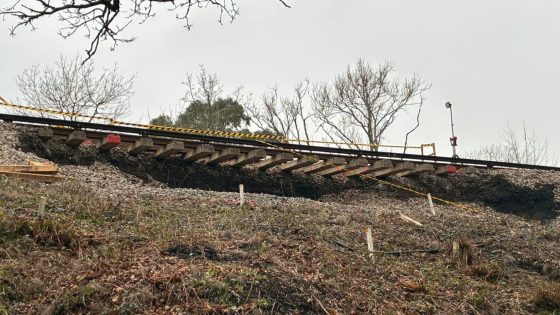
A landslip south of Ockley station in Surrey has stripped away the embankment supporting one of the two Horsham–Dorking tracks, leaving the rail and sleepers cantilevered in mid‑air and forcing full closure of the route until at least mid‑February. Network Rail engineers now face emergency stabilisation of the failed cutting or embankment, reconstruction of the formation, and re‑ballasting before traffic can resume. The incident will focus attention on drainage, slope monitoring and resilience of Victorian earthworks under increasingly intense winter rainfall.
Technical Brief
- Embankment failure appears as a near-vertical scarp with ballast and subgrade completely removed beneath one rail.
- Failure mechanism likely shallow rotational or translational slip in oversteepened, waterlogged fill or cutting.
- Investigation will rely on rapid visual inspection, geomorphological mapping, and targeted boreholes or dynamic probing along the slip.
- Remote condition assessment using LiDAR, photogrammetry and track-mounted geometry cars will define deformation extent and residual capacity.
- Short-term remediation options include sheet piles, king post walls or soil nails with sprayed concrete facing to re-support the cess.
- Continuous monitoring with automated total stations, tilt sensors and piezometers would typically be deployed during and after reinstatement.
- Safety protocols require full line block, exclusion zones at the scarp, and strict plant access control under relevant rail standards.
- Similar earthwork failures are driving route-wide resilience programmes, prioritising high-risk cuttings and embankments for drainage upgrades.
Our Take
Among the 36 Hazards stories in our coverage, UK rail earthwork failures like this Ockley–Surrey landslip are relatively infrequent compared with flood and tunnel incidents, suggesting slope management on secondary routes may now attract closer scrutiny from asset owners.
The extended route closure ‘until at least mid‑February’ implies a significant loss of track support, which typically triggers full geotechnical re‑design rather than simple reinstatement, with knock‑on implications for similar cuttings on the Dorking–Horsham corridor.
With this tagged under both Failure and Projects, it is likely to be treated as a capital intervention rather than routine maintenance, meaning designers may push for more conservative earthwork geometries and drainage upgrades on comparable Victorian-era embankments in the United Kingdom network.
Prepared by collating external sources, AI-assisted tools, and Geomechanics.io’s proprietary mining database, then reviewed for technical accuracy & edited by our geotechnical team.
Related Articles


Related Industries & Products
Construction
Quality control software for construction companies with material testing, batch tracking, and compliance management.
Mining
Geotechnical software solutions for mining operations including CMRR analysis, hydrogeological testing, and data management.
QCDB-io
Comprehensive quality control database for manufacturing, tunnelling, and civil construction with UCS testing, PSD analysis, and grout mix design management.