Devon coast rail services resume: sea wall collapse lessons for coastal engineers
Reviewed by Tom Sullivan
First reported on New Civil Engineer
30 Second Briefing
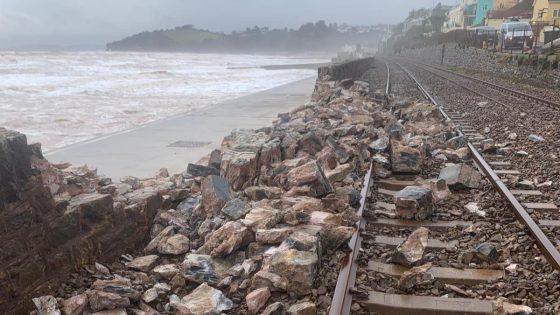
Rail services between Teignmouth and Dawlish Warren have restarted after Network Rail engineers removed debris from the coastal tracks caused by a sea wall collapse during Storm Ingrid. The failure occurred on the exposed Dawlish–Teignmouth frontage, a critical single coastal rail corridor where wave loading and overtopping have previously driven major resilience works. Engineers will now need to reassess wall stability, drainage and scour protection along this reach, with likely implications for design freeboard, armour detail and inspection regimes under more frequent extreme storm events.
Technical Brief
- Collapse mechanism likely involved local toe scour and loss of passive support to the wall stem.
- Network Rail will need detailed post-storm inspections: crack mapping, void detection and foundation exposure checks.
- Failure investigation typically combines bathymetric surveys, LiDAR of the frontage and back-analysis of wave conditions.
- Ongoing monitoring may require tiltmeters, crack gauges and periodic drone photogrammetry along the affected reach.
- Debris clearance and track reopening imply rapid structural triage to confirm no rail-seat or ballast undermining.
- Temporary risk controls would include reduced line speeds, exclusion zones and enhanced lookouts during high tides.
- Safety review is likely to revisit inspection intervals, trigger levels and emergency possession procedures for coastal assets.
- Similar coastal rail defences may need updated design storms and overtopping criteria under revised climate projections.
Our Take
Network Rail’s Devon coastline between Teignmouth and Dawlish Warren already features heavily in our Hazards coverage as a repeat-exposure corridor, signalling that asset owners here are likely to face escalating lifecycle costs for sea wall strengthening and track resilience rather than one-off repairs.
Within the 34 Hazards stories in our database, UK rail incidents often trigger rapid design reviews of adjacent coastal or embankment assets, so similar masonry or concrete sea walls along the South West main line can expect closer structural inspections and more conservative maintenance intervals after this failure.
For practitioners, this type of sea wall collapse on a live route in Devon underlines that resilience schemes now tend to be evaluated on whole-route operability rather than local stability alone, pushing designers to integrate wave loading, overtopping, and debris impact scenarios into rail safety cases for Network Rail assets.
Prepared by collating external sources, AI-assisted tools, and Geomechanics.io’s proprietary mining database, then reviewed for technical accuracy & edited by our geotechnical team.
Related Articles

Related Industries & Products
Mining
Geotechnical software solutions for mining operations including CMRR analysis, hydrogeological testing, and data management.
Construction
Quality control software for construction companies with material testing, batch tracking, and compliance management.
CMRR-io
Streamline coal mine roof stability assessments with our cloud-based CMRR software featuring automated calculations, multi-scenario analysis, and collaborative workflows.
HYDROGEO-io
Comprehensive hydrogeological testing platform for managing, analysing, and reporting on packer tests, lugeon values, and hydraulic conductivity assessments.
GEODB-io
Centralised geotechnical data management solution for storing, accessing, and analysing all your site investigation and material testing data.