Geomechanics.io

  • Free Tools
Sign UpLog In

    Geomechanics.io

    Geomechanics, Streamlined.

    © 2026 Geomechanics.io. All rights reserved.

    Geomechanics.io

    CMRR-ioGEODB-ioHYDROGEO-ioQCDB-ioFree Tools & CalculatorsBlogLatest Industry News

    Industries

    MiningConstructionTunnelling

    Company

    Terms of UsePrivacy PolicyLinkedIn
    Projects
    Product
    Sustainability

    BHP–Rio Tinto battery-electric trucks in Pilbara: haulage trial insights for engineers

    December 6, 2025|

    Reviewed by Joe Ashwell

    BHP–Rio Tinto battery-electric trucks in Pilbara: haulage trial insights for engineers

    First reported on MINING.com

    30 Second Briefing

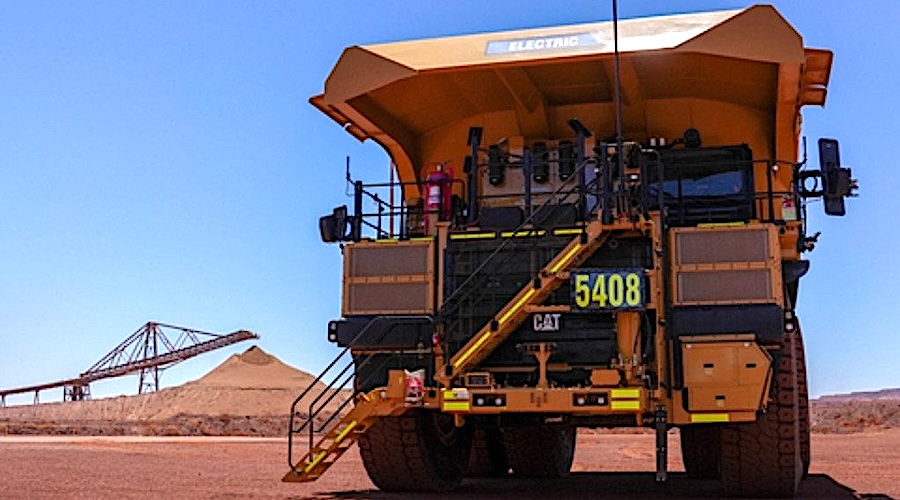
    BHP and Rio Tinto have begun joint trials of two Caterpillar Early Learner 793 XE battery-electric haul trucks at BHP’s Jimblebar iron ore mine in the Pilbara, testing whether fully electric haulage can handle large-scale iron ore operations across 18 Rio Tinto mines and BHP’s Western Australia portfolio. The programme focuses on validating truck battery performance, high-capacity charging infrastructure and associated supply chains under Pilbara duty cycles. Results will determine whether the miners progress to broader trials or fleet integration as they target net zero operational emissions by 2050.

    Technical Brief

    • Initial deployment is at BHP’s Jimblebar iron ore mine in Western Australia’s Pilbara.
    • Joint programme is structured so BHP and Rio Tinto make independent decisions on any fleet roll-out.
    • Testing scope explicitly includes validation of high-capacity charging infrastructure and associated logistics supply chains.
    • Operational focus is on decarbonising large ultra-class haul truck fleets currently dominated by diesel units.
    • OEM involvement (Caterpillar senior vice president–level engagement) signals alignment of truck design with miner duty cycles.
    • Collaboration model reflects an emerging pattern of multi-operator consortia to de-risk zero-emission haulage technology adoption.

    Our Take

    BHP’s Pilbara iron ore operations appear frequently in our 176 Mining stories, but this is one of the few where the company’s decarbonisation push (net-zero by 2050) intersects directly with mobile fleet trials, signalling that haulage is now a primary lever rather than just fixed-plant efficiency.

    With Rio Tinto’s 18-mine Pilbara iron ore network involved, even a two-truck Caterpillar battery-electric trial has system-level implications: any successful duty cycle here can be replicated across one of the world’s largest integrated iron ore hubs, putting pressure on peers in Western Australia to accelerate similar pilots.

    The presence of UBS alongside BHP and Rio Tinto in this piece underlines that capital markets are now tracking operational decarbonisation in iron ore as closely as they track M&A moves such as BHP’s approaches to Anglo American, which can influence the cost of capital for large-scale fleet transition programmes.

    Geotechnical Software for Modern Teams

    Centralise site data, logs, and lab results with GEODB-io, CMRR-io, and HYDROGEO-io.

    No credit card required.

    • Save and export unlimited calculations
    • Advanced data visualisation
    • Generate professional PDF reports
    • Cloud storage for all your projects

    Prepared by collating external sources, AI-assisted tools, and Geomechanics.io’s proprietary mining database, then reviewed for technical accuracy & edited by our geotechnical team.

    Related Articles

    Young-Davidson mine disruptions: seismic and power impacts explained for engineers
    Mining
    about 15 hours ago

    Young-Davidson mine disruptions: seismic and power impacts explained for engineers

    Alamos Gold expects second-quarter output from its Young-Davidson underground mine in northern Ontario to fall to 130,000–135,000 oz, about 12% below prior guidance, after two seismic events damaged infrastructure and cut access to two higher-grade stopes, compounded by a three-day storm-related power outage. Consolidated 2026 production is now projected below full-year guidance with unit costs rising, with revised figures due in July. Production stability is shifting to the Island Gold District, where underground mining rates are planned to increase from 1,500 to 2,000 t/d and the Magino mill ramp-up targets 10,000 t/d by Q3.

    Trinity Metals’ 20% US tungsten supply: project scale and offtake notes for engineers
    Mining
    about 15 hours ago

    Trinity Metals’ 20% US tungsten supply: project scale and offtake notes for engineers

    Trinity Metals has doubled exports from its Nyakabingo tungsten mine in Rwanda to Global Tungsten & Powders, now supplying up to 20% of US primary tungsten concentrate consumption, with more than 320 tonnes of 65–70% WO₃ wolframite shipped since a 2025 offtake deal with Traxys. The 1,600-hectare Nyakabingo concession holds an estimated 30,000 tonnes of recoverable tungsten, is licensed for 25 years from 2015, and is undergoing deep drilling to expand resources. Trinity plans to triple production and is targeting a $100–$200 million international listing, positioning Rwanda as a key conflict-free 3T supplier amid Chinese export restrictions.

    SMRs and mining’s nuclear reality check: key power-planning takeaways for engineers
    Mining
    about 15 hours ago

    SMRs and mining’s nuclear reality check: key power-planning takeaways for engineers

    Small and micro modular reactors (SMRs and microreactors) sit at the bottom of miners’ low‑carbon power options, despite intense promotion of 300 MW‑class SMRs, AI‑optimised reactor operations and bullish uranium price forecasts. Developers are pitching factory‑built, modular units for remote sites and off‑grid mines, but operators still prioritise proven renewables‑plus‑storage, grid power and gas or diesel hybrids. For mine planners and power engineers, nuclear remains a long‑term possibility rather than a near‑term procurement item for new pits, expansions or remote processing hubs.

    Related Industries & Products

    Mining

    Geotechnical software solutions for mining operations including CMRR analysis, hydrogeological testing, and data management.

    Construction

    Quality control software for construction companies with material testing, batch tracking, and compliance management.

    CMRR-io

    Streamline coal mine roof stability assessments with our cloud-based CMRR software featuring automated calculations, multi-scenario analysis, and collaborative workflows.

    HYDROGEO-io

    Comprehensive hydrogeological testing platform for managing, analysing, and reporting on packer tests, lugeon values, and hydraulic conductivity assessments.

    GEODB-io

    Centralised geotechnical data management solution for storing, accessing, and analysing all your site investigation and material testing data.

    AllGeotechnicalMiningInfrastructureMaterialsHazardsEnvironmentalSoftwarePolicy