Geomechanics, Streamlined.
© 2026 Geomechanics.io. All rights reserved.
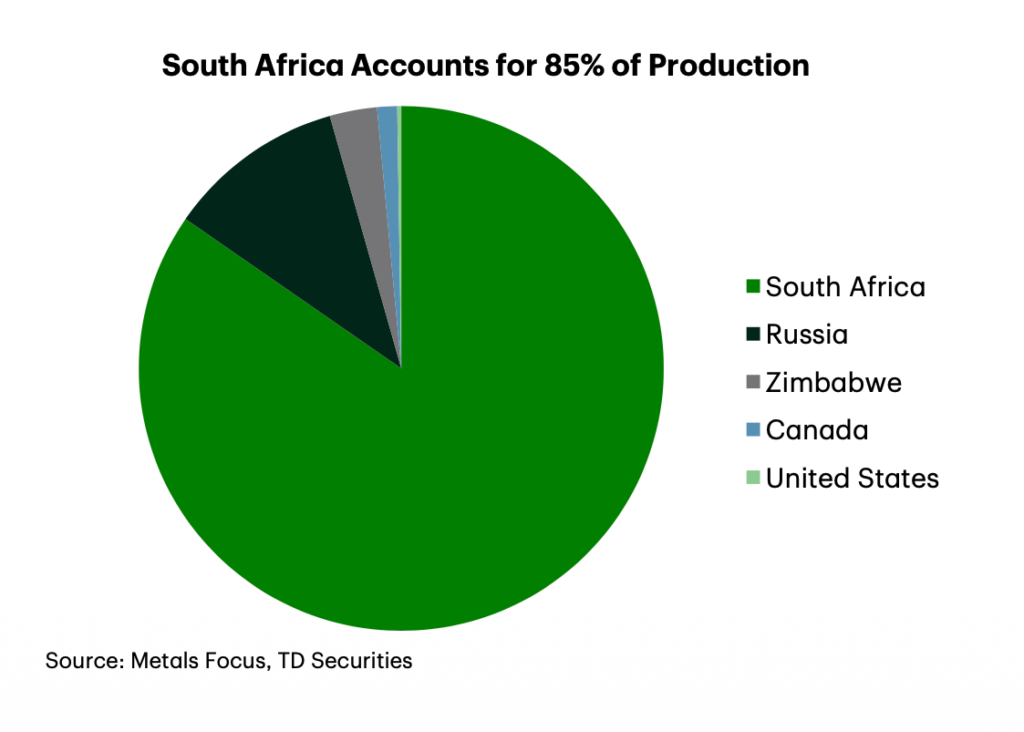
Rhodium is forecast by TD Commodity Strategy to swing to a 20,000‑oz surplus in 2027 after four years of deficits, pushing prices down from about $9,000/oz to $7,600 in 2027 and $6,500 in 2028 as mine and recycled supply rise against flat or falling autocatalyst demand. Above‑ground stocks are seen shrinking to just over three months of consumption, with South Africa’s highly concentrated output (about 85% of primary supply, half from five PGM mines) and a >3‑month refining cycle leaving prices prone to sharp spikes on any disruption. Autocatalyst demand is being eroded by EV uptake, while substitution into palladium can require 18–24 months and five to eight times the metal, and recycling growth is constrained by recovery rates and limited processing capacity.
Gemfields will book a $73.5 million half-year loss after a $125.2 million impairment at its Montepuez ruby mine in Mozambique, lifting the cumulative writedown on the asset to $65 million as premium ruby grades and recoveries lag expectations. The PP2 processing plant, designed to triple capacity from 200 to 600 tonnes per hour, has intermittently exceeded nameplate throughput but remains in final commissioning after transformer damage, excessive component wear, equipment defects and choking cut availability. Management has cut group operating costs by 17%, raised $30 million via a rights issue and sold Fabergé for $50 million as it focuses on stabilising Montepuez output and maintaining auction-driven cash flow.
BHP’s Escondida mine in Chile, the world’s largest copper operation at about 1.3 million tonnes per year and 58.5% owned by BHP with Rio Tinto holding 30%, is gradually restarting after a fatal accident halted production during record COMEX prices of $6.83 per pound. The restart comes as Shanghai Futures Exchange inventories sit near cyclical lows at roughly 47,000 tonnes and International Copper Study Group data show refined demand at an annualised 29 million tonnes versus 28.4 million tonnes of supply. BHP plans a new concentrator at Escondida within a growth pipeline targeting roughly 40% higher group copper output by fiscal 2035, reinforcing the mine’s leverage over market balance.
Lundin Gold has reported record grades at its Fruta del Norte district in Ecuador, including a 3-metre Bonza Sur intercept grading 204.26 g/t gold from 140 m, with a 60 cm sub-interval at 1,035.60 g/t, and 5.5 m at 13.75 g/t gold and 50.8 g/t silver from 715 m in hole BLP-2026-483-D2. The newly defined Quebrada Dorada vein system, 2 km south of Bonza Sur, has returned 13 m at 6.53 g/t gold from ~195 m and extends mineralisation over 2.7 km, open to the south. With three rigs at Bonza Sur and two at Quebrada Dorada, Lundin is targeting higher-grade zones adjacent to existing Fruta del Norte South underground development to extend the current 12-year mine life and build on 5.85 Moz of proven and probable reserves.
Global technology-sector gold demand stayed flat at 323 tonnes in 2025 despite surging AI chip sales, as miniaturisation and design changes to reduce or remove gold offset new AI-related uses, the World Gold Council reports. Gold traded around US$4,270/oz on Friday, roughly 14% higher year-on-year, keeping cost pressure on manufacturers that are redesigning connectors and contacts. Co-packaged optics (CPO) for hyperscale AI data centres, backed by Nvidia and other chipmakers, could become a meaningful new source of demand because lasers and high‑frequency electrodes in CPO packages still rely on gold’s durability and conductivity.
Metals are now trading as “stock puppets”, with Bloomberg Intelligence senior commodity strategist Mike McGlone warning that copper closely shadows US equity moves, potentially falling 20–30% if a “normal” 10% stock market correction occurs. He cautions that current gold enthusiasm looks “too peakish”, arguing investors should “be selling when they’re yelling” rather than treating bullion as a one-way hedge. McGlone links the Fed’s latest rate hike to US checks and balances, expecting equity weakness to be the first clear signal of a shift from inflation to deflation.
North America’s rare earth build‑out is racing ahead of its talent pipeline, with more than $10 billion committed to US rare earths and magnets but only about $180 million earmarked for mining education and just 14 accredited mining schools producing roughly 170–285 mining and mineral engineering graduates a year. The DOE’s PROSPECT programme, worth up to $100 million plus a $16 million Planning Prize, aims to double mining and supply‑chain credentials within two years, while proposed Department of War awards would send $32.7 million to Colorado School of Mines and $25 million to South Dakota Mines. Against DOE’s estimate of 6,000 new mining engineers needed over the next decade and a looming “grey tsunami” of 221,000 retirements by 2029, juniors already report junior geologists billing $500–$600 per day and 71% of mining leaders say talent shortages are constraining production.
Lithium-cesium-tantalum pegmatite projects are being advanced on simplified grade models that ignore strong mineralogical zoning, with cases such as Mount Marion showing fine-grained spodumene and high mica contents can destabilise DMS media, depress concentrate grades and force costly plant retrofits. At Canada’s Tanco pegmatite, assuming a uniform 60:40 spodumene–quartz intergrowth and overlooking iron and phosphate phases contributed to inefficient plant design and shutdowns. Patriot Battery Metals’ Shaakichiuwaanaan feasibility study similarly relies on a 1D Li₂O recovery formula, without 3D modelling of mica, arsenic and antimony domains that could flag low-density clay-rich zones and DMS underperformance.
Development finance for critical minerals mines, processing plants and supporting infrastructure is expanding, while funding for transparency tools, civil society oversight and community participation is being cut, according to a Washington-based donor network. The group warns of a “second funding gap” in governance support as multilateral banks and state-backed lenders prioritise capital-intensive extraction and refining projects. For miners and engineers, this signals rising scrutiny risks around licence-to-operate, community consent processes and ESG reporting, even where project finance appears readily available.
Martin Engineering is expanding its presence in Ghana by partnering with Aggrey & Associates, a UK- and Ghana-based consultancy with a long track record in bulk materials handling across mining and industrial operations. The collaboration is aimed at deploying Martin’s conveyor belt cleaners, transfer point sealing, and flow aid technologies more widely across Ghanaian mines and ports, using Aggrey’s local engineering and project management capability. For operators, this signals easier access to specialist support on carryback control, spillage reduction, and chute performance without relying on overseas service teams.
BQE Water has restarted the selenium removal plant at Centerra Gold’s Kemess project in British Columbia, using its patented Selen-IX™ ion exchange process to treat mine-impacted water. The Kemess installation was the first full-scale Selen-IX™ plant, designed to remove dissolved selenium to low µg/L levels without generating large volumes of sludge typical of lime co-precipitation systems. The restart confirms long-term operability of the modular Selen-IX™ circuit, relevant for sites facing tightening selenium discharge limits in mountainous, high-runoff catchments.
Balfour Beatty plans to recruit about 2,000 additional UK staff by the end of next year, taking its domestic workforce to roughly 16,000 as major infrastructure programmes accelerate. The expansion is expected to support large rail, highways and energy schemes, where labour availability is already a constraint on delivery and productivity. Contractors and consultants bidding into Balfour Beatty’s supply chain can expect increased demand for site engineers, temporary works designers and specialist subcontractors as workbanks on complex civils projects grow.
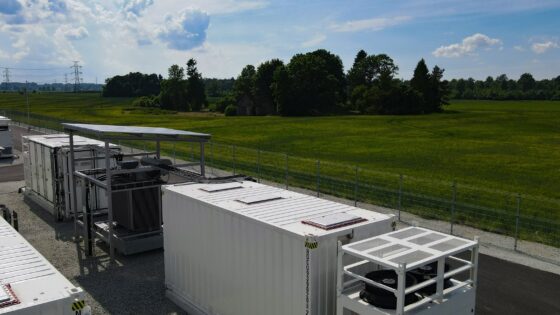
UK infrastructure specialists are targeting large-scale storage, climate-resilient design and grid standardisation to shore up energy resilience as ageing 275kV and 400kV transmission assets meet rapidly growing offshore wind and solar connections. Engineers are modelling multi-day storage using grid-scale batteries and hydrogen-ready peaking plant, while revising substation and cable corridor designs for higher-intensity rainfall, coastal erosion and overheating risk. Standardised connection interfaces and digital twins for transmission–distribution boundaries are being pushed to cut reinforcement delays and manage increasingly intermittent generation profiles.
The UK government has committed £331M to climate resilience projects aimed at protecting critical infrastructure and improving access to clean water for vulnerable communities. Funding will support flood and coastal defence upgrades, nature-based solutions such as wetland and river restoration, and reinforcement of assets like water treatment works and strategic transport links exposed to extreme weather. Civil and geotechnical engineers should expect increased demand for resilient drainage design, asset hardening, and long-term performance assessment under more frequent high-intensity rainfall and coastal surge conditions.
Carbon capture in cement production is being pushed as a near‑term route to cut emissions from a material responsible for up to 8% of global CO₂ output, with technologies such as post‑combustion capture on kiln exhausts and oxy‑fuel firing now moving from pilots to early commercial schemes. Current projects focus on retrofitting existing clinker lines, integrating amine‑based capture units and planning CO₂ transport to geological storage or utilisation plants. For designers and contractors, this raises immediate questions on specifying low‑embodied‑carbon concretes, verifying EPD data, and managing supply risk as capture retrofits disrupt plant operations.
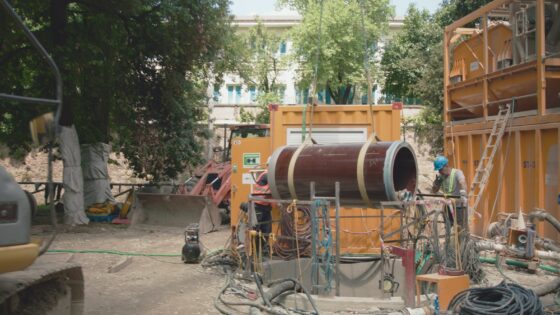
Trenchless tunnelling schemes in Germany and Italy are using microtunnelling to install new utility and wastewater pipelines under urban areas while avoiding open-cut excavation and major traffic disruption. The projects deploy remotely steered, pipe-jacked microtunnel boring machines launched from small shafts to thread beneath existing roads and buried services, maintaining cover and line within tight tolerances. For geotechnical and civil teams, the work reinforces microtunnelling as a practical option where shallow cover, dense service corridors and strict surface access constraints rule out conventional trenching.
Geopolitical and economic uncertainty is pushing 61% of construction businesses to increase their commitment to innovation, according to Ayming’s International Innovation Barometer 2027. The survey points to firms prioritising digital tools, new construction materials and process optimisation to manage cost volatility and supply chain disruption. For civil and infrastructure engineers, this signals stronger client appetite for technologies such as BIM-based design coordination, offsite fabrication and alternative material specifications to de-risk programme and budget.
Delivering a 505km high-voltage “electricity superhighway” between Scotland and England is exposing complex consenting, land access and interface issues across multiple local authorities and environmentally sensitive corridors. Engineers are having to integrate new high-capacity transmission circuits with existing substations and overhead line routes while maintaining system security, often relying on long HDD river crossings, constrained construction compounds and tight outage windows. The project is setting practical benchmarks for routing, stakeholder management and constructability on future UK grid reinforcements needed for large-scale offshore wind and other renewables.
Barhale has secured a £14.6M contract from Anglian Water to build a twin pumped rising main at Alconbury Weald, Cambridgeshire, increasing wastewater network capacity for planned large-scale development on the former airfield site. The scheme will require parallel pressure pipelines, new pumping infrastructure and tie-ins to the existing foul network, with construction likely to involve trenching through mixed glacial and alluvial deposits and careful management of groundwater and settlement risk. For geotechnical and civils teams, key issues will include pipeline alignment optimisation, surge control, and long-term access for maintenance.
Network Rail will invest £1.4M to renew over 730m of track between Hubbert’s Bridge and Swineshead on the Boston–Sleaford line in Lincolnshire, targeting a known maintenance pinch point. Works will involve lifting and replacing rail, sleepers and ballast on this rural two-track section, where drainage and formation condition have previously constrained line speed and imposed temporary speed restrictions. Contractors will need to manage possessions on a mixed-traffic route carrying passenger services and agricultural freight, with careful staging to minimise disruption during the renewal.
Via East Midlands, the highways arm of Nottinghamshire County Council, is launching early market engagement for a proposed £5M highways maintenance and civil engineering framework covering local roads and associated assets. The framework is expected to bundle routine carriageway and footway works, minor structures, drainage and associated civils into a multi-year arrangement, giving SMEs and regional contractors clearer visibility of work pipelines. Contractors should prepare capability evidence on reactive and planned maintenance, traffic management on constrained local networks, and delivery of small to medium civils packages under framework call-offs.
Associated Asphalt has completed a major maintenance programme on the M40, resurfacing and repairing approximately 75km of carriageway on one of the UK’s key north–south motorway links. Works are understood to have focused on high-stress sections, including lane 1 heavy goods vehicle tracks and junction merge/diverge areas, using modern asphalt surfacing systems to improve skid resistance and durability. For geotechnical and pavement engineers, the scale of intervention on a live motorway highlights ongoing asset management demands on ageing flexible pavements under rising traffic and axle loads.
Two low‑carbon heat network schemes spanning seven London boroughs have secured a combined £53.1M in government funding to expand district-scale, pipe‑fed heating infrastructure. The awards back large‑diameter buried distribution mains, central energy centres and building‑level heat interface units designed to displace individual gas boilers in dense urban housing and mixed‑use stock. For civil and geotechnical teams, the projects signal substantial trenching, utility coordination and shaft works in constrained streets, with long linear workfronts and tight programmes across multiple local authorities.
Southern Water is rolling out a distributed fibre‑optic leak‑detection system from UK firm Lightsonic on trunk mains across the south of England to cut losses as drought risk and network age increase. The technology uses continuous fibre along the pipeline to sense acoustic and temperature changes in real time, allowing operators to pinpoint leaks to within metres and respond before major bursts develop. For civil and water engineers, this signals growing deployment of long‑range, permanently installed monitoring rather than spot surveys on critical transmission assets.