Geomechanics.io

  • Free Tools
Sign UpLog In

Geomechanics.io

Geomechanics, Streamlined.

© 2026 Geomechanics.io. All rights reserved.

Geomechanics.io

CMRR-ioGEODB-ioHYDROGEO-ioQCDB-ioFree Tools & CalculatorsBlogLatest Industry News

Industries

MiningConstructionTunnelling

Company

Terms of UsePrivacy PolicyLinkedIn
    AllGeotechnicalMiningInfrastructureMaterialsHazardsEnvironmentalSoftwarePolicy
    Projects
    Sustainability
    Product

    World’s first CO₂‑neutral concrete bridge: design and verification notes for engineers

    January 22, 2026|

    Reviewed by Tom Sullivan

    World’s first CO₂‑neutral concrete bridge: design and verification notes for engineers

    First reported on New Civil Engineer

    30 Second Briefing

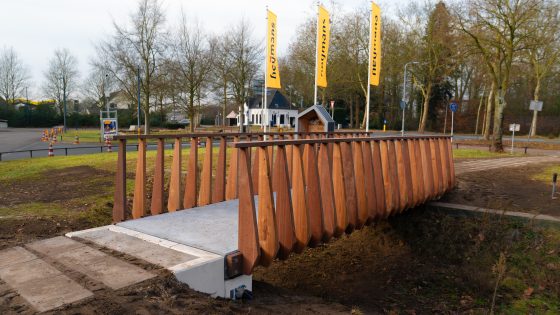
    A 7m pedestrian bridge in the Netherlands has been unveiled as the world’s first using a concrete mix claimed to be CO₂‑neutral over its life cycle. Developers report that the binder system and aggregate selection are engineered so that production and curing emissions are fully offset by in‑service CO₂ uptake, without relying on external carbon credits. For designers, the project signals that carbon‑neutral structural concrete is moving from lab trials to full‑scale applications, raising immediate questions on durability testing, Eurocode compliance and verification of whole‑life carbon accounting.

    Technical Brief

    • Small structural footprint simplifies monitoring of carbonation depth, crack patterns and surface scaling over time.
    • Asset scale and access make it suitable as a long‑term field laboratory for in‑situ coring and NDT.
    • For other projects, short‑span footbridges offer a low‑risk route to trial novel low‑carbon binders.

    Our Take

    Among the 27 Materials stories in our coverage, very few involve the Netherlands, so a CO2‑neutral concrete pedestrian bridge there signals that Dutch infrastructure clients may become early adopters and reference customers for low‑carbon structural materials.

    Because this is a 7 m pedestrian span rather than a highway or rail bridge, it fits a pattern in our sustainability‑tagged projects where novel cementitious products are first proven on small, low‑risk structures before being scaled to major transport assets.

    Within the 1398 tag‑matched pieces on Projects and Sustainability, most concrete‑related items focus on partial emissions reductions; positioning this as ‘CO2‑neutral’ will likely pressure other European materials suppliers to quantify and disclose full life‑cycle carbon for comparable bridge products.

    Geotechnical Software for Modern Teams

    Centralise site data, logs, and lab results with GEODB-io, CMRR-io, and HYDROGEO-io.

    No credit card required.

    • Save and export unlimited calculations
    • Advanced data visualisation
    • Generate professional PDF reports
    • Cloud storage for all your projects

    Prepared by collating external sources, AI-assisted tools, and Geomechanics.io’s proprietary mining database, then reviewed for technical accuracy & edited by our geotechnical team.

    Related Articles

    Advancing low carbon concrete in Australian infrastructure: design notes for engineers
    Materials
    3 days ago

    Advancing low carbon concrete in Australian infrastructure: design notes for engineers

    Approval of a 60 per cent Supplementary Cementitious Material (SCM) concrete mix by VicRoads for road and transport projects across Victoria marks a major shift in allowable low-carbon binders for state infrastructure. The mix, developed and trialled with Geoquest Australia, replaces the majority of Portland cement with SCMs such as fly ash and slag, cutting embodied carbon while maintaining performance to VicRoads specifications. Designers and contractors can now specify substantially higher SCM contents on VicRoads projects without seeking project-by-project exemptions.

    Latrobe Magnesium prepayment: project and process takeaways for materials engineers
    Materials
    4 days ago

    Latrobe Magnesium prepayment: project and process takeaways for materials engineers

    Latrobe Magnesium has secured a non-dilutive prepayment from its US distribution partner Metal Exchange LLC to advance its Latrobe Valley magnesium production project, which uses fly ash from brown coal power generation as feedstock. The funding supports commissioning of LMG’s initial commercial plant designed to produce magnesium ingots and supplementary products such as cementitious material from waste residues. For mining and materials engineers, the deal signals growing commercial backing for ash-to-magnesium processing as an alternative to conventional dolomite- or magnesite-based routes.

    Moonshot metals scramble: alloy demand and specs explained for project engineers
    Materials
    5 days ago

    Moonshot metals scramble: alloy demand and specs explained for project engineers

    NASA’s Orion spacecraft programme is driving demand for advanced alloys, with aluminium‑lithium in the crew module to cut mass, titanium for primary structural members, and nickel‑based superalloys in engines to withstand extreme thermal loads. These specifications exemplify how deep-space missions are tightening requirements on fatigue life, high‑temperature creep resistance and weldability in lightweight alloys. For miners and metallurgical suppliers, the mix of Al‑Li, titanium and high‑nickel feedstocks signals sustained demand for high‑purity ores and tightly controlled processing routes.

    Related Industries & Products

    Construction

    Quality control software for construction companies with material testing, batch tracking, and compliance management.

    Mining

    Geotechnical software solutions for mining operations including CMRR analysis, hydrogeological testing, and data management.

    CMRR-io

    Streamline coal mine roof stability assessments with our cloud-based CMRR software featuring automated calculations, multi-scenario analysis, and collaborative workflows.

    HYDROGEO-io

    Comprehensive hydrogeological testing platform for managing, analysing, and reporting on packer tests, lugeon values, and hydraulic conductivity assessments.

    GEODB-io

    Centralised geotechnical data management solution for storing, accessing, and analysing all your site investigation and material testing data.