Holcim starts imports at Tilbury: circular cement plant design notes for engineers
Reviewed by Tom Sullivan
First reported on The Construction Index
30 Second Briefing
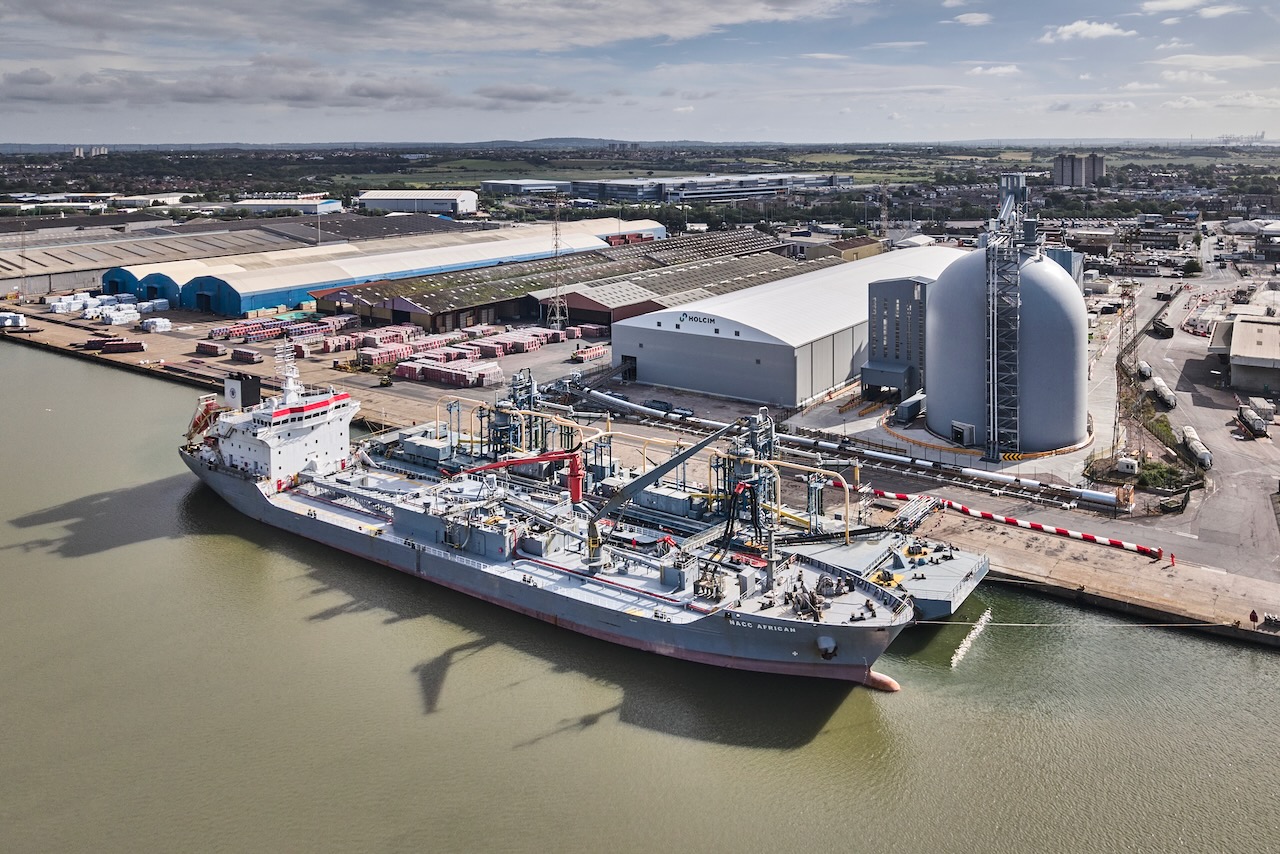
Holcim’s Tilbury Cement Works has begun importing cementitious materials via a deep‑water berth at the Port of Tilbury, using a new ship‑to‑shore conveyor, enclosed belt conveyors and the UK’s first 30,000‑tonne cement dome silo to feed six loading heads and five weighbridges. A vertical roller mill due in late 2026 will grind GBFS and recycled concrete fines to produce GGBFS and blended cements, with ECOPlanet and ECOPlanet with ECOCycle products scheduled for early 2027. The site has been built using circular practices, reusing 25,000m³ of crushed concrete and 10,000 tonnes of reclaimed asphalt.
Technical Brief
- Deep‑water berth at the Port of Tilbury enables direct unloading from large ocean‑going bulk carriers.
- Marine import, storage and dispatch systems are already operational, while grinding and blending modules complete in 2026.
- Location targets London, the South East and major schemes such as the Lower Thames Crossing corridor.
- Six loading heads and five weighbridges are configured for high‑throughput, automated outbound logistics.
- NACC Sustament cement carrier, due 2027, will supply Tilbury using green methanol propulsion.
- Terminal layout has been engineered for future low‑clinker materials, explicitly including potential calcined clay processing.
- Construction reused 25,000 m³ of crushed concrete on site, reducing primary aggregate demand and haulage.
- A further 10,000 tonnes of reclaimed asphalt and 20,000 tonnes of excavated material were recycled into Holcim products and hubs.
Our Take
Holcim UK’s use of granulated blast furnace slag, recycled concrete fines and other circular cementitious materials at Tilbury aligns with its recent promotion of a dedicated managing director for recycling, signalling that imported low‑clinker blends are likely to be tightly integrated with its UK recycling hubs rather than treated as a standalone supply stream.
The focus on cement and cementitious materials in the UK South East adds to a cluster of Holcim UK items in our database involving airport and housing projects, suggesting that Tilbury’s imports could be geared towards large infrastructure and urban schemes such as the Lower Thames Crossing where low‑carbon concrete and asphalt specifications are tightening.
Across the 45 Materials stories in our coverage, only a subset combine ‘Product’, ‘Sustainability’ and ‘Projects’ tags with cement, so Holcim’s Tilbury move stands out as part of a relatively small group of UK‑based initiatives where logistics (via a port site) is being re‑engineered specifically to support lower‑carbon blended cements at scale.
Prepared by collating external sources, AI-assisted tools, and Geomechanics.io’s proprietary mining database, then reviewed for technical accuracy & edited by our geotechnical team.
Related Articles


Related Industries & Products
Construction
Quality control software for construction companies with material testing, batch tracking, and compliance management.
Mining
Geotechnical software solutions for mining operations including CMRR analysis, hydrogeological testing, and data management.
QCDB-io
Comprehensive quality control database for manufacturing, tunnelling, and civil construction with UCS testing, PSD analysis, and grout mix design management.