Geomechanics.io

  • Free Tools
Sign UpLog In

    Geomechanics.io

    Geomechanics, Streamlined.

    © 2026 Geomechanics.io. All rights reserved.

    Geomechanics.io

    CMRR-ioGEODB-ioHYDROGEO-ioQCDB-ioFree Tools & CalculatorsBlogLatest Industry News

    Industries

    MiningConstructionTunnelling

    Company

    Terms of UsePrivacy PolicyLinkedIn
    Product
    Sustainability

    Total Rockbreaking asphalt recycling bucket: practical notes for road engineers

    June 16, 2026|

    Reviewed by Tom Sullivan

    Total Rockbreaking asphalt recycling bucket: practical notes for road engineers

    First reported on Roads & Infrastructure (AU)

    30 Second Briefing

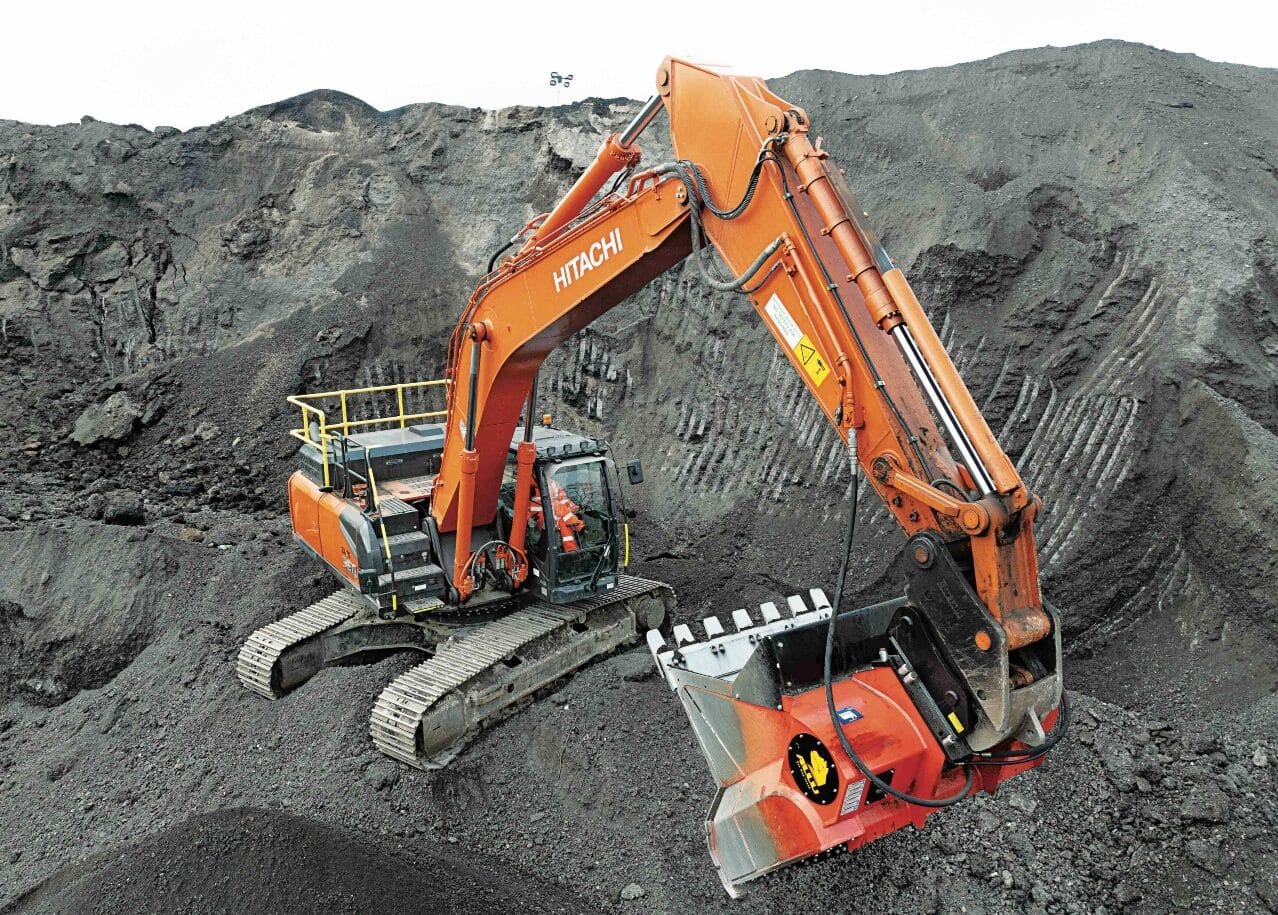
    ALLU’s specialised Asphalt Recycling Bucket, designed for attachment to heavy-duty excavators and wheel loaders, screens and crushes cold-milled asphalt and reclaimed asphalt pavement (RAP) in a single pass to produce reusable aggregate on site. Developed over six years by the Finnish manufacturer founded in 1985, the bucket targets waste and recycling applications where mobile plants are impractical or uneconomic. For road contractors and pavement recyclers, the unit reduces haulage of millings, supports higher RAP contents in new mixes, and enables small-batch, on-demand processing at the jobfront.

    Technical Brief

    • Bucket is configured for direct mounting on heavy excavators and wheel loaders, avoiding separate powerpacks.
    • Integration with existing earthmoving fleets means no additional dedicated crusher or screener is required on smaller jobs.
    • For brownfield or urban worksites, the attachment format reduces the footprint compared with standalone mobile plants.
    • Similar bucket-based processing concepts are increasingly being trialled for construction and demolition waste streams.

    Our Take

    ALLU’s long product development cycle and Finnish origin, combined with Total Rockbreaking’s Australian distribution focus, mirrors the pattern in our database where European attachment OEMs increasingly rely on local partners for niche quarrying and roadwork applications in Australia.

    The related 10 March 2026 piece on ALLU buckets in Australian quarrying and mining shows Total Rockbreaking positioning these tools not just for civil works but also for mine-site waste-to-aggregate conversion, which is becoming a recurring sustainability angle in our Materials coverage.

    Geotechnical Software for Modern Teams

    Centralise site data, logs, and lab results with GEODB-io, CMRR-io, and HYDROGEO-io.

    No credit card required.

    • Save and export unlimited calculations
    • Advanced data visualisation
    • Generate professional PDF reports
    • Cloud storage for all your projects

    Prepared by collating external sources, AI-assisted tools, and Geomechanics.io’s proprietary mining database, then reviewed for technical accuracy & edited by our geotechnical team.

    Related Articles

    Holcim starts imports at Tilbury: circular cement plant design notes for engineers
    Materials
    about 2 hours ago

    Holcim starts imports at Tilbury: circular cement plant design notes for engineers

    Holcim’s Tilbury Cement Works has begun importing cementitious materials via a deep‑water berth at the Port of Tilbury, using a new ship‑to‑shore conveyor, enclosed belt conveyors and the UK’s first 30,000‑tonne cement dome silo to feed six loading heads and five weighbridges. A vertical roller mill due in late 2026 will grind GBFS and recycled concrete fines to produce GGBFS and blended cements, with ECOPlanet and ECOPlanet with ECOCycle products scheduled for early 2027. The site has been built using circular practices, reusing 25,000m³ of crushed concrete and 10,000 tonnes of reclaimed asphalt.

    Materials
    1 day ago

    China Baowu–Rio Tinto low‑carbon steel trials: process design notes for engineers

    China Baowu and Rio Tinto have completed industrial-scale pelletisation and hydrogen-based shaft furnace trials at Baoshan Iron & Steel’s Zhanjiang operations using Rio Tinto’s Pilbara Blend fines. The campaign tested direct reduction-grade pellets in a shaft furnace charged with hydrogen-rich gas, aiming to validate lower-carbon ironmaking routes compatible with existing Baowu infrastructure. Results will inform process design for future DR-grade pellet plants and potential retrofits of blast furnace–basic oxygen furnace lines in China’s coastal steel hubs.

    Rio Tinto’s Pilbara iron ore in hydrogen DRI: process insights for steel engineers
    Materials
    1 day ago

    Rio Tinto’s Pilbara iron ore in hydrogen DRI: process insights for steel engineers

    Rio Tinto and China Baowu have completed industrial-scale hydrogen-based direct reduction trials using Pilbara Blend iron ore in a shaft furnace, showing that the mid-grade (~62% Fe) Western Australian ore can achieve metallisation levels suitable for low-carbon DRI. Tests at Baowu’s Zhanjiang base used hydrogen-rich gas in place of coke-based reductants, validating pellet quality, sticking behaviour and gas utilisation under commercial conditions. The work signals that existing Pilbara ore supply chains could be adapted for hydrogen DRI routes, reducing dependence on high-grade (>67% Fe) ores.

    Related Industries & Products

    Mining

    Geotechnical software solutions for mining operations including CMRR analysis, hydrogeological testing, and data management.

    Construction

    Quality control software for construction companies with material testing, batch tracking, and compliance management.

    CMRR-io

    Streamline coal mine roof stability assessments with our cloud-based CMRR software featuring automated calculations, multi-scenario analysis, and collaborative workflows.

    HYDROGEO-io

    Comprehensive hydrogeological testing platform for managing, analysing, and reporting on packer tests, lugeon values, and hydraulic conductivity assessments.

    GEODB-io

    Centralised geotechnical data management solution for storing, accessing, and analysing all your site investigation and material testing data.

    AllGeotechnicalMiningInfrastructureMaterialsHazardsEnvironmentalSoftwarePolicy