Geomechanics.io

  • Free Tools
Sign UpLog In

Geomechanics.io

Geomechanics, Streamlined.

© 2026 Geomechanics.io. All rights reserved.

Geomechanics.io

CMRR-ioGEODB-ioHYDROGEO-ioQCDB-ioFree Tools & CalculatorsBlogLatest Industry News

Industries

MiningConstructionTunnelling

Company

Terms of UsePrivacy PolicyLinkedIn
    AllGeotechnicalMiningInfrastructureMaterialsHazardsEnvironmentalSoftwarePolicy
    Projects
    Standard/Guideline
    Sustainability

    Chile’s critical minerals strategy: project and permitting signals for engineers

    January 29, 2026|

    Reviewed by Joe Ashwell

    Chile’s critical minerals strategy: project and permitting signals for engineers

    First reported on MINING.com

    30 Second Briefing

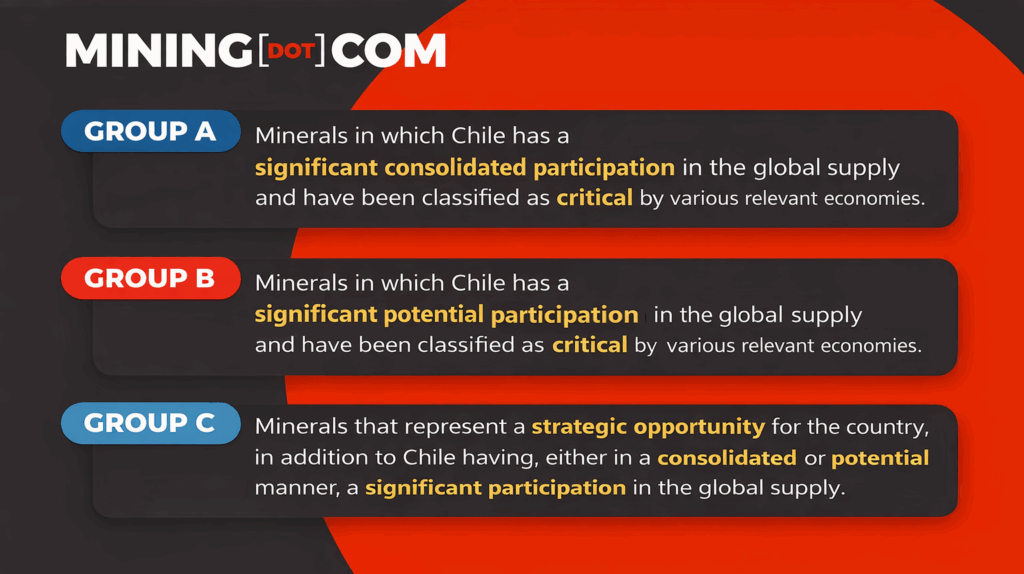
    Chile has released a National Critical Minerals Strategy that classifies 14 minerals into three groups, with copper, lithium, molybdenum and rhenium in “category A”, where Chile already supplies 23%, 20.4%, 14.6% and 46.8% of global output respectively. Consultants note category A growth will mainly come from brownfield expansions, while new streams such as cobalt, rare earths, selenium and tellurium will require greenfield social and environmental approvals and stronger state capacity. Lawyers and analysts stress the strategy is not law, lacks concrete near-term production commitments for minerals like cobalt and rare earths, and its impact will hinge on a forthcoming action plan, permitting performance and institutional execution.

    Technical Brief

    • Fourteen minerals are explicitly listed, including antimony, selenium, tellurium, boron, iodine and rare earth elements.
    • Category B minerals (e.g. cobalt, rare earths, antimony) currently have little or no Chilean production base.
    • GEM’s Juan Ignacio Guzmán expects category A growth mainly via brownfield expansions within existing social–environmental frameworks.
    • Category B developments are expected to require “breaking new ground” in social and environmental permitting, increasing project lead times.

    Our Take

    Chile’s identification of 14 critical minerals, including copper, lithium, molybdenum and rhenium, positions it as the most diversified single-country critical minerals node in Latin America in our database, contrasting with more single-commodity exposure in Bolivia (lithium) and Peru (copper) highlighted in the 27 January 2026 regional security piece.

    With Chile already supplying 23% of global copper and over 20% of global lithium, any policy tightening or new standards emerging from this 30‑day consultation window will likely have immediate pricing and supply-chain implications for the ‘critical minerals’ basket tracked in our recent Top 50 miners valuation coverage.

    The inclusion of lesser-discussed elements such as selenium, rhenium, tellurium and iodine in Chile’s framework broadens the policy lens beyond the copper–lithium duo that dominates most of the 31 keyword-matched pieces, signalling that future ESG and permitting rules may start to bite on by-product recovery circuits at existing Chilean operations.

    Geotechnical Software for Modern Teams

    Centralise site data, logs, and lab results with GEODB-io, CMRR-io, and HYDROGEO-io.

    No credit card required.

    • Save and export unlimited calculations
    • Advanced data visualisation
    • Generate professional PDF reports
    • Cloud storage for all your projects

    Prepared by collating external sources, AI-assisted tools, and Geomechanics.io’s proprietary mining database, then reviewed for technical accuracy & edited by our geotechnical team.

    Related Articles
    Project Vault and US$12bn stockpile: regulatory takeaways for mine planners
    Policy
    about 6 hours ago

    Project Vault and US$12bn stockpile: regulatory takeaways for mine planners

    Project Vault will create a US$12 billion US critical minerals stockpile, combining US$1.67 billion in private capital with a US$10 billion Export-Import Bank loan to buy and store materials for automakers, tech firms and other industrial users. Following a Section 232 probe covering the full USGS critical minerals list plus uranium, the administration found imports threaten national security but chose negotiated price floors and trade mechanisms over tariffs. Forthcoming US–Mexico and US–EU–Japan action plans, under the new FORGE framework, will define which minerals are prioritised, how any border-adjusted price floor is calculated, and how rules of origin or downstream products are treated.

    BC investor’s C$500k mining misrepresentation fine: compliance lessons for project teams
    Policy
    about 7 hours ago

    BC investor’s C$500k mining misrepresentation fine: compliance lessons for project teams

    British Columbia investor Varandeep Singh Grewal has agreed to pay C$500,000 and accept a 10‑year ban from acting as a registrant, promoter or securities market consultant after the BC Securities Commission found he facilitated misleading investor relations for a supposed mineral exploration startup. Over two months in 2018, a third‑party IR provider, arranged by Grewal, claimed the company was actively mining, producing minerals and using “state‑of‑the‑art, environmental‑friendly” technology, when it in fact remained purely in the exploration phase with no such infrastructure. The case signals tighter scrutiny of promotional claims around early‑stage mining projects, particularly where production and proprietary technology are asserted without evidence.

    Gateway 3 delays and 5,000 empty homes: regulatory lessons for project teams
    Policy
    about 17 hours ago

    Gateway 3 delays and 5,000 empty homes: regulatory lessons for project teams

    Delays at the Building Safety Regulator’s Gateway 3 stage are linked by law firm Irwin Mitchell to 44 undecided schemes and 5,594 completed higher-risk residential units remaining unoccupied, with one case waiting 550 days against an eight‑week target. Of 158 Gateway 3 applications in 2023, 55 took more than three months for a decision, raising concerns over cashflow impacts on developers and handover timing for residents. The BSR disputes the interpretation, stating no new-build higher-risk building that passed Gateway 2 has yet applied for Gateway 3 and that current cases are mainly transitional legacy projects with significant safety issues.

    Related Industries & Products

    Mining

    Geotechnical software solutions for mining operations including CMRR analysis, hydrogeological testing, and data management.

    Construction

    Quality control software for construction companies with material testing, batch tracking, and compliance management.

    CMRR-io

    Streamline coal mine roof stability assessments with our cloud-based CMRR software featuring automated calculations, multi-scenario analysis, and collaborative workflows.

    HYDROGEO-io

    Comprehensive hydrogeological testing platform for managing, analysing, and reporting on packer tests, lugeon values, and hydraulic conductivity assessments.

    GEODB-io

    Centralised geotechnical data management solution for storing, accessing, and analysing all your site investigation and material testing data.