£100k fine for temporary works fail: critical lessons for site engineers
Reviewed by Tom Sullivan
First reported on The Construction Index
30 Second Briefing
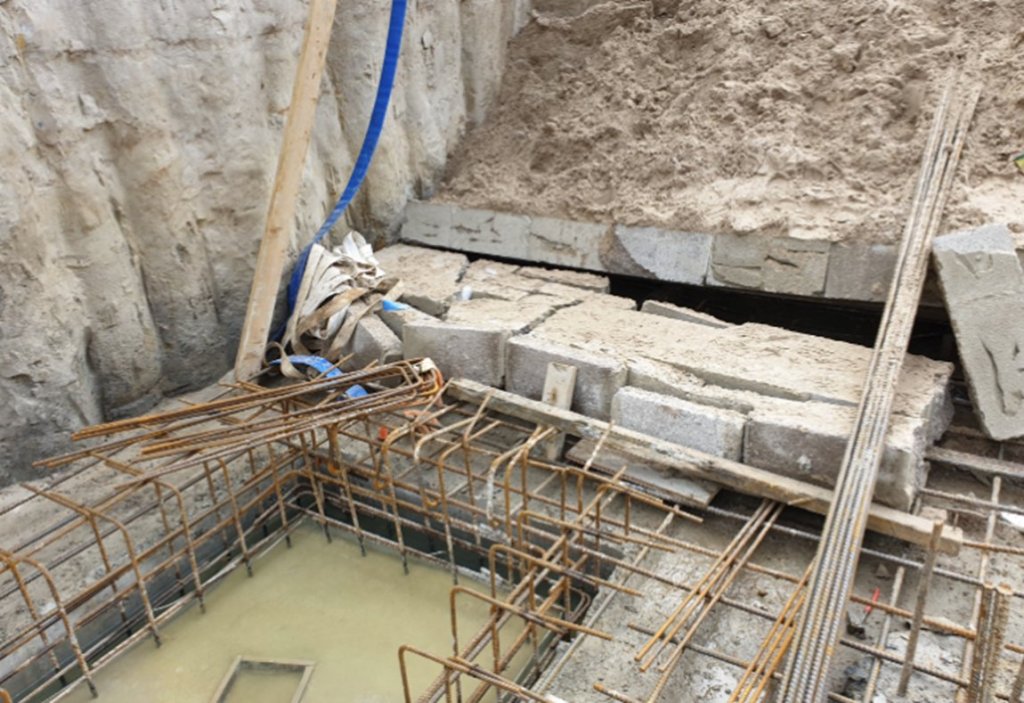
A newly built breeze block retaining wall collapsed into a deep excavation on Old Coast Guard’s Road, Poole, crushing 69-year-old steel-fixer Patrick Grant and prompting a £100,000 fine for principal contractor Matrod Frampton Limited. HSE found the wall had been backfilled before the mortar had set, there was no temporary works design for the wall or other structures, and no temporary works co-ordinator or supervisor had been appointed despite a safety report warning eight days earlier. Rescue was further delayed by reliance on an unstable ladder and the absence of an excavation emergency plan.
Technical Brief
- Failure mechanism: unreinforced breeze block wall in deep excavation overloaded by premature backfill before mortar gained strength.
- HSE investigation focused on absence of any formal temporary works design for the blockwork wall or other supports.
- No temporary works co-ordinator or supervisor had been appointed, despite this being raised in a safety report eight days earlier.
- Incident occurred at around 8:30am on 19 August 2022 at Old Coast Guard’s Road, Poole.
- Access to the excavation relied on an unstable ladder, introducing secondary fall and rescue hazards.
- Rescue required hoisting the injured worker by fire and rescue services and subsequent airlifting to hospital.
- Bristol Magistrates’ Court recorded breaches of CDM 2015 Regulations 13(1) and 19(1) by Matrod Frampton Limited.
- Sentencing included a £100,000 fine, £8,242 costs and a £2,000 victim surcharge, reinforcing CDM enforcement expectations.
- For similar excavations, robust temporary works procedures, early design sign-off and rehearsed excavation emergency plans are critical controls.
Our Take
Among the 16 Hazards stories in our coverage, UK cases involving the Health & Safety Executive (HSE) often lead to six‑figure penalties, signalling that even medium-sized contractors like Matrod Frampton face material financial exposure when temporary works design and supervision are inadequate.
The eight‑day gap between a safety report and the wall collapse fits a recurring pattern in our safety-tagged pieces where early warnings are logged but not escalated into formal design checks or method revisions, suggesting firms need clearer triggers for independent review of temporary works in urban refurbishment jobs.
Incidents in residential or mixed-use settings such as Riverside Park in Dorset tend to attract more scrutiny in our database than comparable failures on closed industrial sites, which likely means contractors in UK towns like Poole and Wimborne will see client and insurer pressure for more rigorous temporary works sign-off and competence records.
Prepared by collating external sources, AI-assisted tools, and Geomechanics.io’s proprietary mining database, then reviewed for technical accuracy & edited by our geotechnical team.
Related Articles

Related Industries & Products
Mining
Geotechnical software solutions for mining operations including CMRR analysis, hydrogeological testing, and data management.
Tunnelling
Specialised solutions for tunnelling projects including grout mix design, hydrogeological analysis, and quality control.
CMRR-io
Streamline coal mine roof stability assessments with our cloud-based CMRR software featuring automated calculations, multi-scenario analysis, and collaborative workflows.
HYDROGEO-io
Comprehensive hydrogeological testing platform for managing, analysing, and reporting on packer tests, lugeon values, and hydraulic conductivity assessments.
GEODB-io
Centralised geotechnical data management solution for storing, accessing, and analysing all your site investigation and material testing data.