Geomechanics, Streamlined.
© 2026 Geomechanics.io. All rights reserved.
Bellway completed 9,695 homes in the first half of 2026, up 10.8% and ahead of its 9,300–9,500 forecast, driven by strong conversion from its bulk sales pipeline, while private units held at 79% of total completions. Housing revenue rose over 13% to £3.14bn and underlying operating profit is expected around £320m, but operating margin slipped to 10% from 10.9% due to a higher share of lower-margin bulk deals. Average selling prices increased slightly, mainly from geographic and product mix rather than market-wide price inflation.
Endurance Land, part of Nan Fung Group, has appointed Multiplex as main contractor for the 36-storey 99 City Road office tower in London, designed by Kohn Pedersen Fox Associates. Structural engineer AKT II will lead the primary frame and foundations, while Arup is responsible for MEP systems and sustainability strategy. The appointment signals progression to detailed construction planning on a high-rise commercial scheme where integrated structural–services coordination and façade performance will be critical to meeting London office loading, comfort and energy targets.
Kimpton has secured the mechanical and electrical engineering contract for The City of Liverpool College after a competitive tender, with its prior hosting of T-Level student placements cited as a contributing factor. The scope will cover full M&E systems installation and integration across the college estate, including building services needed to support modern technical teaching spaces. For contractors and consultants, the award signals growing weight being given to demonstrable skills pipelines and education partnerships in bid evaluations, alongside price and technical competence.
VDMA has issued Revision 21 of its safety manual for concrete delivery and placing machines, restructuring the long‑standing regulations and aligning them with current EU legislation and accident insurance requirements. The update integrates new processes and terminology, explicitly referencing European legal frameworks and the current state of the art in machine safety. Extensive feedback from operational practice has been incorporated, and the revised manual is available free of charge from VDMA, giving contractors, pump operators and OEMs an immediately usable reference for safe set‑up, operation and maintenance.
Northumberland contractor Len Smith & Son Building Contractors Limited has been fined £20,000 after a bricklayer fell approximately 2.4 m through a fragile roof onto concrete, sustaining two fractured vertebrae. HSE inspectors found there was no safe system of work, with no edge protection, staging, crawling boards or fall-arrest measures in place for accessing the fragile roof surface. The case signals continued regulatory focus on temporary works design and formal method statements for work on fragile roofing elements.
Vinci Construction UK has reported a 3.6% margin for 2025 on revenues of £2.7bn, signalling stronger profitability across its British infrastructure portfolio. Asphalt subsidiary Eurovia delivered the fastest growth, pointing to robust demand in road surfacing, maintenance and pavement materials. Civil engineering arm Taylor Woodrow also improved performance, suggesting a solid pipeline of major transport, utilities and public-sector projects requiring complex groundworks and reinforced concrete structures.
North Bridge at Junction 6 of the M42, closed to traffic since July, will be demolished after detailed inspections found significant concrete deterioration and embedded steel at risk of further corrosion. National Highways engineers judged that continued degradation of the reinforced concrete elements could not be managed through interim strengthening or load restrictions. The decision signals likely need for a full replacement structure at this key motorway junction, with geotechnical and traffic management planning now critical to minimise disruption during demolition and reconstruction.
Construction is advancing on Anglian Water’s Middlegate Reservoir in Lincolnshire, a strategic asset intended to bolster potable water storage and supply resilience across the East of England’s drought‑prone network. The scheme forms part of Anglian’s long-term water resources investment programme, which includes new strategic pipelines and additional treated water storage to manage peak demand and climate-driven variability. Geotechnical and civil teams will be focused on embankment stability, seepage control and lining performance to protect groundwater and maintain long-term reservoir integrity.
Construction of the new Fremantle Traffic Bridge over the Swan River in Western Australia is running ahead of programme, with full opening to road traffic expected later this year. The old timber traffic bridge, closed in February, has now been completely removed from the river, including four rows of timber piles, clearing the alignment for final works. Early completion will reduce temporary traffic management on this key north–south corridor and allows contractors to focus on finishing permanent approaches and river navigation clearances.
Planning for a future upgrade of the Riverina Highway in Albury has reached a key milestone, covering the east–west corridor that carries around 25,000 vehicles per day between the Hume Highway, Albury Wodonga Hospital precinct and Albury Airport. The NSW Government’s planning work focuses on the Albury corridor, where the highway passes through growing residential areas and key freight and commuter routes. Geometric improvements, intersection upgrades and better access management are expected to be central, with implications for pavement design, drainage and staging in a constrained urban corridor.
Precast specialist Ozcast is adjusting manufacturing and delivery for Western Sydney International Airport works as shifting timelines and staging alter when and where large concrete components are needed on site. As a National Precast member, the company is coordinating just‑in‑time production and installation of elements such as precast panels and structural units to match evolving airside and landside construction sequences. The case illustrates how precast suppliers must build contingency into yard storage, lifting logistics and transport scheduling to avoid crane downtime and site congestion on major infrastructure programmes.
TMAA chief executive Matthew Bereni calls for evidence-based traffic management on Australian roadworks, arguing that current controls leave traffic controllers standing metres from live traffic with limited physical protection. He points to inconsistent use of temporary speed limits, variable lane closure layouts and gaps in data on near-misses and incursions into work zones as barriers to better design. Bereni urges systematic collection of incident data and performance metrics to justify stronger controls, such as wider lateral clearances, additional barriers and remote or automated signalling.
UK construction workloads showed a modest stabilisation in Q2 2026, with the RICS headline net balance improving to –4% from –12%, driven by infrastructure rather than building sectors. Energy infrastructure reported the strongest gains with a +39% net balance, followed by water and sewerage at +23%, while private housing fell to –12% and private industrial to –9%, signalling continued weakness in development-led work. Financial constraints (67% of respondents) and planning/regulation (61%) remain the main brakes, and although 12‑month infrastructure expectations rose to +34%, profit margin expectations are still negative at –10%.
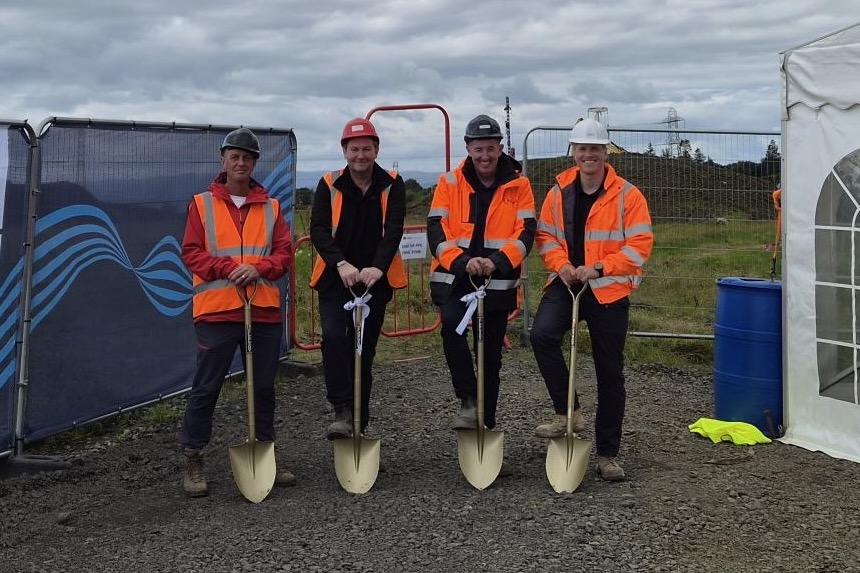
Mitie Power & Grid and Carlyle-backed Revera Energy have broken ground on the Windyhill Battery Energy Storage Site near Glasgow, a 400MWh grid-scale BESS designed to supply 50,000 homes for two hours in its first phase. A second phase of equal 400MWh capacity is planned, taking the total to 800MWh and positioning the site as a major stabilising asset for Scotland’s transmission network. Grid engineers can expect significant implications for peak-shaving, frequency response and integration of intermittent wind generation in the central belt.
National Highways will rapidly demolish a 50-year-old bridge on the north side of the M42 Junction 6 roundabout after inspections found significant concrete and steel corrosion and a rapid change in structural condition, making strengthening non-viable. The bridge, closed since July, will be removed during planned closures between Junctions 6 and 9, with a temporary bridge installed to maintain traffic flows until a permanent replacement to modern standards is built. The scheme typifies RIS3’s focus on renewing ageing motorway structures built over 50 years ago.
Farrans has been appointed to construct new covered “skylink” walkways at London Stansted Airport as part of a major terminal redevelopment programme. The elevated structures will provide weather-protected, step-free routes between the terminal and aircraft stands, reducing reliance on ground-level bussing and simplifying passenger flows. For civil and structural teams, the project points to increased airside integration work, complex phasing around live operations, and stringent airfield pavement and loading interface requirements.
Europe’s rapid build-out of offshore wind farms and interconnectors is driving a surge in subsea assets that must withstand decades of exposure to saltwater, currents and cyclic loading. Developers and TSOs are being pushed to adopt more robust inspection, maintenance and repair regimes for subsea cables, monopile and jacket foundations, including ROV-based condition monitoring and predictive maintenance to prevent cable faults and grout or weld failures. For civil and geotechnical engineers, design life assumptions, access for inspection, and whole-life integrity of subsea structures are becoming as critical as initial installation cost.
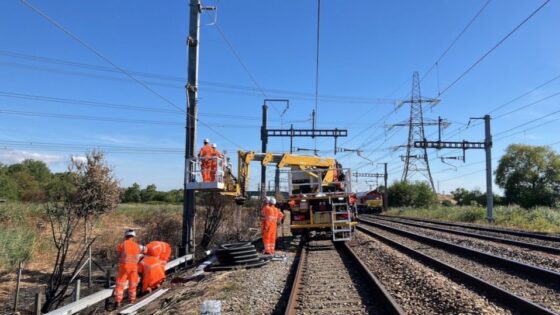
Network Rail has reopened the key Cardiff–Newport main line after an “incredibly harmful” lineside fire on 1 August destroyed signalling and power equipment, with engineers working 24/7 for a week to complete emergency repairs. Teams replaced damaged lineside cabling, location cases and signalling control systems, and installed temporary power supplies to restore safe operations on this high‑traffic South Wales corridor. The incident underlines the vulnerability of densely serviced rail corridors to fire and the need for robust cable routing, fire‑resistant materials and contingency signalling plans.
Network Rail has let an eight-year civils examinations framework worth an estimated £113M (excl. VAT) for bridges, tunnels, retaining walls and other critical assets across its Wales & Western region. The framework will cover routine and detailed inspections, structural condition assessments and reporting to support renewals and maintenance planning on key main lines and secondary routes. Contractors can expect sustained demand for examination teams, rope access and confined-space capability, and robust digital asset data capture to feed Network Rail’s asset management systems.
UK Power Networks has installed 9km of 33kV cross-linked polyethylene cables beneath tramlines, railways and roads in South London using horizontal directional drilling on a £7M scheme. Trenchless drives allowed cable ducts to be threaded under live Croydon tram tracks and Network Rail assets without possessions, reducing surface excavation and traffic disruption. For civil and geotechnical teams, the project shows HDD being used at urban utility scale to navigate dense existing services and sensitive transport corridors while maintaining electrical clearance and cover requirements.
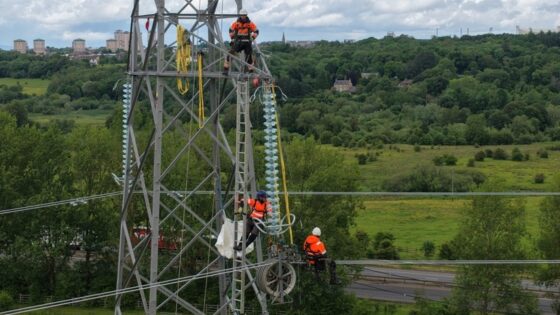
M Group has secured a £110M contract from ScottishPower to upgrade a key 400kV overhead transmission line between Glasgow and Edinburgh, a primary corridor in Scotland’s high-voltage network. Works are expected to include tower steelwork refurbishment, conductor and insulator replacement, and foundation strengthening to increase capacity and resilience under higher wind and ice loading. The project will require live-line working strategies and careful outage planning to maintain grid stability on one of the central belt’s main transmission routes.
Network Rail has awarded Ground Control and Inspire (Structures) a £4.1M package under its Wales and Western Civils Examination Framework Agreement (CEFA – Structures) to inspect rail civil assets across the region. The work will focus on systematic examinations of structures such as bridges, retaining walls and culverts, feeding condition data into Network Rail’s asset management systems. Geotechnical and structural engineers should expect increased demand for detailed defect recording, access planning and follow‑on investigations as examination findings are prioritised into renewals and maintenance works.
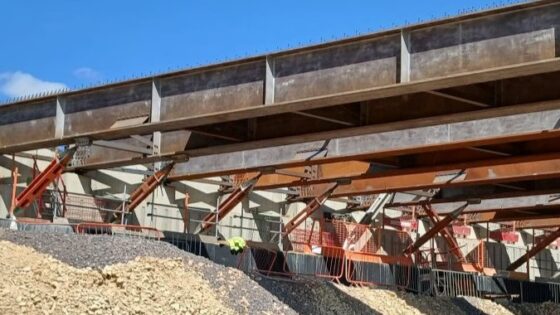
Skanska has installed 15 large steel beams to form the primary support of the new A428 Black Cat junction flyover, a key structural milestone in National Highways’ £1bn improvement scheme. The beams create the main span over the existing junction, enabling subsequent deck works and approach embankment tie-ins to progress while maintaining traffic on the current A1 and A421. For designers and contractors, the lift confirms the permanent works geometry on this constrained interchange, locking in levels for drainage, pavement build-ups and future widening.
Menai Suspension Bridge between Anglesey and mainland Wales will close intermittently on Saturday 8 August as engineers and local authorities mark the 200th anniversary of Thomas Telford’s landmark structure. The Grade I listed, wrought-iron suspension bridge, with a main span of about 176m originally designed for horse-drawn traffic, now carries the A5 and remains a critical crossing parallel to the Britannia Bridge on the A55. Temporary closures will affect road traffic and maintenance access planning for nearby schemes.