Cardiff–Newport trackside fire: resilience and signalling lessons for engineers
Reviewed by Joe Ashwell
First reported on New Civil Engineer
30 Second Briefing
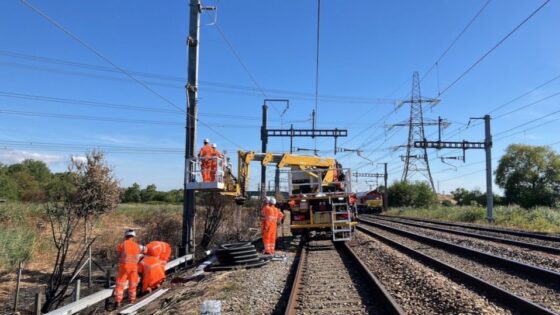
Network Rail has reopened the key Cardiff–Newport main line after an “incredibly harmful” lineside fire on 1 August destroyed signalling and power equipment, with engineers working 24/7 for a week to complete emergency repairs. Teams replaced damaged lineside cabling, location cases and signalling control systems, and installed temporary power supplies to restore safe operations on this high‑traffic South Wales corridor. The incident underlines the vulnerability of densely serviced rail corridors to fire and the need for robust cable routing, fire‑resistant materials and contingency signalling plans.
Technical Brief
- Investigation would focus on ignition source, cable sheath fire performance and separation from combustible vegetation.
- Temporary signalling arrangements required rigorous independent verification and validation before any relaxation of speed or headways.
- Continuous monitoring of replacement cabling and location cases is likely via remote condition and fault detection systems.
- Fire‑damaged troughing and route supports require structural assessment for spalling, deformation and residual load capacity.
- Safety management had to balance emergency access for repair teams with live adjacent lines and OLE.
- Similar corridors with high cable density may need revised fire zoning, physical segregation and enhanced emergency access planning.
Our Take
Network Rail’s rapid one-week restoration between Cardiff and Newport sits alongside several other urgent interventions in our database – such as the Reedham swing bridge and Marston Lane bridge-strike closures – underscoring how much of its UK-wide capacity is now tied up in reactive resilience work rather than planned enhancements.
The new £4.1M Wales and Western Civils Examination Framework (Ground Control and Inspire) reported in our coverage suggests Network Rail is trying to systematise asset condition monitoring in the same region where this Welsh lineside fire occurred, likely to catch heat- and vegetation-related vulnerabilities earlier.
Prepared by collating external sources, AI-assisted tools, and Geomechanics.io’s proprietary mining database, then reviewed for technical accuracy & edited by our geotechnical team.
Related Articles


Related Industries & Products
Construction
Quality control software for construction companies with material testing, batch tracking, and compliance management.
Mining
Geotechnical software solutions for mining operations including CMRR analysis, hydrogeological testing, and data management.
CMRR-io
Streamline coal mine roof stability assessments with our cloud-based CMRR software featuring automated calculations, multi-scenario analysis, and collaborative workflows.
HYDROGEO-io
Comprehensive hydrogeological testing platform for managing, analysing, and reporting on packer tests, lugeon values, and hydraulic conductivity assessments.
GEODB-io
Centralised geotechnical data management solution for storing, accessing, and analysing all your site investigation and material testing data.