Geomechanics.io

  • Free Tools
Sign UpLog In

Geomechanics.io

Geomechanics, Streamlined.

© 2026 Geomechanics.io. All rights reserved.

Geomechanics.io

CMRR-ioGEODB-ioHYDROGEO-ioQCDB-ioFree Tools & CalculatorsBlogLatest Industry News

Industries

MiningConstructionTunnelling

Company

Terms of UsePrivacy PolicyLinkedIn
    Projects
    Sustainability

    WoodMac lithium demand to 2050: supply, capex and risk takeaways for mine planners

    March 3, 2026|

    Reviewed by Joe Ashwell

    WoodMac lithium demand to 2050: supply, capex and risk takeaways for mine planners

    First reported on MINING.com

    30 Second Briefing

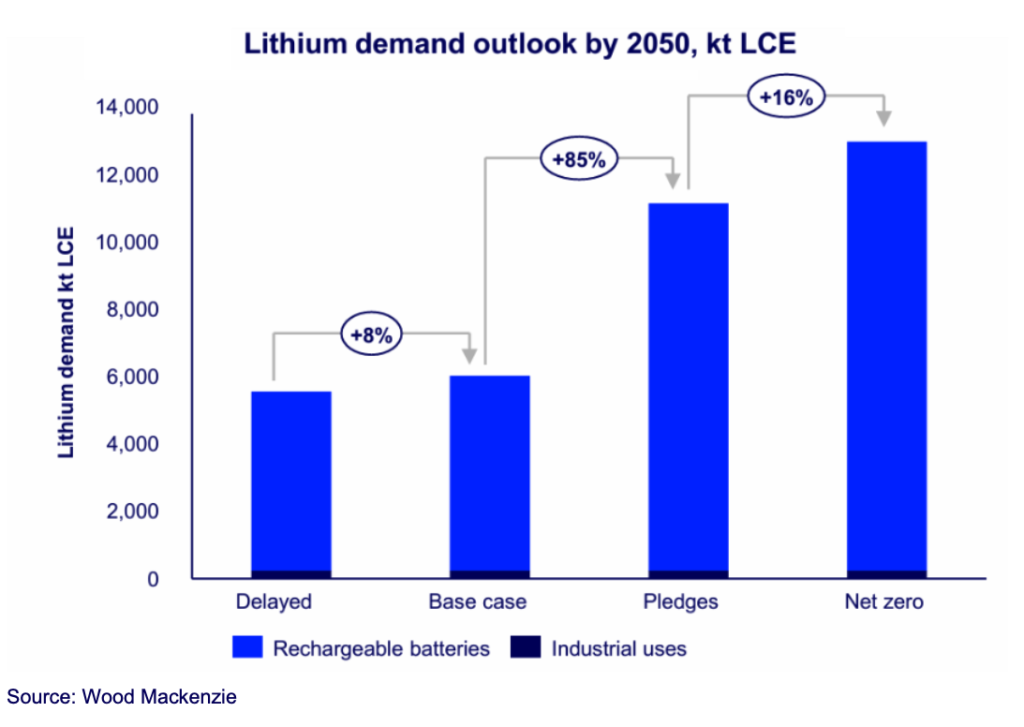
    Global lithium demand is projected by Wood Mackenzie to reach up to 13.2 million tonnes LCE by 2050 under a net-zero pathway, with market deficits starting as early as 2028 and total sector investment needs ranging from $104 billion (delayed transition) to $276 billion (net zero). Electric vehicles account for 72%–80% of demand across scenarios, with EV penetration reaching 75% by 2040 under current country pledges and 95% under net zero, while grid-scale energy storage grows 6%–7% annually. Recycling is forecast to supply 2.3–2.7 million tonnes LCE by 2050, leaving 6.7–8.5 million tonnes of new supply still required, implying sustained pressure on new mines, refineries and regionalised supply chains from the 2030s.

    Technical Brief

    • Wood Mackenzie’s Energy Transition Outlook for Lithium defines four demand scenarios out to 2050.
    • Scenario demand spans from 5.6 Mt LCE (delayed transition) to 13.2 Mt LCE (net zero) by 2050.
    • Under delayed transition, supply remains adequate until about 2037 before deficits appear.
    • Country pledges case requires an additional 6.7 Mt LCE of new supply by 2050.
    • Net-zero pathway needs 8.5 Mt LCE extra supply by 2050, with deficits from 2028 onwards.
    • Rechargeable batteries across all uses account for 96–98% of lithium consumption by mid‑century.

    Our Take

    With lithium and lithium carbonate appearing in over 100 keyword-matched pieces in our database, Wood Mackenzie’s 13–13.2 Mt LCE 2050 demand range effectively sets the high-end bookend that many recent project and pricing stories have lacked when framing long-term market size.

    The projected 2.3–2.7 Mt LCE contribution from recycling by 2050 implies that even aggressive circularity leaves most supply coming from new mines, which will matter for operators in Australia, Latin America and the USA already facing permitting and social-licence constraints in our recent coverage.

    The need for 6.7–8.5 Mt LCE of additional supply by 2050 suggests that diversified miners such as BHP, which feature frequently in our Mining category, are structurally better placed than single-commodity juniors to pivot capital from coal and gold into large-scale lithium projects as policy tightens towards net-zero pathways.

    Geotechnical Software for Modern Teams

    Centralise site data, logs, and lab results with GEODB-io, CMRR-io, and HYDROGEO-io.

    No credit card required.

    • Save and export unlimited calculations
    • Advanced data visualisation
    • Generate professional PDF reports
    • Cloud storage for all your projects

    Prepared by collating external sources, AI-assisted tools, and Geomechanics.io’s proprietary mining database, then reviewed for technical accuracy & edited by our geotechnical team.

    Related Articles
    pH7 Technologies’ closed-loop PGM and chalcopyrite leaching: key notes for mine planners
    Mining
    about 20 hours ago

    pH7 Technologies’ closed-loop PGM and chalcopyrite leaching: key notes for mine planners

    Canadian processor pH7 Technologies is expanding its Vancouver facility, backed by up to C$4 million from NRC IRAP, to scale its organo-electrochemical platform that recovers platinum, palladium and rhodium from secondary materials without toxic reagents or tailings wastewater. The commercial plant already processes spent catalytic converters, producing 30,000–40,000 oz of platinum-equivalent PGMs per year under a tolling and offtake model involving partners such as Mitsubishi. pH7 is now piloting electrochemically generated oxidants to heap leach chalcopyrite and other sulphide ores without cyanide, targeting on-site mine deployment within 1–2 years across South America, Africa and Australia.

    Dellner Bubenzer mining brakes: integrated drivetrain design notes for engineers
    Mining
    1 day ago

    Dellner Bubenzer mining brakes: integrated drivetrain design notes for engineers

    Dellner Bubenzer is supplying a wide range of industrial brakes and couplings for mining hoists, slewing drives and belt conveyors, developed in long-term collaboration with OEMs. The company focuses on both service and emergency braking solutions tailored to heavy-duty mining duty cycles and harsh environments, addressing controlled hoisting, precise slewing and high-tension conveyor stopping. For engineers, the key point is an integrated approach to drivetrain and braking design, rather than bolt-on safety systems, across multiple critical mining applications.

    SKRI ‘phytocapture’ at Raygorodok: dust control performance insights for mine engineers
    Mining
    1 day ago

    SKRI ‘phytocapture’ at Raygorodok: dust control performance insights for mine engineers

    China’s Zijin Mining is expanding RG Gold’s Raygorodok operation in Kazakhstan with a $500 million processing plant while deploying SKRI’s ‘phytocapture’ system, planting over 100,000 Scots pines across more than 20 hectares about 1.7 km downwind of the open pit. Supercomputer modelling using regional wind-rose data sets tree species and spacing to form multilayered vegetative barriers, not simple landscaping. SKRI reports particulate-matter reductions above 40%, with the forest belt expected to capture roughly one-third of dust emissions as mining advances towards the barrier.

    Related Industries & Products

    Mining

    Geotechnical software solutions for mining operations including CMRR analysis, hydrogeological testing, and data management.

    CMRR-io

    Streamline coal mine roof stability assessments with our cloud-based CMRR software featuring automated calculations, multi-scenario analysis, and collaborative workflows.

    HYDROGEO-io

    Comprehensive hydrogeological testing platform for managing, analysing, and reporting on packer tests, lugeon values, and hydraulic conductivity assessments.

    GEODB-io

    Centralised geotechnical data management solution for storing, accessing, and analysing all your site investigation and material testing data.

    AllGeotechnicalMiningInfrastructureMaterialsHazardsEnvironmentalSoftwarePolicy