Wireless mesh networks for modern mining: RF design and resilience notes for engineers
Reviewed by Joe Ashwell
First reported on Australian Mining
30 Second Briefing
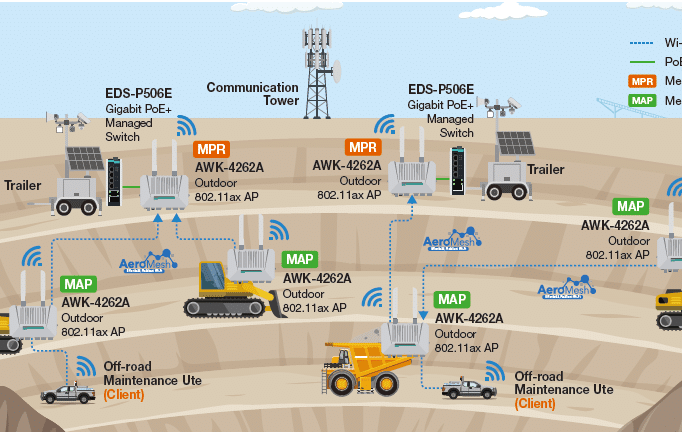
Wireless mesh networks using Moxa AeroMesh are being deployed in autonomous mining to maintain low-latency WLAN connectivity for haul trucks, drills and remote-control stations across pits, crushers and stockpiles. The architecture uses multi-hop, self-healing mesh nodes mounted on mobile equipment and fixed infrastructure to cope with line-of-sight loss from highwalls, moving stockpiles and blast re-entries, avoiding single points of failure typical of point-to-point links. For engineers, the key design issues are RF planning around pit geometry, redundancy in backhaul paths, and QoS for control versus video and telemetry traffic.
Technical Brief
- Mesh firmware supports dynamic route selection to maintain connectivity as trucks and shovels constantly change position.
- Self-healing behaviour automatically re-routes traffic around failed nodes or RF shadows without manual reconfiguration.
- QoS profiles can prioritise safety‑critical control packets over non-essential traffic such as bulk telemetry or video.
- Integration with mine SCADA and fleet management systems enables centralised monitoring of link status and latency alarms.
- Hardware is typically installed in IP‑rated enclosures with high‑gain antennas to withstand dust, moisture and blast overpressure.
- Network design explicitly considers blast exclusion zones so nodes can be powered down or relocated without breaking coverage.
- For other autonomous mines, similar mesh topologies reduce reliance on single high masts or fibre drops at each bench.
Our Take
Colterlec’s focus on wireless mesh in Australia sits alongside Australian Mining’s recent coverage of ESG data systems, signalling that digital infrastructure is now being treated as core plant rather than bolt‑on IT in local operations.
For Australian sites moving bulk product by heavy‑haul rail, as in the Martinus rail expansion piece, resilient pit‑to‑port wireless links are becoming critical to synchronise train loading, signalling interfaces and real‑time maintenance data.
Prepared by collating external sources, AI-assisted tools, and Geomechanics.io’s proprietary mining database, then reviewed for technical accuracy & edited by our geotechnical team.
Related Articles
Related Industries & Products
Mining
Geotechnical software solutions for mining operations including CMRR analysis, hydrogeological testing, and data management.
Construction
Quality control software for construction companies with material testing, batch tracking, and compliance management.
CMRR-io
Streamline coal mine roof stability assessments with our cloud-based CMRR software featuring automated calculations, multi-scenario analysis, and collaborative workflows.
HYDROGEO-io
Comprehensive hydrogeological testing platform for managing, analysing, and reporting on packer tests, lugeon values, and hydraulic conductivity assessments.
GEODB-io
Centralised geotechnical data management solution for storing, accessing, and analysing all your site investigation and material testing data.