Geomechanics.io

  • Free Tools
Sign UpLog In
Built byBoxcut Studio

Geomechanics.io

Geomechanics, Streamlined.

© 2026 Geomechanics.io. All rights reserved.

Geomechanics.io

CMRR-ioGEODB-ioHYDROGEO-ioQCDB-ioFree Tools & CalculatorsBlogLatest Industry News

Industries

MiningConstructionTunnelling

Company

Terms of UsePrivacy PolicyLinkedIn
    Projects
    Sustainability

    WA1’s high‑grade niobium concentrates: flowsheet and water risks for engineers

    June 22, 2026|

    Reviewed by Joe Ashwell

    WA1’s high‑grade niobium concentrates: flowsheet and water risks for engineers

    First reported on Australian Mining

    30 Second Briefing

    WA1 Resources’ latest metallurgical programme at the Luni niobium project in Western Australia shows a scaled‑up two‑stage flotation circuit using raw site water can deliver high‑grade niobium concentrates with strong recoveries across the deposit. Open‑cycle bulk flotation tests on four composite samples confirmed consistent performance without reagent‑grade water, a key factor for remote Pilbara-style sites with constrained water treatment. The results materially de‑risk flowsheet design and support progression of Luni’s process plant and infrastructure studies.

    Technical Brief

    • Using raw site water removes dependence on reagent-grade water supply and associated treatment infrastructure.
    • Consistent metallurgical response across composites suggests limited ore-type specific re-optimisation of the flowsheet.
    • Testwork outcomes directly inform sizing of flotation cells, water circuits and reagent storage in current studies.
    • Reduced water treatment requirements could materially lower both capital and operating costs for a remote plant.
    • Results provide a basis for more confident mine scheduling, as variable ore feed is less likely to disrupt recoveries.
    • Similar critical-mineral projects with constrained water quality can reference this approach when screening flowsheets.

    Our Take

    Niobium appears in only a handful of keyword‑matched pieces in our database, so WA1 Resources’ Luni project in Western Australia is emerging as one of the few Australian case studies for this commodity alongside more common critical minerals like heavy rare earths and antimony in recent coverage.

    The earlier piece on high‑grade infill drilling at Luni (3 March 2026) suggests that unlocking high‑grade concentrates now is likely being underpinned by a growing indicated resource base immediately around those intersections, which can de‑risk flowsheet testwork and early project studies.

    With Western Australia simultaneously advancing heavy rare earth projects such as Victory Metals’ North Stanmore (3 June 2026), a successful niobium concentrate route at Luni would strengthen the state’s position as a diversified critical minerals hub rather than just an iron ore and gold province.

    Geotechnical Software for Modern Teams

    Centralise site data, logs, and lab results with GEODB-io, CMRR-io, and HYDROGEO-io.

    No credit card required.

    • Save and export unlimited calculations
    • Advanced data visualisation
    • Generate professional PDF reports
    • Cloud storage for all your projects

    Prepared by collating external sources, AI-assisted tools, and Geomechanics.io’s proprietary mining database, then reviewed for technical accuracy & edited by our geotechnical team.

    Related Articles
    Hertha Metals’ $100M Texas iron plant: supply and process notes for mine planners
    Mining
    about 8 hours ago

    Hertha Metals’ $100M Texas iron plant: supply and process notes for mine planners

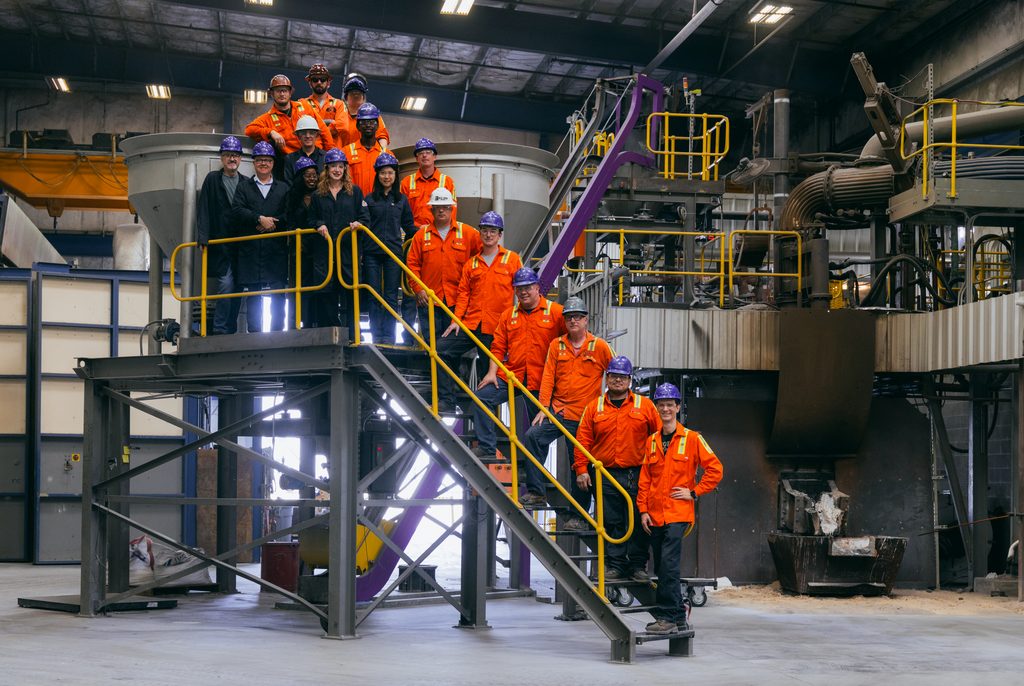
    Hertha Metals has broken ground on its $100 million Hertha Chalyx plant in Conroe, Texas, designed to produce about 10,000 tonnes per year of combined steel-grade and magnet-grade high-purity iron using domestic ore from Minnesota’s Iron Range and Texas natural gas. The facility, adjacent to the Pi100 pilot plant where 99.95% purity was achieved in August, will scale Hertha’s FLEXHERS process, which couples electric arc furnace technology with natural gas or hydrogen. First magnet-grade output is targeted for early 2028, feeding US NdFeB magnet makers that currently rely on China for an estimated 94% of high-purity iron.

    PC Gold’s new North Link zone at Spring Hill: pit and slope implications for planners
    Mining
    about 8 hours ago

    PC Gold’s new North Link zone at Spring Hill: pit and slope implications for planners

    PC Gold has identified a new high-grade North Link zone immediately north of the existing mineral resource estimate at its Spring Hill gold project in the Northern Territory, based on recent reverse-circulation drilling targeting mineralisation extensions. The North Link structure is interpreted to connect with known lodes within the current MRE footprint, potentially extending strike continuity and adding shallow, open-pittable ounces. For mine planners and geotechs, the result signals a need to revisit pit shell optimisation, geotechnical domains and slope design north of the present resource limits.

    Horizon’s Snook gold hits: pit shell growth and UG options for mine planners
    Mining
    about 8 hours ago

    Horizon’s Snook gold hits: pit shell growth and UG options for mine planners

    Horizon Gold has reported its strongest intercept yet at the Snook prospect within the Gum Creek project in Western Australia, with reverse-circulation drilling returning 44m at 5.08g/t gold from 145m, including 11m at 16.30g/t from 174m. The thick, high-grade zone at moderate depth points to a larger open pit shell and supports evaluation of underground mining scenarios beneath any eventual pit floor. For mine planners and geotechs, the result justifies updated pit optimisations, geotechnical domain modelling and closer-spaced drilling to refine continuity and rock mass conditions.

    Related Industries & Products

    Mining

    Geotechnical software solutions for mining operations including CMRR analysis, hydrogeological testing, and data management.

    Construction

    Quality control software for construction companies with material testing, batch tracking, and compliance management.

    CMRR-io

    Streamline coal mine roof stability assessments with our cloud-based CMRR software featuring automated calculations, multi-scenario analysis, and collaborative workflows.

    HYDROGEO-io

    Comprehensive hydrogeological testing platform for managing, analysing, and reporting on packer tests, lugeon values, and hydraulic conductivity assessments.

    GEODB-io

    Centralised geotechnical data management solution for storing, accessing, and analysing all your site investigation and material testing data.

    AllGeotechnicalInfrastructureHazardsEnvironmental