Geomechanics.io

  • Free Tools
Sign UpLog In

Geomechanics.io

Geomechanics, Streamlined.

© 2026 Geomechanics.io. All rights reserved.

Geomechanics.io

CMRR-ioGEODB-ioHYDROGEO-ioQCDB-ioFree Tools & CalculatorsBlogLatest Industry News

Industries

MiningConstructionTunnelling

Company

Terms of UsePrivacy PolicyLinkedIn
    Projects
    Sustainability

    The copper the world needs above ground: tailings reprocessing lens for mine planners

    July 7, 2026|

    Reviewed by Joe Ashwell

    The copper the world needs above ground: tailings reprocessing lens for mine planners

    First reported on MINING.com

    30 Second Briefing

    Copper tailings reprocessing is framed as a near‑term supply solution, with S&P Global projecting demand rising from 28 million tonnes in 2025 to 42 million tonnes by 2040 while new copper mines take an average 17.9 years to reach production and are expected to meet only about 70% of 2035 demand. Andrew Dennan, CEO of Halo Minerals, points to advances in flotation, leaching and fine‑particle recovery and to projects such as Halo’s Playa Verde in Chile, where 250 million tonnes of historic Potrerillos and El Salvador tailings at Chañaral could be reworked. With an estimated 282 billion tonnes of tailings globally, he argues that above‑ground material, already blasted and crushed, can be rapidly mobilised using existing infrastructure while also remediating legacy arsenic‑rich pollution.

    Technical Brief

    • BHP forecasts copper use in data centres increasing sixfold by 2050, heavily driven by AI workloads.
    • A single hyperscale AI data centre can require up to 50,000 tonnes of copper cabling and equipment.
    • Conventional data centres typically use only 5,000–15,000 tonnes of copper, underscoring the AI step-change in intensity.
    • Potrerillos and El Salvador mines discharged ~250 million tonnes of tailings into the Salado River between 1938–1978.
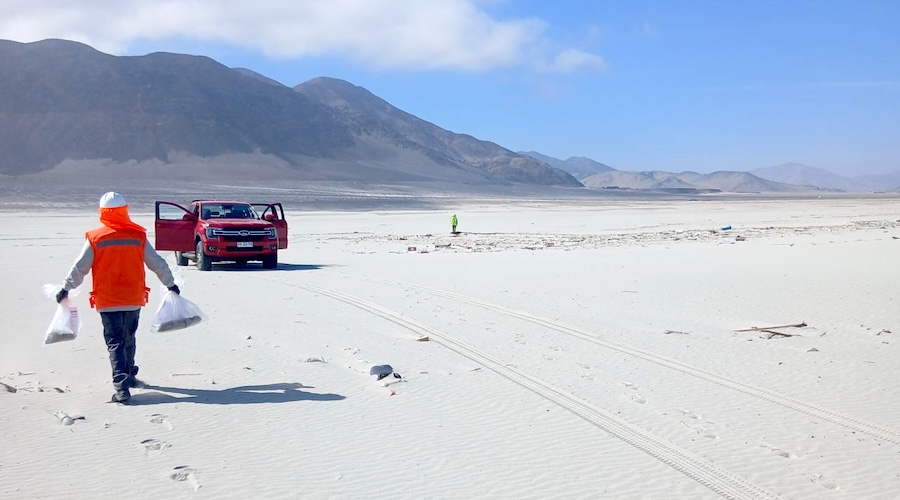
    • Those tailings formed the current Chañaral beach deposit, now targeted by Halo Minerals’ Playa Verde project.
    • The UN has labelled the Chañaral coastal area as one of the Pacific’s most serious pollution cases.
    • Globally, an estimated 282 billion tonnes of mine tailings exist, representing a large above‑ground copper inventory.

    Our Take

    BHP’s role in this copper narrative aligns with several recent items in our database where it is trialling waste‑stream recovery technologies with SiTration and BHP Invent, signalling that majors are already testing pathways to treat tailings and low‑grade material as a strategic copper source rather than a liability.

    The focus on Chilean sites such as Potrerillos, El Salvador and the Salado River dovetails with BHP’s current push to secure a new 20‑year life at Cerro Colorado in Chile, suggesting that future permitting there is likely to be judged against legacy tailings impacts and the credibility of re‑mining or remediation plans.

    With S&P Global’s estimate that only 70% of copper demand will be met by existing and planned mines by 2035 and an average 17.9‑year development time for new projects, assets like Halo Minerals’ Playa Verde and South32’s Arizona zinc–manganese project are positioned in a window where tailings reprocessing and secondary recovery could become bankable faster than many greenfield copper mines.

    Geotechnical Software for Modern Teams

    Centralise site data, logs, and lab results with GEODB-io, CMRR-io, and HYDROGEO-io.

    No credit card required.

    • Save and export unlimited calculations
    • Advanced data visualisation
    • Generate professional PDF reports
    • Cloud storage for all your projects

    Prepared by collating external sources, AI-assisted tools, and Geomechanics.io’s proprietary mining database, then reviewed for technical accuracy & edited by our geotechnical team.

    Related Articles

    China’s top ETF now gold: demand signals and price risk notes for miners
    Mining
    about 4 hours ago

    China’s top ETF now gold: demand signals and price risk notes for miners

    Central banks bought a net 41 tonnes of gold in May 2026, led by Poland’s 18 tonnes and China’s 10 tonnes, with China now holding 2,331 tonnes and 89% of surveyed reserve managers expecting global official gold holdings to rise further. In China’s domestic market, the Huaan Yifu Gold ETF has become the country’s largest ETF at about 90 billion yuan, overtaking the Huatai-PineBridge CSI 300 equity fund on 83 billion amid weak equities and constrained capital outflows. In London, Citi has joined HSBC, ICBC Standard Bank, JPMorgan and UBS as the fifth clearing member of London Precious Metals Clearing Limited, gaining Loco London settlement access to the roughly $160‑billion‑a‑day OTC bullion market.

    Molybdenum and the geopolitics of substitution: project economics lens for mine planners
    Mining
    about 4 hours ago

    Molybdenum and the geopolitics of substitution: project economics lens for mine planners

    Molybdenum’s price surge to about $65,500/t in May 2026, nearly $30/lb and up 48.9% year-on-year, signals a shift from simple by-product tightness to a security premium on alloying metals as China’s February 2025 export controls on tungsten, tellurium, bismuth, indium and molybdenum inject licensing risk into defence, aerospace and tooling supply chains. Partial substitution away from tungsten via molybdenum carbides, Mo-bearing steels and superalloys is driving small absolute but material demand gains in a roughly 300,000 t/y market, where supply is constrained by copper mine plans. Chile and Peru already export about US$2.48 billion and US$1.65 billion of molybdenum respectively, with higher prices materially improving copper by-product credits and project economics.

    Dakota Gold’s Richmond Hill assays: project economics and pit design notes
    Mining
    about 4 hours ago

    Dakota Gold’s Richmond Hill assays: project economics and pit design notes

    New drilling at Dakota Gold’s Richmond Hill project in South Dakota has returned high-grade intercepts inside the planned open pit, including 26 metres at 11.36 g/t gold and 14.92 g/t silver from ~75 metres in hole RH26C-432 and 38 metres at 2.89 g/t gold and 8.18 g/t silver from ~145 metres in RH26C-437. The 2026 programme totalled 17,273 metres across 112 infill, expansion and geotechnical holes, with assays from 350+ holes feeding a prefeasibility study due by 31 December and long-lead items such as an electrical substation already queued with Black Hills Energy. Richmond Hill, a large oxide gold system amenable to open-pit and heap leach, carries 244.7 Mt measured and indicated at 0.46 g/t Au and 4.83 g/t Ag (3.6 Moz Au, 38 Moz Ag), with an S-K 1300 Initial Assessment outlining 2.6–3.9 Moz Au production over 28 years and a post-tax NPV of $1.6–2.1 billion at a 55–59% IRR.

    Related Industries & Products

    Mining

    Geotechnical software solutions for mining operations including CMRR analysis, hydrogeological testing, and data management.

    Construction

    Quality control software for construction companies with material testing, batch tracking, and compliance management.

    CMRR-io

    Streamline coal mine roof stability assessments with our cloud-based CMRR software featuring automated calculations, multi-scenario analysis, and collaborative workflows.

    HYDROGEO-io

    Comprehensive hydrogeological testing platform for managing, analysing, and reporting on packer tests, lugeon values, and hydraulic conductivity assessments.

    GEODB-io

    Centralised geotechnical data management solution for storing, accessing, and analysing all your site investigation and material testing data.

    AllGeotechnicalMiningInfrastructureMaterialsHazardsEnvironmentalSoftwarePolicy