Dakota Gold’s Richmond Hill assays: project economics and pit design notes
Reviewed by Joe Ashwell
First reported on MINING.com
30 Second Briefing
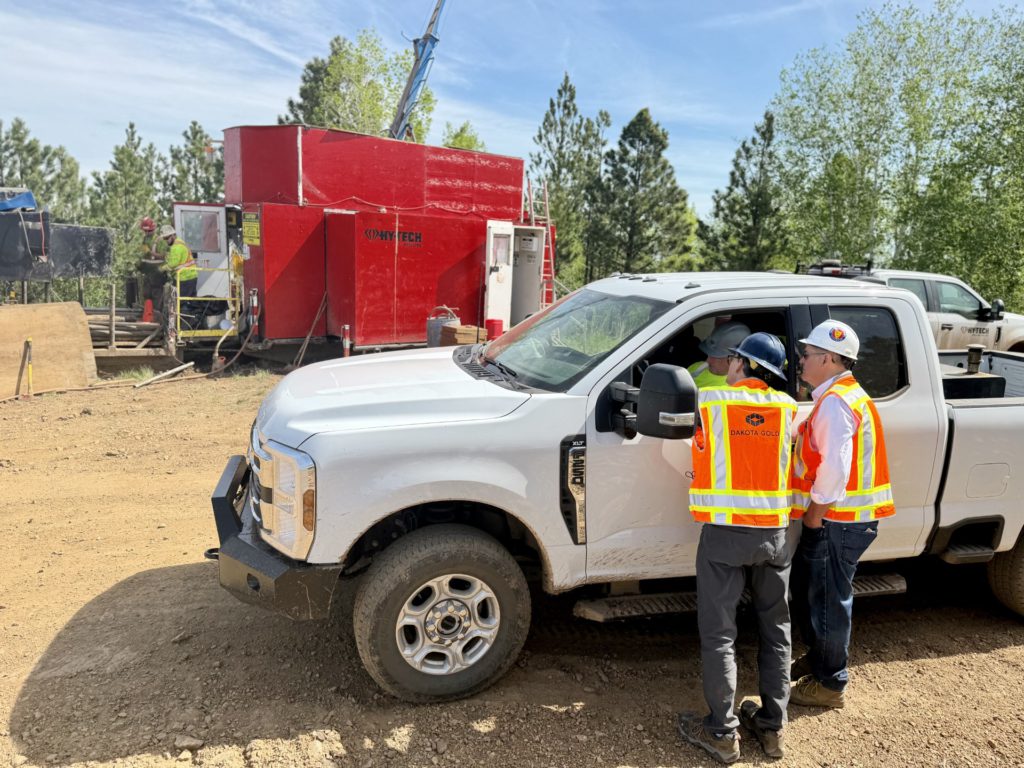
New drilling at Dakota Gold’s Richmond Hill project in South Dakota has returned high-grade intercepts inside the planned open pit, including 26 metres at 11.36 g/t gold and 14.92 g/t silver from ~75 metres in hole RH26C-432 and 38 metres at 2.89 g/t gold and 8.18 g/t silver from ~145 metres in RH26C-437. The 2026 programme totalled 17,273 metres across 112 infill, expansion and geotechnical holes, with assays from 350+ holes feeding a prefeasibility study due by 31 December and long-lead items such as an electrical substation already queued with Black Hills Energy. Richmond Hill, a large oxide gold system amenable to open-pit and heap leach, carries 244.7 Mt measured and indicated at 0.46 g/t Au and 4.83 g/t Ag (3.6 Moz Au, 38 Moz Ag), with an S-K 1300 Initial Assessment outlining 2.6–3.9 Moz Au production over 28 years and a post-tax NPV of $1.6–2.1 billion at a 55–59% IRR.
Technical Brief
- Expansion hole RH26C-452 intersected 16 m at 1.63 g/t Au and 12.03 g/t Ag from 79 m.
- Near-surface hole RH26C-448 returned 22 m at 0.61 g/t Au and 55.85 g/t Ag from 11 m.
- 2026 drilling comprised 112 holes over 17,273 m, including dedicated geotechnical holes for pit and infrastructure design.
- Assay dataset now exceeds 350 holes across 2025–26, providing dense spacing for PFS resource and pit optimisation.
- Expansion drilling in the northeast project area remains open in all directions, indicating potential for further pit growth.
- Electrical substation identified as the longest-lead critical item, with a construction slot secured via Black Hills Energy.
- Richmond Hill lies ~320 km west of Pierre within a 180 km² land package near the historic Homestake mine.
- S-K 1300 Initial Assessment (July) underpins economics: post-tax NPV US$1.6–2.1 billion, IRR 55–59%, initial capex US$384 million.
- Initial resource (Feb 2025) totals 244.7 Mt M&I at 0.46 g/t Au and 4.83 g/t Ag plus 230.6 Mt inferred at 0.35 g/t Au and 3.09 g/t Ag.
- CEO Robert Quartermain previously developed the Brucejack mine before its ~C$3.5 billion sale to Newcrest (now Newmont).
Our Take
With measured and indicated resources of 244.7 million tonnes at 0.46 g/t gold and 4.83 g/t silver, Richmond Hill sits at the low-grade, bulk-tonnage end of the gold spectrum in our Mining database, which makes the reported 11.36 g/t and similar intercepts particularly important for lifting early-phase economics and justifying the US$384 million initial cost profile.
The previous Richmond Hill drilling piece from 17 March 2026 in our coverage also highlighted step-out success to the north; combined with the current 112-hole 2026 programme and more than 350 holes already completed, this signals a deliberate push to convert a very large inferred inventory (230.6 million tonnes) into mineable reserves ahead of the S-K 1300 Initial Assessment and PFS work.
Dakota Gold’s potential 2.6–3.9 million oz life-of-mine production in South Dakota is modest compared with senior producers like Newmont (also referenced in the article facts), but the 55–59% post-tax IRR range and sub-US$400 million capex put Richmond Hill into the kind of high-return, mid-scale project bracket that larger gold companies in our database have recently been targeting for bolt-on growth rather than mega-projects.
Prepared by collating external sources, AI-assisted tools, and Geomechanics.io’s proprietary mining database, then reviewed for technical accuracy & edited by our geotechnical team.
Related Articles


Related Industries & Products
Mining
Geotechnical software solutions for mining operations including CMRR analysis, hydrogeological testing, and data management.
Construction
Quality control software for construction companies with material testing, batch tracking, and compliance management.
CMRR-io
Streamline coal mine roof stability assessments with our cloud-based CMRR software featuring automated calculations, multi-scenario analysis, and collaborative workflows.
HYDROGEO-io
Comprehensive hydrogeological testing platform for managing, analysing, and reporting on packer tests, lugeon values, and hydraulic conductivity assessments.
GEODB-io
Centralised geotechnical data management solution for storing, accessing, and analysing all your site investigation and material testing data.