Geomechanics.io

  • Free Tools
Sign UpLog In

Geomechanics.io

Geomechanics, Streamlined.

© 2026 Geomechanics.io. All rights reserved.

Geomechanics.io

CMRR-ioGEODB-ioHYDROGEO-ioQCDB-ioFree Tools & CalculatorsBlogLatest Industry News

Industries

MiningConstructionTunnelling

Company

Terms of UsePrivacy PolicyLinkedIn
    AllGeotechnicalMiningInfrastructureMaterialsHazardsEnvironmentalSoftwarePolicy
    Failure
    Safety
    Projects

    Spain retaining wall collapse derailment: failure lessons for rail engineers

    January 21, 2026|

    Reviewed by Tom Sullivan

    Spain retaining wall collapse derailment: failure lessons for rail engineers

    First reported on New Civil Engineer

    30 Second Briefing

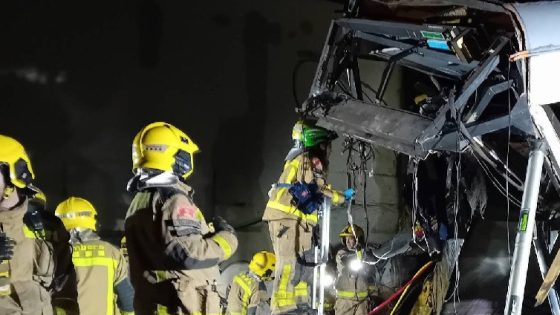
    A commuter train derailed in Gelida, near Barcelona, on 20 January after striking a collapsed retaining wall that had fallen onto the track, killing the driver and injuring 37 passengers. The incident, Spain’s second fatal rail accident in a week, occurred on a section of line with trackside earth-retaining structures, raising immediate questions over wall design, drainage, inspection frequency and slope stability under recent weather conditions. For civil and geotechnical engineers, failure mode identification and rapid condition assessment of similar retaining systems on active corridors will be a priority.

    Technical Brief

    • Failure mechanism likely involved loss of retaining wall stability, with forensic focus on drainage, backfill and bearing.
    • Investigation will need detailed wall type identification (gravity, cantilever, crib, etc.) and construction records review.
    • Geotechnical back‑analysis should compare as‑built geometry and soil parameters against original design factors of safety.
    • Targeted boreholes, trial pits and non‑destructive testing can characterise foundation conditions and detect hidden degradation.
    • Monitoring options for similar assets include inclinometers, crack gauges, tilt sensors and periodic LiDAR trackside surveys.
    • Remediation on comparable walls may require relieving structures, improved toe support, retrofitted anchors or reconstructed sections.
    • Safety review is expected to examine inspection intervals, defect classification thresholds and emergency line‑closure protocols.
    • For other rail corridors, systematic risk ranking of retaining walls under extreme weather loading becomes a priority task.

    Our Take

    Among the 32 Hazards stories in our coverage, very few involve retaining wall collapses onto active rail lines, which signals that the Gelida incident will likely be scrutinised as a geotechnical and asset-management failure rather than a routine operational safety lapse in Spain.

    With 37 injured passengers and one fatality, this Spain event sits at the higher-consequence end of recent Failure-tagged pieces, which may push Spanish rail and civil authorities around Barcelona to revisit inspection regimes for older earth-retaining structures near transport corridors.

    Given that many Safety- and Projects-tagged items in our database now reference AI or artificial intelligence for condition monitoring, the collapse near Gelida underscores the potential value of deploying sensor- and AI-based early warning on retaining walls adjacent to busy passenger routes.

    Geotechnical Software for Modern Teams

    Centralise site data, logs, and lab results with GEODB-io, CMRR-io, and HYDROGEO-io.

    No credit card required.

    • Save and export unlimited calculations
    • Advanced data visualisation
    • Generate professional PDF reports
    • Cloud storage for all your projects

    Prepared by collating external sources, AI-assisted tools, and Geomechanics.io’s proprietary mining database, then reviewed for technical accuracy & edited by our geotechnical team.

    Related Articles

    Melbourne sinkhole investigations: geotechnical lessons for tunnel project teams
    Hazards
    in 5 months

    Melbourne sinkhole investigations: geotechnical lessons for tunnel project teams

    A sinkhole roughly 8–10 m wide and several metres deep has opened on the AJ Burkitt Reserve sporting oval in Heidelberg, directly adjacent to the North East Link tunnel alignment in Melbourne’s northeast. Victorian Infrastructure Delivery Authority has confirmed the “surface hole” is in the vicinity of active tunnelling operations, leading to a work pause while engineers and emergency crews carry out geotechnical investigations and monitoring. No injuries or structural damage have been reported, but the area remains fully cordoned off pending cause determination and stability assessment.

    Salford Grab Hire £10k fine: maintenance safety lessons for plant engineers
    Hazards
    2 days ago

    Salford Grab Hire £10k fine: maintenance safety lessons for plant engineers

    A Manchester-based grab hire firm, Salford Grab Hire Limited, has been fined £10,000 plus £3,475.90 costs after a one-tonne excavator bucket, used to prop a raised tipper truck body during repair, became dislodged and crushed a mechanic in October 2023. The worker sustained multiple fractures to his hand, shoulder blade, ribs, shin and thigh, a crushed ankle and foot, and a pulmonary blood clot. HSE found the bucket lacked a quick hitch or retaining pin and that no appropriate tipper body support equipment or safe system of work had been used.

    Reactivated landslide at Köprülü: multi-sensor insights for slope risk decisions
    Hazards
    4 days ago

    Reactivated landslide at Köprülü: multi-sensor insights for slope risk decisions

    A 21,000 m² reactivated landslide threatening the settlement of Köprülü in northeastern Turkey forced engineers to combine InSAR, GNSS, inclinometers, piezometers and detailed geomorphological mapping to understand rapidly accelerating ground deformation and building cracking. The team distinguished an active deep-seated slide from adjacent dormant and secondary movements, using displacement rates and groundwater data to refine the failure surface geometry and kinematics. This combined analysis directly informed whether to pursue large-scale stabilisation works or managed relocation, illustrating how multi-sensor monitoring can de-risk high-consequence decisions on inhabited slopes.

    Related Industries & Products

    Construction

    Quality control software for construction companies with material testing, batch tracking, and compliance management.

    Mining

    Geotechnical software solutions for mining operations including CMRR analysis, hydrogeological testing, and data management.

    QCDB-io

    Comprehensive quality control database for manufacturing, tunnelling, and civil construction with UCS testing, PSD analysis, and grout mix design management.