Geomechanics.io

  • Free Tools
Sign UpLog In

Geomechanics.io

Geomechanics, Streamlined.

© 2026 Geomechanics.io. All rights reserved.

Geomechanics.io

CMRR-ioGEODB-ioHYDROGEO-ioQCDB-ioFree Tools & CalculatorsBlogLatest Industry News

Industries

MiningConstructionTunnelling

Company

Terms of UsePrivacy PolicyLinkedIn
    AllGeotechnicalMiningInfrastructureMaterialsHazardsEnvironmentalSoftwarePolicy
    Sustainability
    Projects

    Sizewell C concrete reuse from Sizewell A: circular design lessons for engineers

    November 21, 2025|

    Reviewed by Joe Ashwell

    Sizewell C concrete reuse from Sizewell A: circular design lessons for engineers

    First reported on The Construction Index

    30 Second Briefing

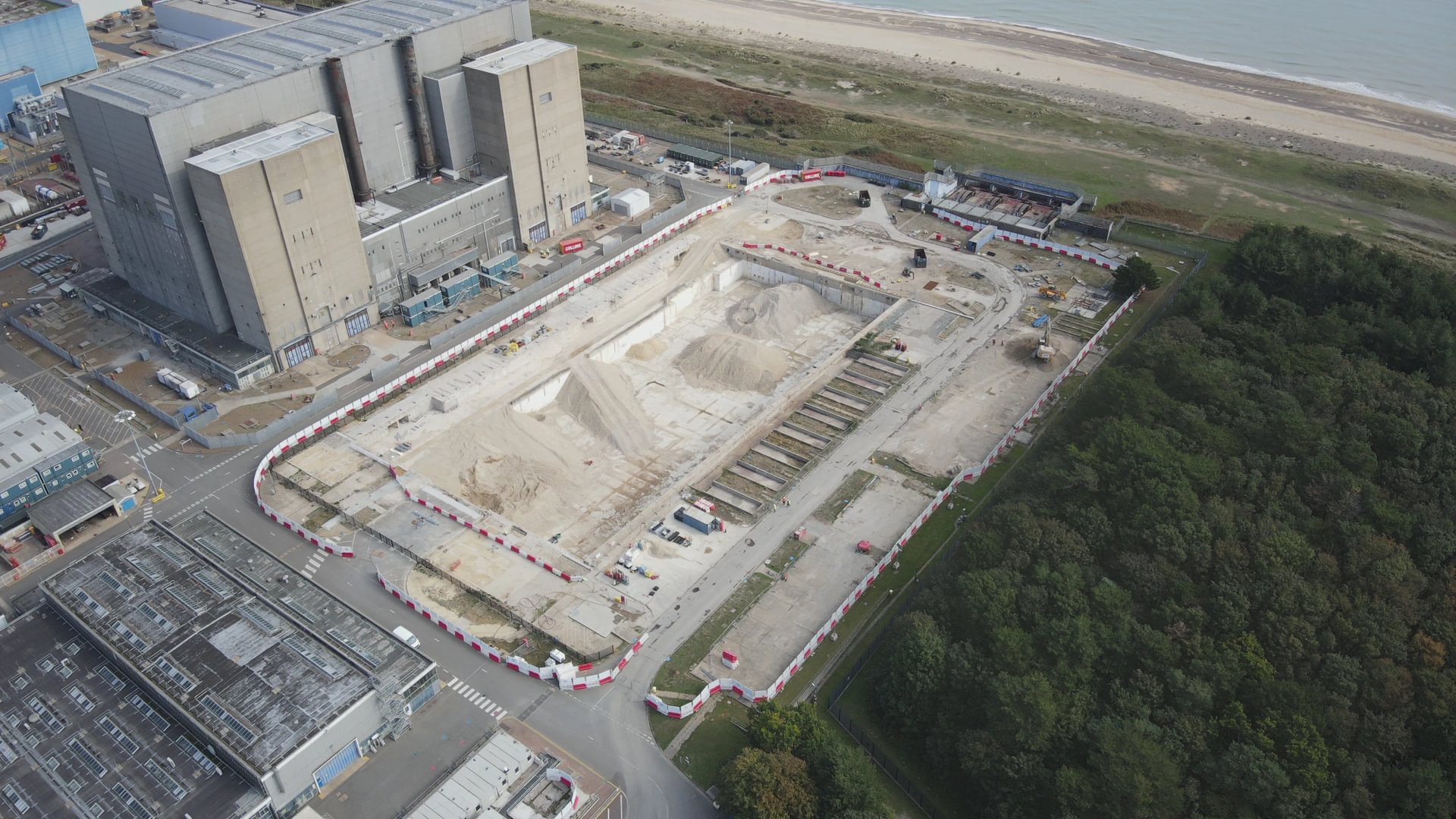
    More than 15,000 tonnes of crushed concrete from the demolished turbine alternator plinths at Sizewell A has been certified to WRAP quality protocol and reused as sub-base for foundation platforms in the Sizewell C main construction area, just a few hundred metres away. Nuclear Restoration Services and Sizewell C report the material transfers are complete, avoiding landfill and an estimated 28 tonnes of CO₂ while cutting heavy truck movements through East Suffolk. The reuse scheme was initiated by the Environment Agency and East Suffolk Council as part of a wider push for circular decommissioning practice on nuclear sites.

    Technical Brief

    • Recycled aggregate originates from demolished turbine alternator plinths within Sizewell A’s turbine hall.
    • Nuclear Restoration Services (NRS) led demolition, on-site crushing, testing and certification activities at Sizewell A.
    • Crushing and WRAP protocol compliance testing have been ongoing since September before any material transfer.
    • Material is reused as engineered sub-base for multiple foundation platforms within Sizewell C’s main construction area.
    • Environment Agency applied an “enabling approach to regulation” to permit reuse of nuclear site demolition arisings.
    • Environment Agency states it is pushing NRS to replicate this circular decommissioning approach at all UK sites where feasible.

    Our Take

    Among the 53 Sustainability/Projects-tagged pieces in our database, very few involve nuclear sites in the United Kingdom, so Sizewell C’s reuse of material from Sizewell A stands out as one of the more advanced circular-economy applications in the nuclear sector rather than in mainstream building or mining projects.

    The involvement of the Environment Agency and East Suffolk Council at the Sizewell C site signals that regulatory comfort with on-site reuse of demolition arisings is strengthening in Suffolk, which could shorten approvals for similar materials strategies on other large infrastructure schemes in the region.

    Although 28 tonnes of CO2 emissions prevented is modest at project scale, our coverage of other UK infrastructure jobs suggests that once a recycled-concrete supply chain is proven on one major site, contractors often replicate the methodology across multiple phases and assets, multiplying the carbon and cost savings over time.

    Geotechnical Software for Modern Teams

    Centralise site data, logs, and lab results with GEODB-io, CMRR-io, and HYDROGEO-io.

    No credit card required.

    • Save and export unlimited calculations
    • Advanced data visualisation
    • Generate professional PDF reports
    • Cloud storage for all your projects

    Prepared by collating external sources, AI-assisted tools, and Geomechanics.io’s proprietary mining database, then reviewed for technical accuracy & edited by our geotechnical team.

    Related Articles
    Hinkley Point C acoustic fish deterrent: design and permitting lessons for engineers
    Environmental
    7 days ago

    Hinkley Point C acoustic fish deterrent: design and permitting lessons for engineers

    An ultrasonic acoustic fish deterrent designed for EDF’s Hinkley Point C cooling water intakes has proved “highly effective” in Swansea University trials, significantly reducing fish approach rates to the intake zone. The system uses targeted sound frequencies to steer multiple species away from the intake channel, aiming to meet Environment Agency requirements on impingement and entrainment without major changes to the intake structure. Trial results may remove the need for a large compensatory saltmarsh scheme on the Severn Estuary, easing local planning and coastal engineering constraints.

    UK geothermal as mainstream heat: design and monitoring notes for engineers
    Environmental
    7 days ago

    UK geothermal as mainstream heat: design and monitoring notes for engineers

    Britain is being urged to treat deep and shallow geothermal as a mainstream heat source, with a new national roadmap arguing that the country’s substantial but underused subsurface resource could displace a significant share of gas‑fired heating. The plan points to proven concepts such as mine‑water geothermal in former coalfields and district heating from deep sedimentary aquifers, which can be integrated with existing heat networks and large heat pumps. For civil and geotechnical engineers, this signals growing demand for high‑temperature boreholes, well integrity design and long‑term monitoring of thermal–hydraulic behaviour in urban ground.

    WSP and Mott MacDonald Wylfa SMR deal: permitting and EIA lens for engineers
    Environmental
    11 days ago

    WSP and Mott MacDonald Wylfa SMR deal: permitting and EIA lens for engineers

    WSP and Mott MacDonald have secured a £25M contract from Great British Energy – Nuclear (GBE‑N) to deliver environmental services and permitting support for the proposed small modular reactor (SMR) development at Wylfa on Anglesey. The consultancies will lead environmental impact assessment, regulatory interface and consents strategy for the multi‑unit SMR site, a former nuclear location with complex coastal, seismic and ecological constraints. Early permitting work will be critical for geotechnical investigations, marine works and long‑lead nuclear island foundations once a reactor technology is selected.

    Related Industries & Products

    Construction

    Quality control software for construction companies with material testing, batch tracking, and compliance management.

    Mining

    Geotechnical software solutions for mining operations including CMRR analysis, hydrogeological testing, and data management.

    CMRR-io

    Streamline coal mine roof stability assessments with our cloud-based CMRR software featuring automated calculations, multi-scenario analysis, and collaborative workflows.

    HYDROGEO-io

    Comprehensive hydrogeological testing platform for managing, analysing, and reporting on packer tests, lugeon values, and hydraulic conductivity assessments.

    GEODB-io

    Centralised geotechnical data management solution for storing, accessing, and analysing all your site investigation and material testing data.