Sandvik’s C$51M Saskatoon mining hub: design and logistics notes for engineers
Reviewed by Joe Ashwell
First reported on MINING.com
30 Second Briefing
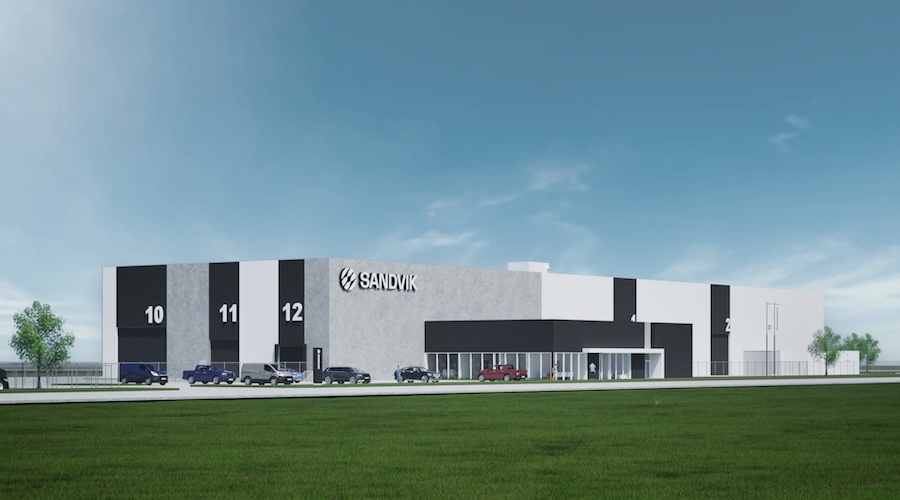
Sandvik will invest about C$51 million to build a 51,000-square-foot mechanical cutting, parts and services hub in Saskatoon’s North Marquis Industrial Area, on a 155-acre site east of Highway 11 and north of Marquis Drive. The facility will consolidate workflow-optimised workshop bays, wash bays, staging areas and clearance for next-generation mechanical cutting equipment with an integrated warehouse for regional parts inventory. Ground-breaking is planned for February 2026, with operations in Q4 2026 to support potash, uranium, gold and copper mines across Central and Western Canada.
Technical Brief
- Capex is stated at about C$51 million (US$37 million) for the Saskatoon development.
- Facility is explicitly described as “purpose-built” for mechanical cutting, parts and services workflows.
- Layout consolidates mechanical cutting maintenance, component repair, and aftermarket support into a single operations hub.
- Workflow-optimised workshop bays are planned to handle full equipment maintenance and major component overhauls.
- Dedicated wash bays and staging areas are included to manage large, next-generation cutting units safely and efficiently.
- Integrated warehouse is intended to centralise regional parts inventory and shorten aftermarket supply lead times.
- Design focus on capacity and readiness is aimed at long-term support for potash, uranium, gold and copper fleets.
Our Take
Taken with the C$85 million Sudbury facility announced on 5 December 2025, the Saskatoon hub signals Sandvik is building a two-node service spine across Ontario and Saskatchewan, which should materially shorten parts and rebuild lead times for copper, potash and uranium operations in central and western Canada.
Recent orders for Sandvik battery-electric fleets at Eldorado Gold’s Lamaque and intelligent loaders and trucks for Northern Star in Western Australia suggest the Saskatoon site is likely to support a growing installed base of high-spec, sensor-rich and electrified equipment rather than just conventional fleets.
Our database shows Sandvik appearing frequently in potash and hard-rock coverage, including mechanical cutting systems for potash and industrial minerals, so a large service footprint in Saskatchewan positions the company to capture aftermarket work as more underground potash and uranium projects move from study to execution in the province.
Prepared by collating external sources, AI-assisted tools, and Geomechanics.io’s proprietary mining database, then reviewed for technical accuracy & edited by our geotechnical team.
Related Articles

Related Industries & Products
Mining
Geotechnical software solutions for mining operations including CMRR analysis, hydrogeological testing, and data management.
Construction
Quality control software for construction companies with material testing, batch tracking, and compliance management.
CMRR-io
Streamline coal mine roof stability assessments with our cloud-based CMRR software featuring automated calculations, multi-scenario analysis, and collaborative workflows.
HYDROGEO-io
Comprehensive hydrogeological testing platform for managing, analysing, and reporting on packer tests, lugeon values, and hydraulic conductivity assessments.
GEODB-io
Centralised geotechnical data management solution for storing, accessing, and analysing all your site investigation and material testing data.