Geomechanics.io

  • Free Tools
Sign UpLog In

Geomechanics.io

Geomechanics, Streamlined.

© 2026 Geomechanics.io. All rights reserved.

Geomechanics.io

CMRR-ioGEODB-ioHYDROGEO-ioQCDB-ioFree Tools & CalculatorsBlogLatest Industry News

Industries

MiningConstructionTunnelling

Company

Terms of UsePrivacy PolicyLinkedIn
    AllGeotechnicalMiningInfrastructureMaterialsHazardsEnvironmentalSoftwarePolicy
    Projects
    Contract Award

    Rio Tinto–Glencore coal option: portfolio and project impacts for mine planners

    January 9, 2026|

    Reviewed by Joe Ashwell

    Rio Tinto–Glencore coal option: portfolio and project impacts for mine planners

    First reported on MINING.com

    30 Second Briefing

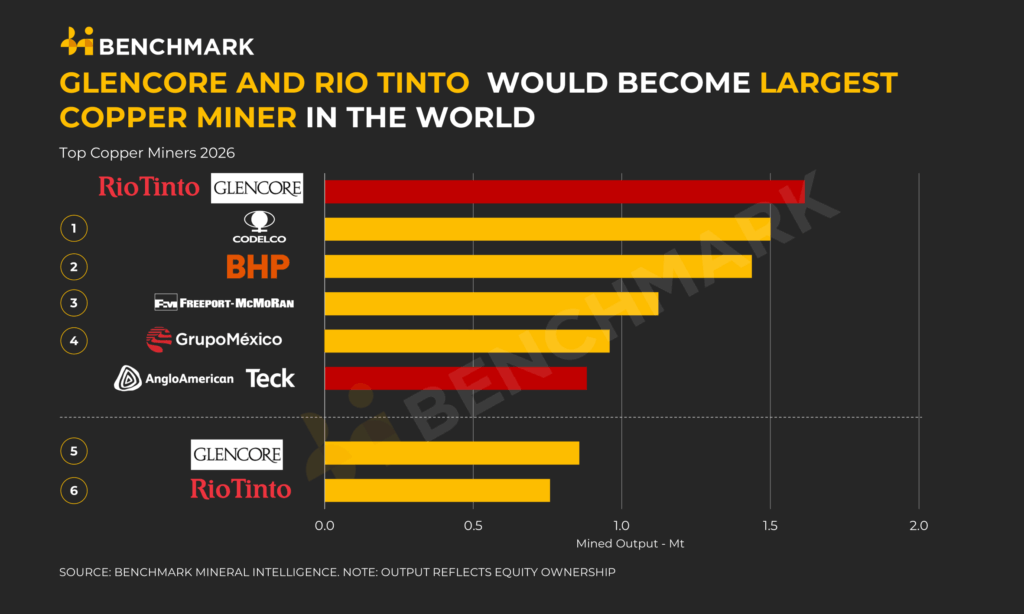
    Rio Tinto is considering temporarily owning Glencore’s coal business, including the Ulan complex and Teck-acquired assets, to clear a key hurdle in buyout talks that could create a $207 billion mega-miner and the world’s largest listed mining company. One option under discussion is Rio acquiring all of Glencore, then later divesting coal while retaining the $1.4 billion‑EBIT first-half 2024 marketing division, which Goldman Sachs values at up to $4 billion by 2030. Analysts expect significant portfolio reshuffling, with copper the core rationale as combined 2026 copper output could exceed 1.6 million tonnes.

    Technical Brief

    • Rio exited coal in 2018, so any temporary coal ownership reverses an established portfolio constraint.
    • Glencore’s coal portfolio includes the Ulan complex in New South Wales plus Teck’s former coal assets.
    • Rio has an enterprise value of about A$200 billion ($134 billion), positioning it as the likely acquirer.
    • Goldman Sachs assigns up to $4 billion 2030 value to Glencore’s marketing business, shaping deal economics.

    Our Take

    The potential Rio Tinto–Glencore tie-up follows Canada’s approval of the Anglo American–Teck Resources merger, which our coverage notes would control just under 5% of global copper supply, signalling regulators are currently willing to sign off on very large diversified miners so long as copper and critical minerals exposure is strengthened.

    In our database of 539 Mining stories, Glencore and Rio Tinto appear frequently in copper- and coal-tagged items, and the projected structural copper deficit from 2026 highlighted in the December 2025 copper outlook piece suggests that any combined group would be under pressure to prioritise copper and rare earth growth over legacy coal even if it temporarily accepts coal exposure.

    Benchmark Minerals’ estimate of 1.6 million tonnes combined output by 2026 for Rio and Glencore sits against a backdrop of other mega-mergers like Anglo–Teck, indicating that scale in bulk commodities and marketing (such as Glencore’s trading arm) is becoming a key strategic lever for negotiating offtake and capital access, particularly with buyers in China and Japan referenced in this article’s country set.

    Geotechnical Software for Modern Teams

    Centralise site data, logs, and lab results with GEODB-io, CMRR-io, and HYDROGEO-io.

    No credit card required.

    • Save and export unlimited calculations
    • Advanced data visualisation
    • Generate professional PDF reports
    • Cloud storage for all your projects

    Prepared by collating external sources, AI-assisted tools, and Geomechanics.io’s proprietary mining database, then reviewed for technical accuracy & edited by our geotechnical team.

    Related Articles

    Meta and Sprott in nuclear revival: demand signals and risks for uranium projects
    Mining
    44 minutes ago

    Meta and Sprott in nuclear revival: demand signals and risks for uranium projects

    Meta has signed nuclear power deals with Vistra, TerraPower and Oklo for up to 6.6 GW of capacity by 2035 to run its US data centres and the Prometheus AI supercluster in Ohio, adding to a 20‑year, 1.12 GW offtake from Constellation’s Clinton plant. In parallel, the Sprott Physical Uranium Trust has bought 300,000 lb of U₃O₈ in a week, lifting holdings to about 75.2 million lb worth US$6.17 billion, as spot prices hover around US$82/lb. For miners and project developers, this combination of long‑term nuclear PPAs and aggressive physical uranium accumulation signals firmer demand visibility despite persistent SMR cost and schedule risk.

    Mining
    about 12 hours ago

    Derrick Experience Center: fine screening test gains and risks for plant engineers

    Derrick Corporation has opened its Derrick Experience Center (DEX Center) in January 2026 to mark its 75th anniversary, creating a dedicated test hub for advanced fine screening technology. The “first-of-its-kind” facility is designed for current and prospective customers to run full-scale trials on Derrick high-frequency screens and Polyweb® urethane panels under controlled conditions, rather than relying solely on on-site pilots. The centre is intended to shorten test campaigns, de-risk screen selection, and optimise cut size and throughput for fine coal, iron ore, base metals and industrial minerals circuits.

    University of Arizona mine waste project: key processing insights for engineers
    Mining
    1 day ago

    University of Arizona mine waste project: key processing insights for engineers

    A $3.6 million Arbor-funded University of Arizona Tailings Center project, led by mining engineer Dr Isabel Barton, is evaluating whether 17.5 billion tons of historic copper tailings in Arizona—growing by ~100 million tonnes per year—can be reprocessed to recover critical minerals and reduce environmental risk. The team is combining statewide and UAV-based remote sensing, industry tailings datasets, drilling and surface sampling, mineralogical characterisation and techno-economic analysis using magnetic separation and basic leaching. Early work has identified unexpected mineral occurrences, including arsenic, zinc and possibly tungsten, which could justify flowsheet changes to keep these elements out of future tailings.

    Related Industries & Products

    Mining

    Geotechnical software solutions for mining operations including CMRR analysis, hydrogeological testing, and data management.

    CMRR-io

    Streamline coal mine roof stability assessments with our cloud-based CMRR software featuring automated calculations, multi-scenario analysis, and collaborative workflows.

    HYDROGEO-io

    Comprehensive hydrogeological testing platform for managing, analysing, and reporting on packer tests, lugeon values, and hydraulic conductivity assessments.

    GEODB-io

    Centralised geotechnical data management solution for storing, accessing, and analysing all your site investigation and material testing data.