Geomechanics.io

  • Free Tools
Sign UpLog In
Built byBoxcut Studio

Geomechanics.io

Geomechanics, Streamlined.

© 2026 Geomechanics.io. All rights reserved.

Geomechanics.io

CMRR-ioGEODB-ioHYDROGEO-ioQCDB-ioFree Tools & CalculatorsBlogLatest Industry News

Industries

MiningConstructionTunnelling

Company

Terms of UsePrivacy PolicyLinkedIn
    Projects
    Product

    Queensland critical minerals lab: design and testwork gains for process engineers

    February 19, 2026|

    Reviewed by Joe Ashwell

    Queensland critical minerals lab: design and testwork gains for process engineers

    First reported on Australian Mining

    30 Second Briefing

    A new state-of-the-art minerals processing facility has opened in Queensland to accelerate testwork and flowsheet development for critical minerals, positioning local projects to move faster from resource definition to pilot scale. The lab is geared to handle complex ore characterisation, bench-scale processing and variability testing, supporting commodities such as rare earths, vanadium and battery-grade manganese under controlled, repeatable conditions. For miners and process engineers, this centralised capability should de-risk plant design, reduce reliance on overseas laboratories and shorten timelines for metallurgical optimisation.

    Technical Brief

    • Facility is configured as a dedicated minerals processing lab rather than a mine-site pilot plant.
    • Located in Queensland, giving proximity to emerging critical minerals hubs in the state’s north and west.
    • Centralised testwork capability reduces logistics complexity for sample export to overseas laboratories and associated delays.
    • Co-location of testing, innovation and research functions enables tighter feedback loops between geometallurgy and flowsheet design.
    • Likely to support both greenfield and brownfield projects needing bench-scale verification of novel processing routes.
    • Shared infrastructure model should lower per‑project metallurgical test costs compared with standalone bespoke facilities.
    • For similar critical minerals clusters, such hubs can anchor regional supply chains and skills development.

    Our Take

    Critical minerals pieces in our database often centre on mine approvals or downstream processing plants, so a Queensland state-of-the-art minerals processing facility signals a push to de‑risk flowsheet development earlier in the value chain.

    Within the 1065 Mining stories, Australia frequently appears in critical minerals coverage as a low‑sovereign‑risk jurisdiction, meaning a Queensland lab of this type is likely to become a preferred test hub for international juniors needing bankable metallurgical data.

    For Queensland specifically, where several critical minerals projects are still at scoping or PFS stage in our coverage, access to a dedicated processing facility can shorten metallurgical testwork timelines and help projects move from concept to financing more quickly.

    Geotechnical Software for Modern Teams

    Centralise site data, logs, and lab results with GEODB-io, CMRR-io, and HYDROGEO-io.

    No credit card required.

    • Save and export unlimited calculations
    • Advanced data visualisation
    • Generate professional PDF reports
    • Cloud storage for all your projects

    Prepared by collating external sources, AI-assisted tools, and Geomechanics.io’s proprietary mining database, then reviewed for technical accuracy & edited by our geotechnical team.

    Related Articles
    Fortescue copper–arsenic Toowong Process: project economics lens for mine planners
    Mining
    about 7 hours ago

    Fortescue copper–arsenic Toowong Process: project economics lens for mine planners

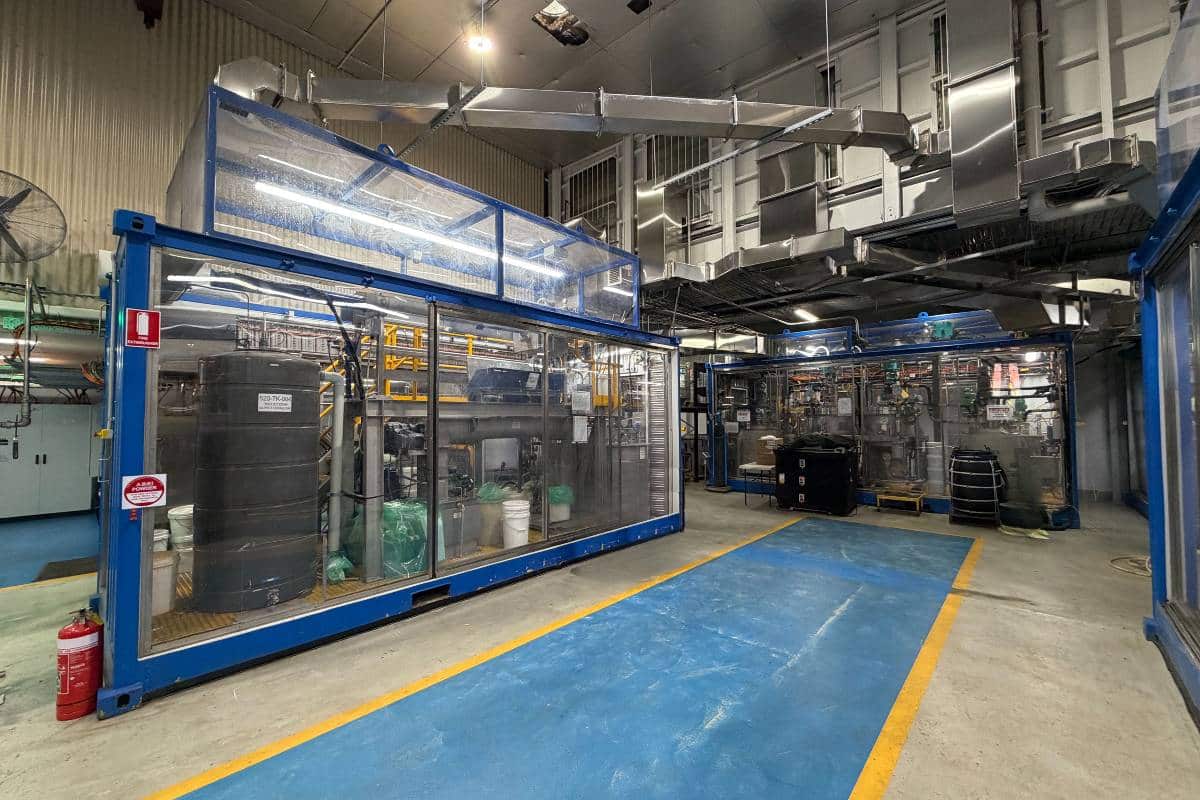
    Fortescue has sold more than 40 tonnes of copper concentrate treated with its patented Toowong Process, a low-temperature, low-pressure hydrometallurgical circuit that removes arsenic from copper concentrates. Developed and tested over four years after Fortescue acquired the technology, the process targets a longstanding penalty element constraint that limits saleability of high-arsenic ores. Commercial deployment could materially change project economics for arsenic-rich copper deposits, enabling miners to convert previously marginal or stranded resources into exportable concentrate streams.

    Core’s Finniss lithium: 92 m Blackbeard hit and what it means for mine design
    Mining
    about 7 hours ago

    Core’s Finniss lithium: 92 m Blackbeard hit and what it means for mine design

    Core Lithium has reported its longest mineralised downhole intersection at the Blackbeard prospect within the Finniss lithium operation in the Northern Territory, with diamond drillhole NMRD104 returning 92m at 1.25 per cent Li₂O, including 73m at 1.45 per cent Li₂O. The thick, continuous spodumene-bearing pegmatite materially extends known mineralisation at depth and along strike, improving the potential for larger, more coherent underground or bulk open-pit mine designs. For resource modellers and geotechs, the interval supports tighter geological domaining and may justify updated pit shells and geotechnical slope assessments.

    South32 Australian manganese output lift: throughput takeaways for mine planners
    Mining
    about 7 hours ago

    South32 Australian manganese output lift: throughput takeaways for mine planners

    South32 lifted Australia Manganese saleable output 15 per cent quarter-on-quarter to 902,000 wet metric tonnes in the September 2026 quarter, driven by higher utilisation of the primary processing circuit, while keeping full-year production guidance unchanged across its operations. Alumina production also increased, and the company is continuing capital deployment into base metals growth projects, including copper and zinc developments. For mine planners and process engineers, the numbers signal more stable plant throughput assumptions and sustained demand for processing circuit optimisation and debottlenecking work.

    Related Industries & Products

    Mining

    Geotechnical software solutions for mining operations including CMRR analysis, hydrogeological testing, and data management.

    Construction

    Quality control software for construction companies with material testing, batch tracking, and compliance management.

    CMRR-io

    Streamline coal mine roof stability assessments with our cloud-based CMRR software featuring automated calculations, multi-scenario analysis, and collaborative workflows.

    HYDROGEO-io

    Comprehensive hydrogeological testing platform for managing, analysing, and reporting on packer tests, lugeon values, and hydraulic conductivity assessments.

    GEODB-io

    Centralised geotechnical data management solution for storing, accessing, and analysing all your site investigation and material testing data.

    AllGeotechnicalInfrastructureHazardsEnvironmental