Oil shock and mining costs: BMO sensitivities unpacked for project teams
Reviewed by Joe Ashwell
First reported on MINING.com
30 Second Briefing
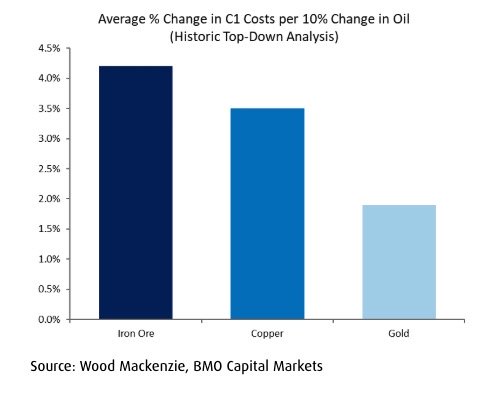
Rising Brent crude above $100/bbl could lift iron ore cash costs by about 20%, copper by 16% and gold by 9% if prices hold near that level, BMO Capital Markets estimates from Wood Mackenzie data. Historical sensitivities show iron ore costs rising ~4.2% for every 10% oil increase, versus 3.5% for copper and 1.9% for gold, with diesel now only ~5% of copper site costs but higher energy feeding through power, consumables, labour and equipment. Africa and the Americas appear less exposed than Europe and Asia, while sulphur and ammonia flows via the Strait of Hormuz threaten acid and explosives input costs.
Technical Brief
- BMO’s analysis uses ~25 years of Wood Mackenzie mine cost and oil price data for sensitivities.
- Diesel’s direct share of copper site operating costs has fallen from ~8% in 2005 to ~5% now.
- Analysts warn “bottom‑up” fuel line items miss indirect energy pass‑through via power, consumables, labour and equipment.
- Copper solvent extraction–electrowinning circuits are exposed to sulphur price spikes via sulphuric acid reagent costs.
- Individual mine exposure depends heavily on local power contracts, fuel hedging and captive generation arrangements.
Our Take
The cost sensitivities BMO cites for copper and iron ore sit at the high end of what our database shows for major bulk and base metals, implying that an extended period of $100 oil would likely squeeze margins hardest at diesel‑intensive open pits in Latin America, Africa and Australia.
With diesel’s direct share of copper mine operating costs already down from 8% to 5%, the remaining 3.5% cost uplift per 10% oil move suggests that indirect channels (reagents like sulphuric acid, explosives from ammonia/ammonium nitrate, and freight) are now the main transmission path miners need to hedge or re‑engineer.
The note that about one‑fifth of ammonia exports pass through the Strait of Hormuz, combined with Iran/Russia supplying roughly 15% of China’s feedstock, signals that any disruption there could tighten global sulphur and fertiliser‑linked inputs, raising costs not just for copper and gold but also for zinc projects that feature in other recent sustainability‑tagged coverage.
Prepared by collating external sources, AI-assisted tools, and Geomechanics.io’s proprietary mining database, then reviewed for technical accuracy & edited by our geotechnical team.
Related Articles
Related Industries & Products
Mining
Geotechnical software solutions for mining operations including CMRR analysis, hydrogeological testing, and data management.
CMRR-io
Streamline coal mine roof stability assessments with our cloud-based CMRR software featuring automated calculations, multi-scenario analysis, and collaborative workflows.
HYDROGEO-io
Comprehensive hydrogeological testing platform for managing, analysing, and reporting on packer tests, lugeon values, and hydraulic conductivity assessments.
GEODB-io
Centralised geotechnical data management solution for storing, accessing, and analysing all your site investigation and material testing data.