Geomechanics.io

  • Free Tools
Sign UpLog In
AllGeotechnicalMiningInfrastructureMaterialsHazardsEnvironmentalSoftwarePolicy

Geomechanics.io

Geomechanics, Streamlined.

© 2026 Geomechanics.io. All rights reserved.

Geomechanics.io

CMRR-ioGEODB-ioHYDROGEO-ioQCDB-ioFree Tools & CalculatorsBlogLatest Industry News

Industries

MiningConstructionTunnelling

Company

Terms of UsePrivacy PolicyLinkedIn
    Projects
    Contract Award

    Maaden’s US$110bn Saudi build-out: project and infrastructure notes for mine planners

    January 16, 2026|

    Reviewed by Joe Ashwell

    Maaden’s US$110bn Saudi build-out: project and infrastructure notes for mine planners

    First reported on MINING.com

    30 Second Briefing

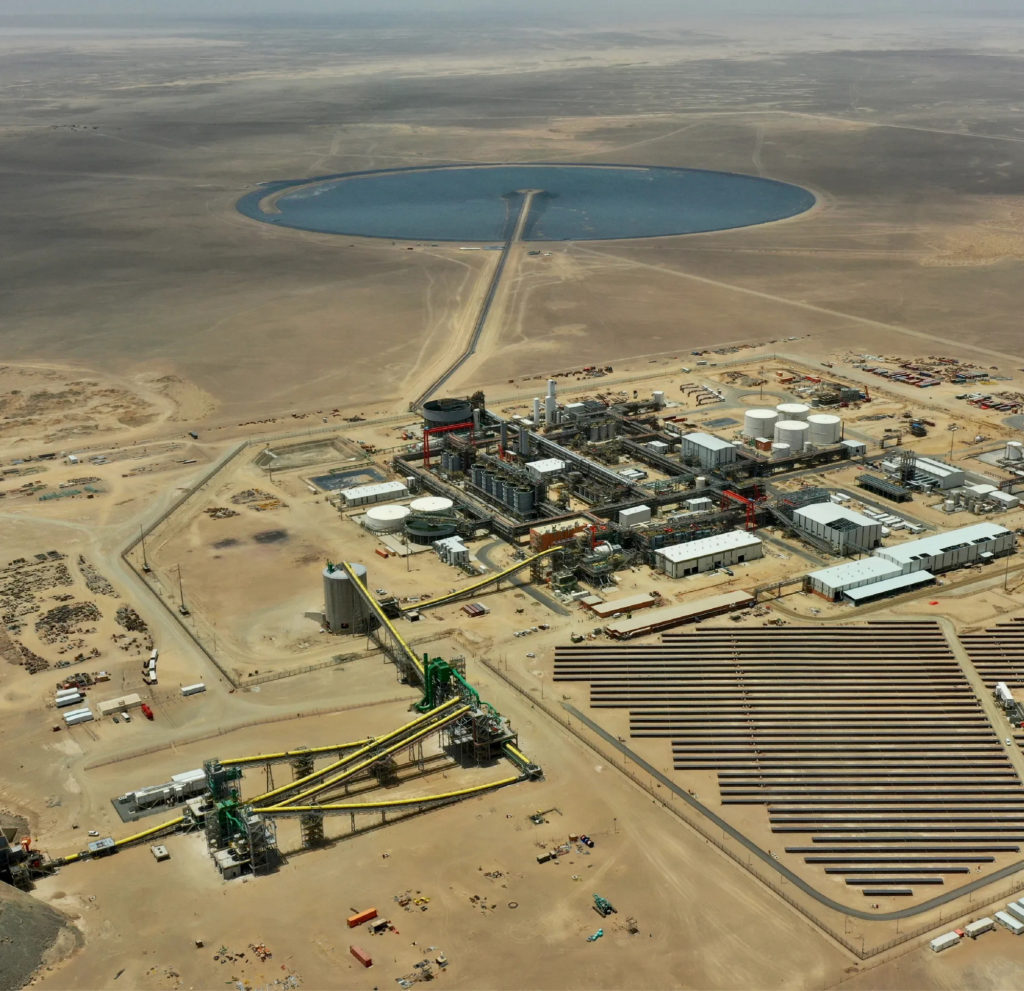
    Maaden will invest US$110 billion over the next decade to triple its phosphate and gold output and double aluminium production, centred on eight megaprojects including the US$22.7 billion Wa’ad Al Shamal phosphate complex and its US$7.7 billion Phosphate 3 expansion due in 2027. Current capacity stands at about 500,000 oz. gold and 7 million tonnes per year of phosphate and aluminium, with phosphate output from Wa’ad Al Shamal and Ras Al Khair alone rated at 6 million tonnes per year. The build-out will drive major new pipelines, ports and rail links in Saudi Arabia and deepen processing partnerships with both MP Materials/US DoD and Chinese firms.

    Technical Brief

    • Wa’ad Al Shamal’s initial capex of US$22.7 billion makes it among the world’s costliest mining complexes.
    • Phosphate 3 at Wa’ad Al Shamal adds a further US$7.7 billion in expansion capital, completion targeted next year.
    • Wa’ad Al Shamal processes ore mainly trucked or conveyed from the Al Khabra phosphate mine in northern Saudi Arabia.
    • Combined nameplate phosphate capacity of Wa’ad Al Shamal and Ras Al Khair is 6 Mtpa, supporting large-scale fertiliser production chains.
    • Maaden drilled four Saudi sites recently, delineating almost 8 million oz. of additional gold resources for future mine development.
    • Aluminium output guidance from the Ras Al Khair smelter complex was 850,000–1,150,000 t for the last reported year.
    • Gold production guidance for 2025 is 475,000–560,000 oz. from seven operating mines distributed across the kingdom.
    • A JV with MP Materials and the US Department of Defense will build a rare earth refinery inside Saudi Arabia, anchoring critical minerals processing capacity.

    Our Take

    The nearly 8 million oz of added gold resources across four Arabian Shield sites in the 2026-01-13 item in our database underpins Maaden’s plan to triple its gold business, suggesting that the current growth targets are backed by recent exploration success rather than purely aspirational guidance.

    The rare earth refinery JV between Maaden, MP Materials and the US Department of War (2025-11-19 entry) indicates that Saudi Arabia is positioning its rare earths and lithium ambitions as part of a US-aligned critical minerals supply chain, which may help de-risk offtake for the planned megaprojects relative to China-centric routes.

    Within our 645 Mining stories, Maaden appears unusually active across multiple commodities (gold, aluminium, phosphate and rare earths), signalling that Saudi Arabia is one of the few jurisdictions trying to build an integrated multi-commodity value chain rather than a single-commodity play, which could change competitive dynamics for regional producers in the Middle East and Asia.

    Geotechnical Software for Modern Teams

    Centralise site data, logs, and lab results with GEODB-io, CMRR-io, and HYDROGEO-io.

    No credit card required.

    • Save and export unlimited calculations
    • Advanced data visualisation
    • Generate professional PDF reports
    • Cloud storage for all your projects

    Prepared by collating external sources, AI-assisted tools, and Geomechanics.io’s proprietary mining database, then reviewed for technical accuracy & edited by our geotechnical team.

    Related Articles

    Krypton in zircon grains: storage timescales and mineral sands insight for miners
    Mining
    about 6 hours ago

    Krypton in zircon grains: storage timescales and mineral sands insight for miners

    Krypton trapped in zircon grains from ancient Australian beach sands has been used by Curtin University’s Timescales of Mineral Systems Group, with the Universities of Göttingen and Cologne, as a “cosmic clock” to quantify how long sediments stayed near the surface before burial. Measurements of cosmogenic krypton show that under tectonically stable conditions with high sea levels, erosion rates drop sharply and sediments can be stored and reworked for millions of years in river basins, coastlines and continental shelves. The work links prolonged sediment storage to the concentration of durable heavy minerals, helping explain Australia’s large mineral sand deposits and offering new constraints for resource prospectivity models under changing climate and sea-level regimes.

    Sprott’s 2026 outlook: metals, debt and tariffs – key signals for mine planners
    Mining
    about 8 hours ago

    Sprott’s 2026 outlook: metals, debt and tariffs – key signals for mine planners

    Deglobalisation, fractured metal inventories and the “debasement trade” into hard assets are expected by Sprott to drive 2026 markets, with US public debt above $38 trillion and copper in the US trading up to 30% higher than London prices in 2025 as tariffs and stockpiling distorted flows. Central banks, led by China, are projected to keep buying gold heavily after reserves freezes in 2022, while silver’s dual role as monetary hedge and critical input for clean energy and AI infrastructure supports its bull cycle. Uranium, copper and rare earths remain key watchpoints, with $80 billion in new US reactor support, 17‑year average copper mine lead times, and rare earth supply still dominated by China.

    Kinross greenlights three US builds: capex, output and design notes for mine planners
    Mining
    about 12 hours ago

    Kinross greenlights three US builds: capex, output and design notes for mine planners

    Kinross Gold has approved three US projects—Round Mountain Phase X, Bald Mountain Redbird 2 (Nevada) and the Kettle River–Curlew restart (Washington)—aimed at adding about 3 million oz between 2028 and 2038 and holding group output near 2 million oz per year. Round Mountain will shift to 3,000 t/d bulk underground mining of 11 Mt at 3.2 g/t (1.2 Moz) with initial capex of US$400 million, while Curlew will feed the 1,800 t/d Kettle River mill using dry-stack tailings and US$485 million upfront spend. Bald Mountain’s Redbird 2 pushback and five satellite pits will leverage existing leach infrastructure to deliver roughly 155,000 oz per year to 2031, with a US$490 million build and a SART plant to handle higher-copper ore.

    Related Industries & Products

    Mining

    Geotechnical software solutions for mining operations including CMRR analysis, hydrogeological testing, and data management.

    Construction

    Quality control software for construction companies with material testing, batch tracking, and compliance management.

    CMRR-io

    Streamline coal mine roof stability assessments with our cloud-based CMRR software featuring automated calculations, multi-scenario analysis, and collaborative workflows.

    HYDROGEO-io

    Comprehensive hydrogeological testing platform for managing, analysing, and reporting on packer tests, lugeon values, and hydraulic conductivity assessments.

    GEODB-io

    Centralised geotechnical data management solution for storing, accessing, and analysing all your site investigation and material testing data.