Geomechanics.io

  • Free Tools
Sign UpLog In

Geomechanics.io

Geomechanics, Streamlined.

© 2026 Geomechanics.io. All rights reserved.

Geomechanics.io

CMRR-ioGEODB-ioHYDROGEO-ioQCDB-ioFree Tools & CalculatorsBlogLatest Industry News

Industries

MiningConstructionTunnelling

Company

Terms of UsePrivacy PolicyLinkedIn
    AllGeotechnicalMiningInfrastructureMaterialsHazardsEnvironmentalSoftwarePolicy
    Projects
    Sustainability

    Lundin’s US$150M Caserones upgrade: heap leach and water strategy for mine engineers

    January 9, 2026|

    Reviewed by Tom Sullivan

    Lundin’s US$150M Caserones upgrade: heap leach and water strategy for mine engineers

    First reported on MINING.com

    30 Second Briefing

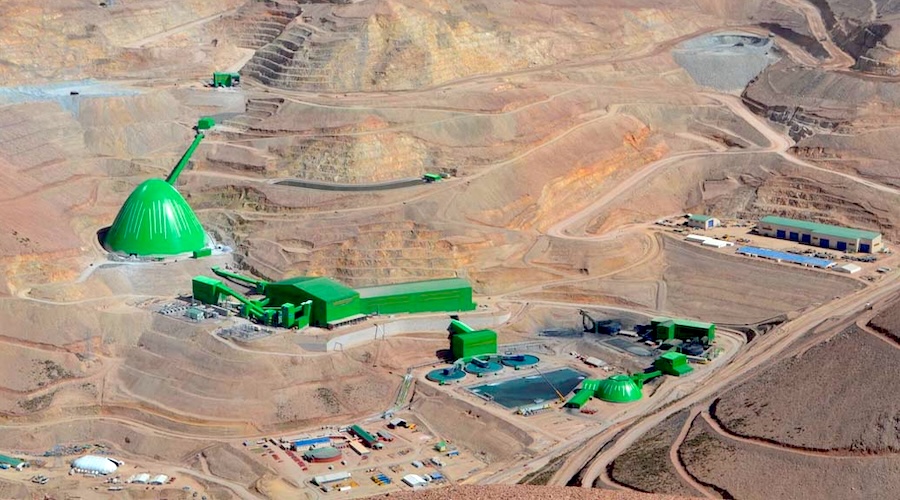
    Lundin Mining has filed for Chilean environmental approval for a US$150 million upgrade at the Caserones copper-molybdenum mine, aiming to maintain current production and fresh water use while extending operating continuity to 2039. The project adds new access roads, a fresh water reservoir, two backup sulphuric acid storage tanks, and a 90 Mt increase in heap leach capacity, while extending operations at the existing solvent extraction–electrowinning plant. Caserones currently processes about 84 Mt/a of ore with 100,000 t/d milling capacity and up to 35,000 t/a cathode output, but faces declining grades and lower production from 2027.

    Technical Brief

    • Environmental approval was filed on 6 January 2026 with Chile’s Environmental Evaluation Service via SCM Minera Lumina Copper.
    • Permit conditions are proposed to keep all input and output volumes identical to the 2010 RCA.
    • Declining Chilean ore grades are forecast to drop Caserones output to 105,000–115,000 t from 2027.
    • The mine currently treats about 84 Mt of ore per year against an installed milling capacity of 100,000 t/d.
    • Lundin drilled 18 km around Caserones in 2025 to support potential brownfield resource growth and future expansions.
    • Caserones is integrated into Lundin’s Vicuña district strategy alongside Josemaría and Filo del Sol on the Chile–Argentina border.
    • Group-wide, Lundin is targeting 500,000 t/a copper and ~550,000 oz/a gold within three to five years, mainly via brownfield expansions.

    Our Take

    With Caserones already processing about 84 Mt/a, a 90 Mt leach capacity boost signals a pivot to maximising metal recovery from lower-grade ore and stockpiles, which can materially improve unit costs without the permitting risk of a greenfield expansion in Chile’s Atacama Region.

    Extending Caserones’ operating continuity to 2039 under a 70/30 Lundin–JX Advanced Metals ownership structure gives Japanese downstream users long-term copper and molybdenum exposure from Latin America, which is strategically valuable as AI-linked forecasts in our database point to copper demand potentially rising by around 50% by 2040.

    The 18 km of drilling completed around Caserones in 2025, combined with nearby Lundin projects like Josemaría and Filo del Sol in the Vicuña district, suggests the company is de-risking a district-scale copper hub on the Chile–Argentina border rather than treating Caserones as a stand-alone asset.

    Geotechnical Software for Modern Teams

    Centralise site data, logs, and lab results with GEODB-io, CMRR-io, and HYDROGEO-io.

    No credit card required.

    • Save and export unlimited calculations
    • Advanced data visualisation
    • Generate professional PDF reports
    • Cloud storage for all your projects

    Prepared by collating external sources, AI-assisted tools, and Geomechanics.io’s proprietary mining database, then reviewed for technical accuracy & edited by our geotechnical team.

    Related Articles

    Meta and Sprott in nuclear revival: demand signals and risks for uranium projects
    Mining
    about 1 hour ago

    Meta and Sprott in nuclear revival: demand signals and risks for uranium projects

    Meta has signed nuclear power deals with Vistra, TerraPower and Oklo for up to 6.6 GW of capacity by 2035 to run its US data centres and the Prometheus AI supercluster in Ohio, adding to a 20‑year, 1.12 GW offtake from Constellation’s Clinton plant. In parallel, the Sprott Physical Uranium Trust has bought 300,000 lb of U₃O₈ in a week, lifting holdings to about 75.2 million lb worth US$6.17 billion, as spot prices hover around US$82/lb. For miners and project developers, this combination of long‑term nuclear PPAs and aggressive physical uranium accumulation signals firmer demand visibility despite persistent SMR cost and schedule risk.

    Mining
    about 12 hours ago

    Derrick Experience Center: fine screening test gains and risks for plant engineers

    Derrick Corporation has opened its Derrick Experience Center (DEX Center) in January 2026 to mark its 75th anniversary, creating a dedicated test hub for advanced fine screening technology. The “first-of-its-kind” facility is designed for current and prospective customers to run full-scale trials on Derrick high-frequency screens and Polyweb® urethane panels under controlled conditions, rather than relying solely on on-site pilots. The centre is intended to shorten test campaigns, de-risk screen selection, and optimise cut size and throughput for fine coal, iron ore, base metals and industrial minerals circuits.

    University of Arizona mine waste project: key processing insights for engineers
    Mining
    1 day ago

    University of Arizona mine waste project: key processing insights for engineers

    A $3.6 million Arbor-funded University of Arizona Tailings Center project, led by mining engineer Dr Isabel Barton, is evaluating whether 17.5 billion tons of historic copper tailings in Arizona—growing by ~100 million tonnes per year—can be reprocessed to recover critical minerals and reduce environmental risk. The team is combining statewide and UAV-based remote sensing, industry tailings datasets, drilling and surface sampling, mineralogical characterisation and techno-economic analysis using magnetic separation and basic leaching. Early work has identified unexpected mineral occurrences, including arsenic, zinc and possibly tungsten, which could justify flowsheet changes to keep these elements out of future tailings.

    Related Industries & Products

    Mining

    Geotechnical software solutions for mining operations including CMRR analysis, hydrogeological testing, and data management.

    CMRR-io

    Streamline coal mine roof stability assessments with our cloud-based CMRR software featuring automated calculations, multi-scenario analysis, and collaborative workflows.

    HYDROGEO-io

    Comprehensive hydrogeological testing platform for managing, analysing, and reporting on packer tests, lugeon values, and hydraulic conductivity assessments.

    GEODB-io

    Centralised geotechnical data management solution for storing, accessing, and analysing all your site investigation and material testing data.