Llangollen Canal breach near Whitchurch: geotechnical repair lens for engineers
Reviewed by Joe Ashwell
First reported on New Civil Engineer
30 Second Briefing
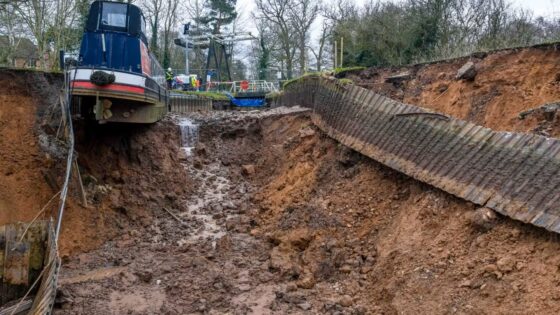
Repairing the Llangollen Canal breach near New Mills Lift Bridge, Whitchurch, is expected by the Canal & River Trust to cost several million pounds and occupy most of 2026, severely disrupting navigation on this key feeder from the River Dee. Engineers will need to dewater and stabilise the affected pound, reconstruct the failed canal bank and towpath, and reinstate clay lining and embankment drainage to prevent further leakage. The scale and duration signal significant geotechnical investigation and temporary works to manage soft ground and maintain adjacent infrastructure.
Technical Brief
- Likely failure mechanism involves progressive internal erosion (piping) through the embankment and clay core.
- Initial investigation will rely on visual inspection of the breach scar, crack patterns and seepage paths.
- Follow‑up geotechnical investigation expected to include targeted boreholes, trial pits and piezometer installations along the pound.
- Continuous water‑level and pore‑pressure monitoring during works will be critical to detect renewed leakage or instability.
- Temporary works must maintain stability of the remaining embankment while allowing plant access in soft, saturated ground.
- Safety management will need strict exclusion zones, edge protection and confined‑space controls during dewatering and excavation.
- Similar UK canal embankment failures have driven adoption of more formal dam‑safety style inspection and risk assessment regimes.
Our Take
Within the 16 Geotechnical stories in our coverage, very few involve linear waterway assets like the Llangollen Canal, so this failure gives Canal & River Trust a relatively high-profile case study on ageing earthworks and embankment risk compared with the more common road and rail slips.
A repair bill in the 'several million pounds' range and works lasting most of a year at New Mills Lift Bridge will likely force Canal & River Trust to re-sequence other non-safety-critical works, a pattern seen in other safety-tagged failures where reactive spend crowds out planned asset management.
Given the safety tag and long repair duration, this incident around Whitchurch is likely to strengthen the case for more proactive geotechnical monitoring on UK canals, aligning with other failure-tagged pieces in our database where operators have subsequently expanded inspection and early-warning programmes.
Prepared by collating external sources, AI-assisted tools, and Geomechanics.io’s proprietary mining database, then reviewed for technical accuracy & edited by our geotechnical team.
Related Articles

Related Industries & Products
Mining
Geotechnical software solutions for mining operations including CMRR analysis, hydrogeological testing, and data management.
Construction
Quality control software for construction companies with material testing, batch tracking, and compliance management.
CMRR-io
Streamline coal mine roof stability assessments with our cloud-based CMRR software featuring automated calculations, multi-scenario analysis, and collaborative workflows.
HYDROGEO-io
Comprehensive hydrogeological testing platform for managing, analysing, and reporting on packer tests, lugeon values, and hydraulic conductivity assessments.
GEODB-io
Centralised geotechnical data management solution for storing, accessing, and analysing all your site investigation and material testing data.