La Mancha’s $313M stake in G Mining: project economics and risk notes for engineers
Reviewed by Joe Ashwell
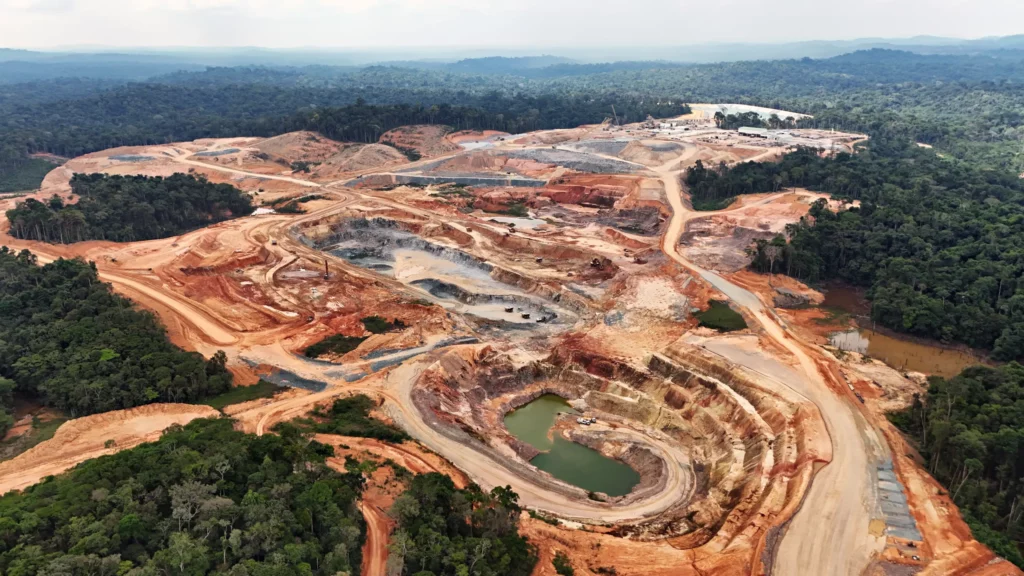
First reported on MINING.com
30 Second Briefing
La Mancha Resource Capital is lifting its stake in G Mining Ventures to 19.9% via a C$427 million purchase of 9.3 million shares at C$45.89, backing the ramp-up of the Tocantinzinho mine in Pará, Brazil, and development of the $973 million Oko West project in Guyana. G Mining guides 2026 output of 160,000–190,000 oz. at Tocantinzinho at AISC of $1,230–$1,444/oz, and targets first gold at Oko West in H2 2027 with 350,000 oz./year over 12.3 years at $1,123/oz AISC. A 2025 feasibility study pegs Oko West’s post-tax NPV at $2.2 billion and IRR at 27% at $2,500/oz gold, with 80.3 Mt indicated at 2.1 g/t (5.4 Moz) and a 2.9-year payback.
Technical Brief
- La Mancha’s C$427 million subscription involves 9.3 million G Mining shares at C$45.89 each.
- Post-transaction, La Mancha’s holding rises from 16.7% to 19.9%, becoming G Mining’s largest shareholder.
- G Mining’s market capitalisation sits at about C$11.5 billion despite a 5% share price drop to C$49.60.
- Tocantinzinho produced 171,871 oz. of gold in 2025, its first full year of commercial output.
- 2026 guidance at Tocantinzinho marginally exceeds 2025 production, indicating incremental ramp-up rather than step-change expansion.
- Guyana’s mines commission granted the Oko West mining licence in December, enabling Q1 pre-production open-pit works.
- La Mancha’s resource fund controls about $2.9 billion in mining assets, including >10% of Endeavour Mining and prior stakes in Evolution Mining and Elemental Altus Royalties.
- Pattern of large minority positions by La Mancha suggests continued preference for partnering to build mid-tier producers rather than full takeovers.
Our Take
With Oko West showing a post-tax NPV of $2.2 billion and a 27% IRR on a $973-million capex, La Mancha’s move into G Mining Ventures aligns with its pattern of backing high-margin gold projects in emerging hubs rather than mature Tier-1 districts, which in our database often correlates with faster portfolio NAV growth but higher permitting and infrastructure execution risk.
The 19.9% ceiling on La Mancha’s stake in G Mining Ventures mirrors its ‘significant but non-controlling’ position of more than 10% in Endeavour Mining, suggesting a deliberate strategy of exerting strong technical and capital markets influence across multiple gold operators without taking on full operator risk.
Guyana’s Oko West and Brazil’s Tocantinzinho place G Mining Ventures squarely in the Latin American growth corridor that, in our recent gold project coverage, is increasingly competing with West Africa for capital; this diversification may appeal to investors already heavily exposed to Burkina Faso and other higher-security-risk jurisdictions in Endeavour Mining’s portfolio.
Prepared by collating external sources, AI-assisted tools, and Geomechanics.io’s proprietary mining database, then reviewed for technical accuracy & edited by our geotechnical team.
Related Articles


Related Industries & Products
Mining
Geotechnical software solutions for mining operations including CMRR analysis, hydrogeological testing, and data management.
Construction
Quality control software for construction companies with material testing, batch tracking, and compliance management.
CMRR-io
Streamline coal mine roof stability assessments with our cloud-based CMRR software featuring automated calculations, multi-scenario analysis, and collaborative workflows.
HYDROGEO-io
Comprehensive hydrogeological testing platform for managing, analysing, and reporting on packer tests, lugeon values, and hydraulic conductivity assessments.
GEODB-io
Centralised geotechnical data management solution for storing, accessing, and analysing all your site investigation and material testing data.