Japan deep-sea rare earth mining test: design and risk notes for engineers
Reviewed by Joe Ashwell
First reported on MINING.com
30 Second Briefing
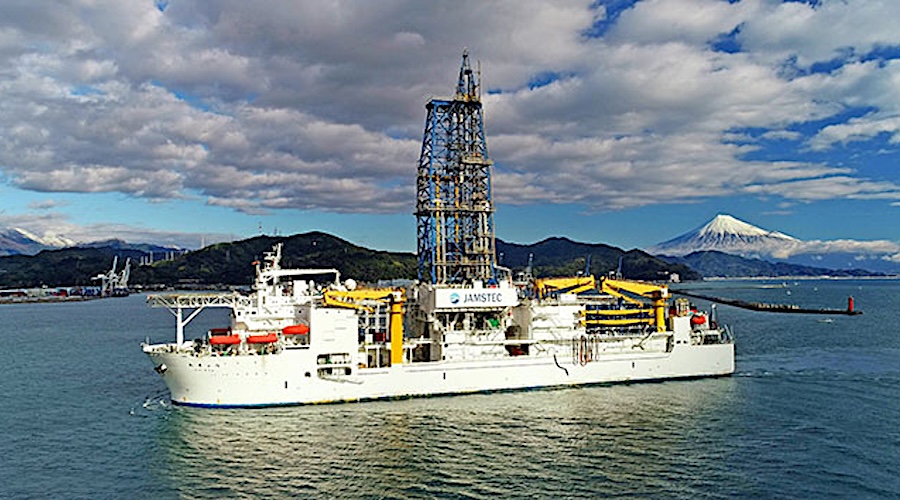
Japan has begun the world’s first test to lift rare-earth-rich deep-sea mud from about 4 miles (≈6.4 km) below sea level near Minamitori Island using the drilling vessel Chikyu, aiming to cut dependence on Chinese supply that still covers roughly 60% of its needs. The ¥40 billion government-funded programme plans, if the trial is viable, a full-scale demonstration by February 2027, with seabed sludge dewatered on Minamitorishima using spin-dryer-type equipment to cut volume by about 80% before shipment to mainland refineries.
Technical Brief
- Deep-sea drilling vessel Chikyu is configured to lift rare-earth-bearing sludge directly from seabed to deck.
- Test area lies within Japan’s exclusive economic zone near Minamitorishima, a remote Pacific coral atoll.
- Operational water depth is about four miles, pushing current limits for subsea lifting and slurry handling.
- Government funding totals roughly ¥40 billion since 2018 under the Strategic Innovation Promotion Program.
- Dewatered mud will undergo separation and refining only on mainland Japan, not on the vessel or atoll.
- No production tonnage target has been disclosed, indicating programme remains at proof-of-concept stage.
- Previous diversification included Sojitz–Lynas overseas supply, plus domestic recycling and rare-earth-thrifty manufacturing.
Our Take
The presence of Sojitz, Lynas Rare Earths and Nomura Research Institute in both this Minamitori Island test and the 8 January 2026 coverage of China’s rare earth export threats signals that Japan is building an integrated policy–commercial–analytics bloc to manage supply risk rather than treating seabed mining as a stand‑alone technical experiment.
Working at ~4 miles water depth puts the Chikyu operation in a different technical class from most seabed resource stories in our Mining database, implying that any viable production route here is more likely to feed into high‑value, security‑driven rare earth supply chains than bulk commodities such as copper.
The roughly ¥40 billion spent since 2018 on this government‑backed critical minerals effort is modest compared with large onshore mining capex in Australia or Chile, suggesting Japan is treating Minamitorishima as an options‑creating strategic hedge against its still‑60% dependence on Chinese rare earths rather than a near‑term replacement for existing supply chains.
Prepared by collating external sources, AI-assisted tools, and Geomechanics.io’s proprietary mining database, then reviewed for technical accuracy & edited by our geotechnical team.
Related Articles

Related Industries & Products
Mining
Geotechnical software solutions for mining operations including CMRR analysis, hydrogeological testing, and data management.
Construction
Quality control software for construction companies with material testing, batch tracking, and compliance management.
CMRR-io
Streamline coal mine roof stability assessments with our cloud-based CMRR software featuring automated calculations, multi-scenario analysis, and collaborative workflows.
QCDB-io
Comprehensive quality control database for manufacturing, tunnelling, and civil construction with UCS testing, PSD analysis, and grout mix design management.
HYDROGEO-io
Comprehensive hydrogeological testing platform for managing, analysing, and reporting on packer tests, lugeon values, and hydraulic conductivity assessments.