Geomechanics.io

  • Free Tools
Sign UpLog In

Geomechanics.io

Geomechanics, Streamlined.

© 2026 Geomechanics.io. All rights reserved.

Geomechanics.io

CMRR-ioGEODB-ioHYDROGEO-ioQCDB-ioFree Tools & CalculatorsBlogLatest Industry News

Industries

MiningConstructionTunnelling

Company

Terms of UsePrivacy PolicyLinkedIn
    AllGeotechnicalMiningInfrastructureMaterialsHazardsEnvironmentalSoftwarePolicy
    Projects
    Product
    Sustainability

    Intrepid Potash Utah lithium plant option: DLE performance and capex lens for engineers

    January 7, 2026|

    Reviewed by Joe Ashwell

    Intrepid Potash Utah lithium plant option: DLE performance and capex lens for engineers

    First reported on MINING.com

    30 Second Briefing

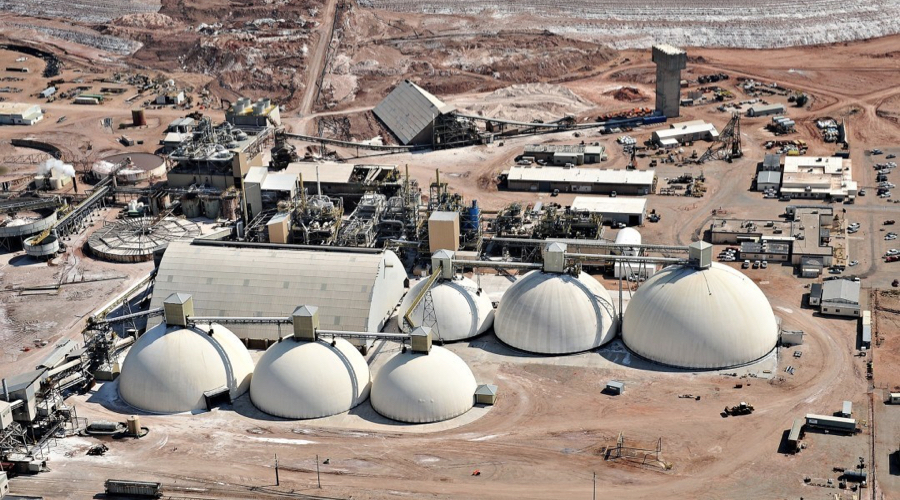
    Intrepid Potash, working with Aquatech International and Adionics SAS, has produced battery-grade lithium carbonate from post-process brine at its Wendover, Utah potash facility using direct lithium extraction, achieving 92.9% lithium recovery and >99.5% lithium chloride purity. Aquatech’s downstream processing converted the lithium-rich brine to ≥99.5% lithium carbonate meeting battery manufacturing specifications, and the partners will continue evaluating a dedicated lithium plant under their existing Joint Development Agreement. Intrepid plans to leverage existing evaporation and brine-handling infrastructure while limiting new capital exposure, positioning lithium as a margin uplift alongside its core muriate of potash operations.

    Technical Brief

    • Lithium feedstock is Intrepid’s post-process magnesium chloride brine from the existing Wendover potash operation.
    • Aquatech’s role is downstream conversion and refining of Adionics’ lithium-rich brine to carbonate product.
    • The work is governed by an existing Joint Development Agreement between Intrepid, Aquatech and Adionics.
    • Wendover is one of Intrepid’s two Utah facilities, complementing Moab and Carlsbad, New Mexico operations.
    • Intrepid remains primarily a muriate of potash producer, with lithium positioned as a byproduct margin uplift.
    • CEO Kevin Crutchfield stresses limiting new capital exposure and maintaining focus on core fertiliser production.

    Our Take

    Among the 54 lithium- and lithium carbonate–linked pieces in our database, very few involve US-based brine operations like Intrepid’s Wendover and Moab assets, so this signals a rare domestic attempt to leverage legacy potash infrastructure into battery-grade supply.

    The reported ≥99.5% lithium carbonate purity and 92.9% extraction rate would, if replicated at scale, place Intrepid Potash’s prospective Utah output in the quality range typically required for direct battery cathode feedstock, reducing dependence on additional refining steps in the United States.

    With a market capitalisation of about $382 million, Intrepid Potash is relatively small compared with many listed lithium specialists in our coverage, so a successful JV-driven lithium project at Wendover could be disproportionately material to its valuation versus larger peers.

    Geotechnical Software for Modern Teams

    Centralise site data, logs, and lab results with GEODB-io, CMRR-io, and HYDROGEO-io.

    No credit card required.

    • Save and export unlimited calculations
    • Advanced data visualisation
    • Generate professional PDF reports
    • Cloud storage for all your projects

    Prepared by collating external sources, AI-assisted tools, and Geomechanics.io’s proprietary mining database, then reviewed for technical accuracy & edited by our geotechnical team.

    Related Articles
    Iltani’s Orient silver–indium project: 2025 drilling and mine design takeaways
    Mining
    about 5 hours ago

    Iltani’s Orient silver–indium project: 2025 drilling and mine design takeaways

    Iltani Resources’ Orient project in North Queensland, billed as one of Australia’s largest silver–indium developments, has reported standout 2025 drilling results that support a potential resource expansion. The polymetallic system targets silver, indium, zinc and lead, with recent intercepts extending known mineralisation along strike and at depth beyond the current drilling grid. Iltani is now planning follow-up step-out drilling and updated resource modelling, which could materially influence mine design, metallurgical testwork priorities and long-term development options for the Orient tenements.

    Silica, gold and rare earths exploration: pit design and schedule notes for planners
    Mining
    about 5 hours ago

    Silica, gold and rare earths exploration: pit design and schedule notes for planners

    Australian explorers are advancing silica sand, gold and rare earths projects, with silica gaining attention as a feedstock for solar glass and high‑purity industrial applications. Activity is concentrating in Western Australia and Queensland, where juniors are drilling shallow, laterally extensive sand deposits and following up high‑grade gold intercepts near existing processing hubs. For geotechs and mine planners, the focus on near‑surface, free‑digging sand bodies and brownfield gold step‑outs points to relatively low strip ratios, simpler pit designs and faster development timelines than deeper hard‑rock projects.

    Clarks Gully standout intercept: underground design notes for Hillgrove teams
    Mining
    about 6 hours ago

    Clarks Gully standout intercept: underground design notes for Hillgrove teams

    Recent diamond drilling at Larvotto Resources’ Clarks Gully prospect within the Hillgrove gold–antimony project in New South Wales has returned a “standout intercept”, strengthening the case for higher-grade underground mineralisation. The work forms part of a targeted diamond programme testing extensions of known lodes beneath historical workings at Hillgrove, a past producer with multiple steeply dipping, narrow-vein structures. For geotechnical and mine planning teams, the results point to continued focus on underground access, ground support in vein-hosted systems, and potential sequencing of gold–antimony stopes.

    Related Industries & Products

    Mining

    Geotechnical software solutions for mining operations including CMRR analysis, hydrogeological testing, and data management.

    Construction

    Quality control software for construction companies with material testing, batch tracking, and compliance management.

    CMRR-io

    Streamline coal mine roof stability assessments with our cloud-based CMRR software featuring automated calculations, multi-scenario analysis, and collaborative workflows.

    QCDB-io

    Comprehensive quality control database for manufacturing, tunnelling, and civil construction with UCS testing, PSD analysis, and grout mix design management.

    HYDROGEO-io

    Comprehensive hydrogeological testing platform for managing, analysing, and reporting on packer tests, lugeon values, and hydraulic conductivity assessments.