Geomechanics.io

  • Free Tools
Sign UpLog In

Geomechanics.io

Geomechanics, Simplified.

© 2025 Geomechanics.io. All rights reserved.

Geomechanics.io

CMRR-ioGEODB-ioHYDROGEO-ioQCDB-ioFree Tools & CalculatorsBlogLatest Industry News

Industries

MiningConstructionTunnelling

Company

Terms of UsePrivacy PolicyLinkedIn
    AllGeotechnicalMiningInfrastructureMaterialsHazardsEnvironmentalSoftwarePolicy
    Projects
    Sustainability

    IEA coal demand record: system planning and decarbonisation notes for engineers

    December 17, 2025|

    Reviewed by Tom Sullivan

    IEA coal demand record: system planning and decarbonisation notes for engineers

    First reported on MINING.com

    30 Second Briefing

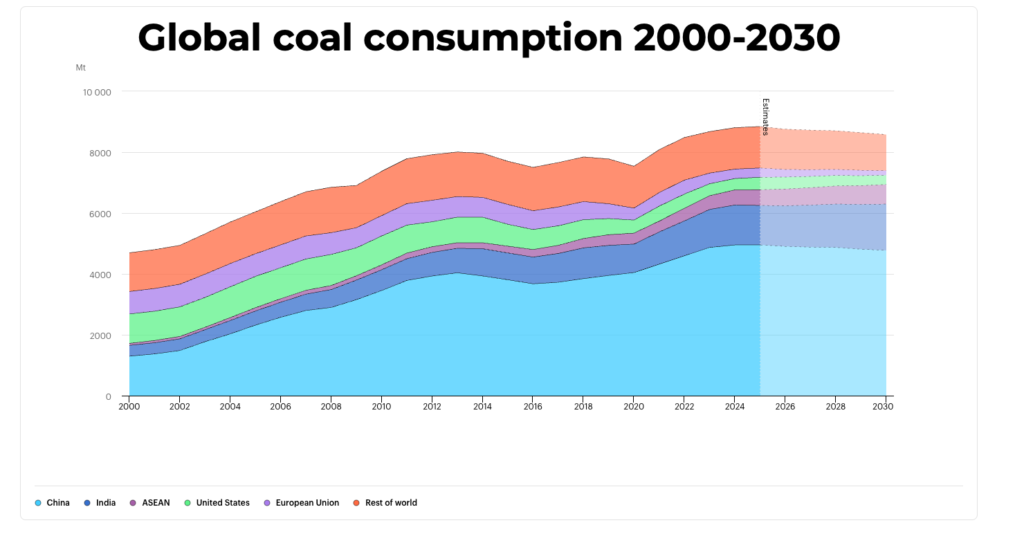
    Global coal demand is forecast by the IEA to rise 0.5% in 2025 to a record 8.85 billion tonnes, with US coal use jumping 8% after 15 years of roughly 6% annual declines as higher gas prices, slower coal plant retirements and federal policy support lift output. Weak wind conditions in Europe are also sustaining coal burn, while surging electricity demand in China, India and other fast-growing economies keeps global consumption elevated. The IEA expects demand to plateau and then edge down only slowly through 2030, leaving long-term decarbonisation pathways under pressure.

    Technical Brief

    • IEA’s 2025 coal outlook pegs global demand at 8.85 billion tonnes, up 0.5% year-on-year.
    • US coal consumption reverses ~15 years of ~6% annual decline with an 8% 2025 rebound.
    • Higher US coal burn is explicitly linked to elevated gas prices and delayed coal plant retirements.
    • Weak wind resource in Europe is identified as a direct driver of continued coal-fired generation.
    • IEA concedes earlier 2023 call that coal demand had “likely peaked” was invalidated by 2024–2025 records.
    • Surging electricity demand in China, India and other fast-growing economies is singled out as the main upside risk.
    • IEA flags “significant uncertainties” in its five‑year coal forecast, implying high scenario spread for fuel planning.
    • UNEP’s 2025 Emissions Gap Report projects ~2.3°C warming by 2100 even if current pledges are fully met.

    Our Take

    With projected global coal demand at 8.85 billion tonnes in 2025, the IEA numbers imply that any accelerated phase-out in Europe or North America would have to be offset by much steeper cuts in Asia to stay near the 2.3°C pathway flagged by the UN Emissions Gap Report.

    An 8% uptick in US coal use after roughly 15 years of ~6% annual decline signals that gas and power-price volatility can still reverse decarbonisation gains at the margin, which project developers in coal and natural gas in North America will read as justification for keeping some legacy capacity warm rather than fully retired.

    Among the 18 coal- and natural-gas-tagged pieces in our database, most recent coal coverage has focused on mine closures and ESG pressure, so this IEA-driven demand growth story stands out as a reminder that global system-level emissions are diverging from the project-by-project decarbonisation narrative in Europe and Australia.

    Geotechnical Software for Modern Teams

    Centralise site data, logs, and lab results with GEODB-io, CMRR-io, and HYDROGEO-io.

    No credit card required.

    • Save and export unlimited calculations
    • Advanced data visualisation
    • Generate professional PDF reports
    • Cloud storage for all your projects

    Prepared by collating external sources, AI-assisted tools, and Geomechanics.io’s proprietary mining database, then reviewed for technical accuracy & edited by our geotechnical team.

    Related Articles

    MEGAMINES’ top 10 most capital intensive bulk mines: capex and risk notes for engineers
    Mining
    about 5 hours ago

    MEGAMINES’ top 10 most capital intensive bulk mines: capex and risk notes for engineers

    MEGAMINES ranks Saudi Arabia’s Wa’ad Al Shamal phosphate complex as the world’s costliest mining project, with total industrial-city investment of $22.7 billion and Ma’aden’s mine-and-refining CAPEX estimated at $15.5 billion, including an $8 billion original plant and a $7.7 billion Phosphate 3 expansion due by 2027. Guinea’s Simandou iron ore development follows with more than $20 billion in shared mine–rail–port spend, a 600 km trans-Guinean railway to a new deepwater port, and targeted output of 120 Mtpa of ~66% Fe ore by 2028. Brazil’s Serra Sul (S11D) at $19.5 billion plus a $2.8 billion brownfield expansion to 120 Mtpa, and Adani’s Carmichael coal project, originally scoped at 60 Mtpa with A$16.5–A$22 billion CAPEX but now operating at 10 Mtpa with a 200 km rail link, illustrate the scale, long timelines and redesign risk inherent in bulk mining megaprojects.

    Trilogy–South32 Arctic copper permit push: design and geotech notes for engineers
    Mining
    about 9 hours ago

    Trilogy–South32 Arctic copper permit push: design and geotech notes for engineers

    Trilogy Metals and South32’s 50/50 Ambler Metals JV has approved a $35 million 2026 work programme at Alaska’s Upper Kobuk Mineral Projects, targeting mine-permit submissions for the high-grade Arctic copper deposit under federal FAST-41. Drilling will focus on geotechnical and condemnation holes for mine design and infrastructure siting, while the Bornite camp is upgraded for multi-year geotechnical and exploration campaigns and an independent UKMP management team is re-established. Arctic’s 2023 feasibility study outlines a 13-year operation producing 149 Mlb/y copper plus zinc, lead, gold and silver, with an after-tax NPV8 of $1.1 billion and 22.8% IRR.

    Almonty’s Sangdong tungsten mine: commercial start and stoping plan notes for engineers
    Mining
    about 10 hours ago

    Almonty’s Sangdong tungsten mine: commercial start and stoping plan notes for engineers

    Almonty Industries has begun commercial mining at the Sangdong tungsten mine in Yeongwol, Gangwon Province, with the first truckload of ore delivered to the run-of-mine (ROM) pad, signalling the shift from development to active extraction. The project is centred on redeveloping one of the world’s historically significant tungsten deposits, aiming to supply high-grade ore into Asian and global hardmetal and alloy markets. For mine planners and geotechnical teams, the move commits the site to full-scale stoping, ground support, and backfill sequencing rather than purely development headings.

    Related Industries & Products

    Mining

    Geotechnical software solutions for mining operations including CMRR analysis, hydrogeological testing, and data management.

    CMRR-io

    Streamline coal mine roof stability assessments with our cloud-based CMRR software featuring automated calculations, multi-scenario analysis, and collaborative workflows.

    HYDROGEO-io

    Comprehensive hydrogeological testing platform for managing, analysing, and reporting on packer tests, lugeon values, and hydraulic conductivity assessments.

    GEODB-io

    Centralised geotechnical data management solution for storing, accessing, and analysing all your site investigation and material testing data.