Geomechanics.io

  • Free Tools
Sign UpLog In

Geomechanics.io

Geomechanics, Streamlined.

© 2026 Geomechanics.io. All rights reserved.

Geomechanics.io

CMRR-ioGEODB-ioHYDROGEO-ioQCDB-ioFree Tools & CalculatorsBlogLatest Industry News

Industries

MiningConstructionTunnelling

Company

Terms of UsePrivacy PolicyLinkedIn
    AllGeotechnicalMiningInfrastructureMaterialsHazardsEnvironmentalSoftwarePolicy
    Projects
    Sustainability

    Glencore’s Horne smelter 2027 closure risk: investment and emissions lens for engineers

    February 3, 2026|

    Reviewed by Joe Ashwell

    Glencore’s Horne smelter 2027 closure risk: investment and emissions lens for engineers

    First reported on MINING.com

    30 Second Briefing

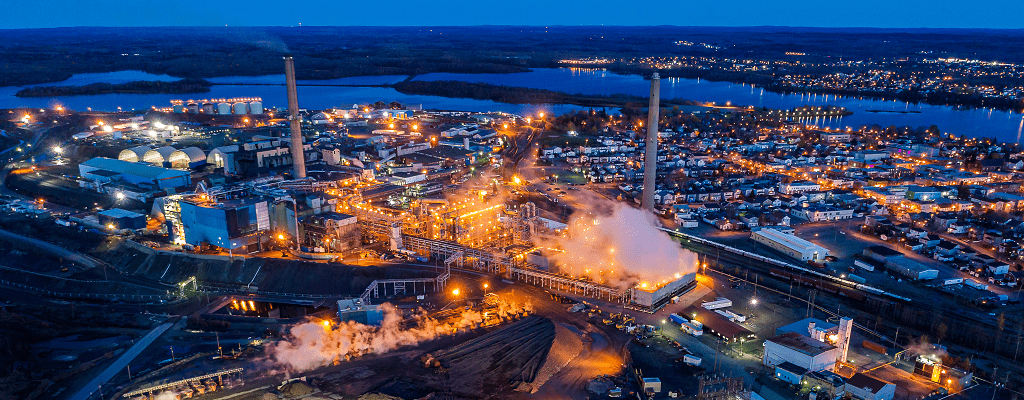
    Glencore has frozen nearly C$1 billion of planned investment at its 100‑year‑old Horne copper smelter in Rouyn‑Noranda, including C$300 million earmarked for emissions‑reduction upgrades, after failing to secure a regulatory framework with the Quebec government. Without these projects, the smelter will be unable to meet new emissions limits taking effect from March 2027, forcing a review of the site’s future and signalling a potential closure. Capital spending at Glencore’s CCR copper refinery in Montreal will also be scaled back over the medium term.

    Technical Brief

    • Glencore said it was prepared to invest almost C$1 billion at Horne over five years, including C$300 million for emissions reduction.
    • Despite sustained negotiations with Quebec dating back to mid-2025, the regulatory framework needed to justify the planned investments is “not sufficiently in place,” Glencore said.
    • Without completing the planned investments, it will become impossible for the smelter to meet certain emissions targets that come into effect starting in March 2027, Glencore said.
    • Investments at Glencore’s CCR copper refinery in Montreal will also be scaled back over the medium term, the company said.
    • Management messaging focuses on job protection and continuity of operations, subject to an acceptable regulatory agreement.

    Our Take

    The standoff over the Horne copper smelter comes just days after coverage of Glencore’s 11% drop in 2025 copper output, suggesting closure in Quebec would further tighten a portfolio already under grade and operational pressure.

    In our database, the earlier 30 January piece on Horne highlighted Quebec’s strict arsenic limits, so any failure to reach a deal by the March 2027 emissions deadline would signal to other Canadian base‑metal operators that legacy plants face limited regulatory forbearance.

    With copper one of the most frequently flagged commodities in recent Mining coverage, the potential loss of a Canadian smelting and refining route at Horne and CCR could push more North American concentrates and scrap into longer export chains, raising logistics and ESG costs for regional miners and recyclers.

    Geotechnical Software for Modern Teams

    Centralise site data, logs, and lab results with GEODB-io, CMRR-io, and HYDROGEO-io.

    No credit card required.

    • Save and export unlimited calculations
    • Advanced data visualisation
    • Generate professional PDF reports
    • Cloud storage for all your projects

    Prepared by collating external sources, AI-assisted tools, and Geomechanics.io’s proprietary mining database, then reviewed for technical accuracy & edited by our geotechnical team.

    Related Articles
    Mining
    about 12 hours ago

    DELKOR India thickener for Arab Potash: process design notes for HLP engineers

    DELKOR India has secured an EPC contract from Arab Potash Company to supply a 50 m diameter DELKOR Thickener for the Hot Leach Potash (HLP) circuit in the firm’s latest capacity expansion project. The large-diameter unit is designed for high-throughput liquid/solid separation in hot brine conditions, a critical bottleneck in potash crystallisation and recovery. For process and tailings engineers, the installation signals further scaling of HLP operations at Arab Potash’s Jordan facilities, with implications for water balance, underflow rheology and downstream evaporation capacity.

    Top 20 automakers by battery metals spending: cost signals for mine planners
    Mining
    about 21 hours ago

    Top 20 automakers by battery metals spending: cost signals for mine planners

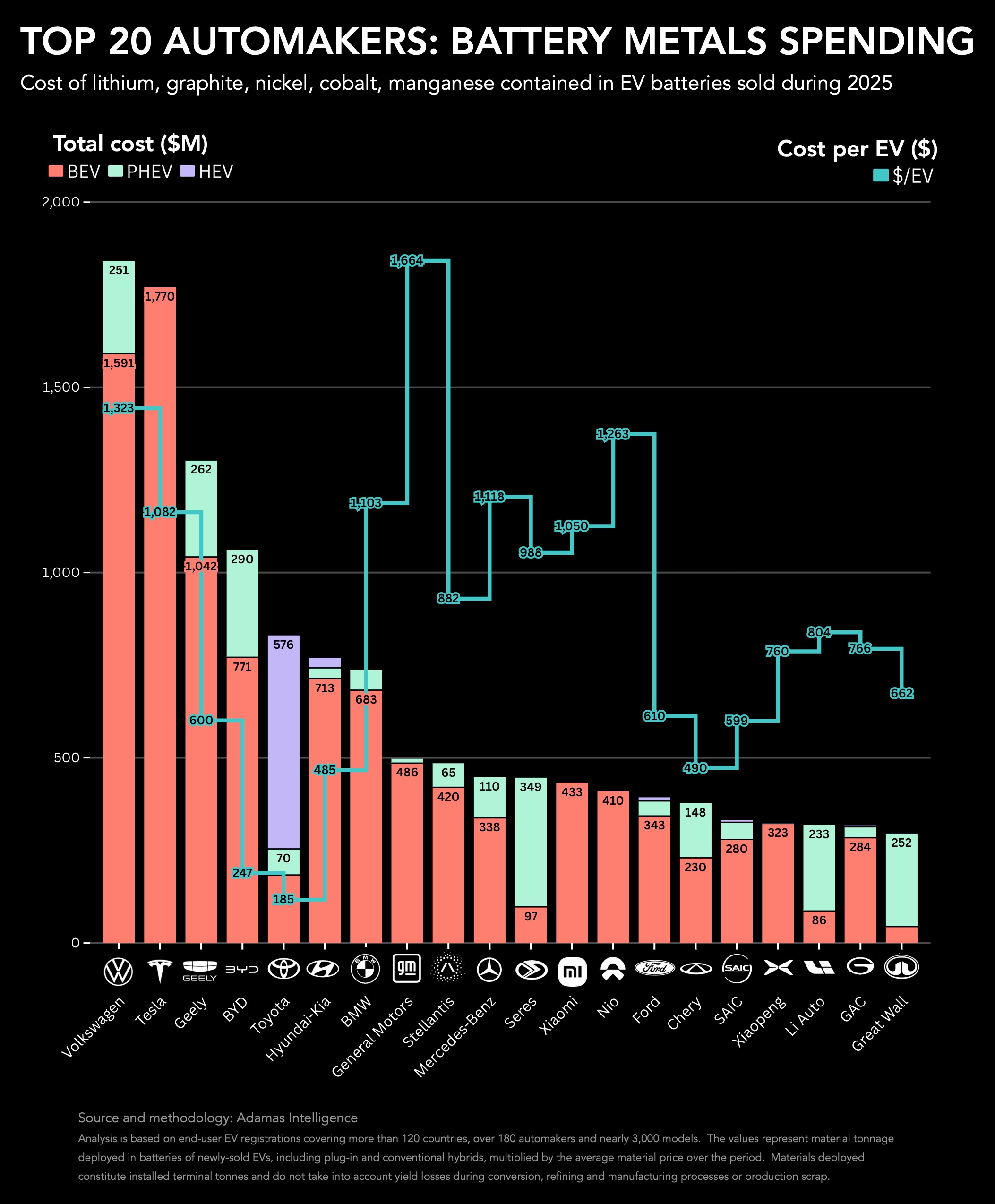
    Global EV battery capacity deployment passed 1 TWh in 2025, nearly quadruple 2021 levels, yet the raw material bill for lithium, graphite, nickel, cobalt and manganese in passenger EVs reached only $15.6 billion, still about half the 2022 peak. BYD’s all‑LFP, lower‑end line-up and heavy plug‑in hybrid mix kept average battery metals spend to $247 per EV (US$366 per BEV), versus Tesla’s US$1,082 and Volkswagen’s US$1,624 per BEV, with VW now the largest battery metals spender. GM’s NCMA‑heavy Ultium strategy yields an average US$1,664 per EV and is being retooled towards LFP, while Toyota’s HEV‑dominated portfolio limits spend to US$185 per vehicle.

    Mining
    about 21 hours ago

    Weir ENDURON HPGR at Platreef Phase 2: comminution design notes for engineers

    Weir has secured a contract to supply ENDURON® high pressure grinding rolls (HPGR) for the tertiary crushing circuit in Ivanhoe Mines’ Platreef Phase 2 concentrator expansion in South Africa. The HPGR circuit will be integrated as part of the Phase 2 flowsheet rather than relying solely on conventional cone crushing, targeting improved energy efficiency and finer product for downstream milling. For process engineers, the move signals continued adoption of HPGR technology on large-scale PGM–nickel concentrators to cut specific energy and potentially reduce overall comminution footprint.

    Related Industries & Products

    Mining

    Geotechnical software solutions for mining operations including CMRR analysis, hydrogeological testing, and data management.

    CMRR-io

    Streamline coal mine roof stability assessments with our cloud-based CMRR software featuring automated calculations, multi-scenario analysis, and collaborative workflows.

    HYDROGEO-io

    Comprehensive hydrogeological testing platform for managing, analysing, and reporting on packer tests, lugeon values, and hydraulic conductivity assessments.

    GEODB-io

    Centralised geotechnical data management solution for storing, accessing, and analysing all your site investigation and material testing data.