Garmouth Spey viaduct collapse: inspection and survey lessons for engineers
Reviewed by Joe Ashwell
First reported on New Civil Engineer
30 Second Briefing
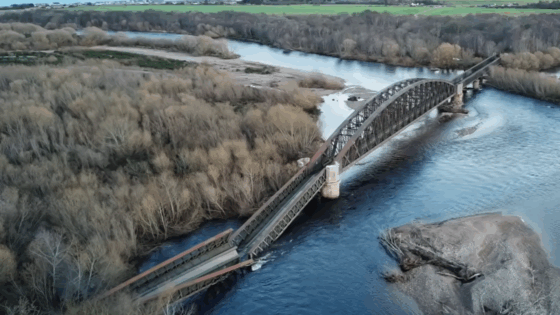
The 19th-century Garmouth Viaduct over the River Spey in Moray, Scotland has collapsed, exposing a decade-long failure to act on a 2014 recommendation for a full structural survey. The former rail viaduct, now used as a pedestrian and cycle crossing, had already been subject to partial closures after previous flood damage and scour concerns. The incident raises immediate questions over inspection regimes, asset management of legacy wrought-iron and masonry structures, and how local authorities prioritise intrusive surveys for ageing river crossings.
Technical Brief
- Typical investigation now would combine dive inspections, bathymetric survey, pier core sampling and metallurgical assessment of ironwork.
- Ongoing monitoring, if reinstatement is considered, would need real-time water level, scour and displacement instrumentation on piers.
- Incident exposes a gap between routine visual inspections and more intrusive surveys for non-standard, heritage river crossings.
- Safety management of legacy pedestrian structures may need reclassification to bridge-type inspection regimes with stricter intervals.
Our Take
Among the 253 Infrastructure stories in our coverage, only a small subset of the 654 safety- and failure-tagged pieces involve 19th-century assets in the United Kingdom, suggesting ageing structures like the Garmouth Viaduct in Moray are now standing out as higher-risk legacy elements in local networks.
A recommendation for a full structural survey going unfulfilled since 2014 signals a governance gap that asset owners of similar historic bridges in Scotland will likely be pressed to address through more formalised inspection regimes and clearer accountability chains.
For practitioners, the Spey viaduct case underlines that once a detailed survey is formally recommended on an older structure, deferring it effectively shifts the risk profile from technical uncertainty to management liability, which can influence insurers’ and regulators’ stance on comparable projects.
Prepared by collating external sources, AI-assisted tools, and Geomechanics.io’s proprietary mining database, then reviewed for technical accuracy & edited by our geotechnical team.
Related Articles


Related Industries & Products
Mining
Geotechnical software solutions for mining operations including CMRR analysis, hydrogeological testing, and data management.
Construction
Quality control software for construction companies with material testing, batch tracking, and compliance management.
CMRR-io
Streamline coal mine roof stability assessments with our cloud-based CMRR software featuring automated calculations, multi-scenario analysis, and collaborative workflows.
HYDROGEO-io
Comprehensive hydrogeological testing platform for managing, analysing, and reporting on packer tests, lugeon values, and hydraulic conductivity assessments.
GEODB-io
Centralised geotechnical data management solution for storing, accessing, and analysing all your site investigation and material testing data.